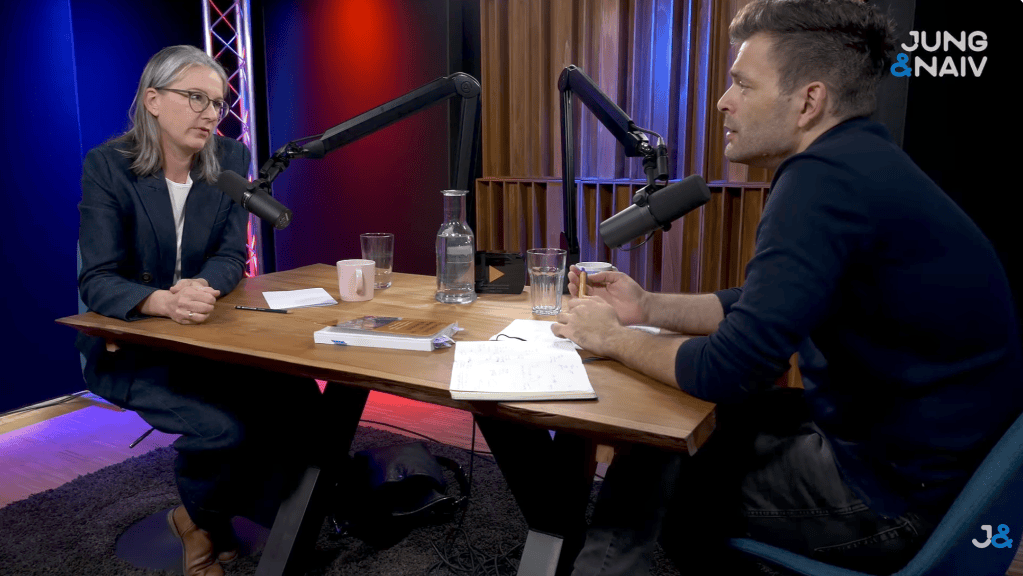
Berühmt-berüchtigt für sein schnelles, direktes Fragen und die langen Gesprächsformate mit Personen aus Politik und Wissenschaft: Tilo Jung ist einer der bekanntesten Journalisten Deutschlands. Als ich die Einladung in seine Sendung “Jung & Naiv” bekam, habe ich zwar zweimal nachdenken müssen, da ich Interviews im Forschungskontext so gar nicht mag (wie all meine Studierenden wissen!), aber die Gespräche, die ich mir angeschaut hatte, waren in den allermeisten Fällen wertschätzend und boten genügend Zeit zum Zuhören und Ausredenlassen … aufgrund des sehr großen Publikums von Jung & Naiv war dies auch eine Chance: über die Ethnologie zu sprechen, über meine Forschungsfelder in Asien und über die aktuellen Projekte zu Staatenlosigkeit in Europa.
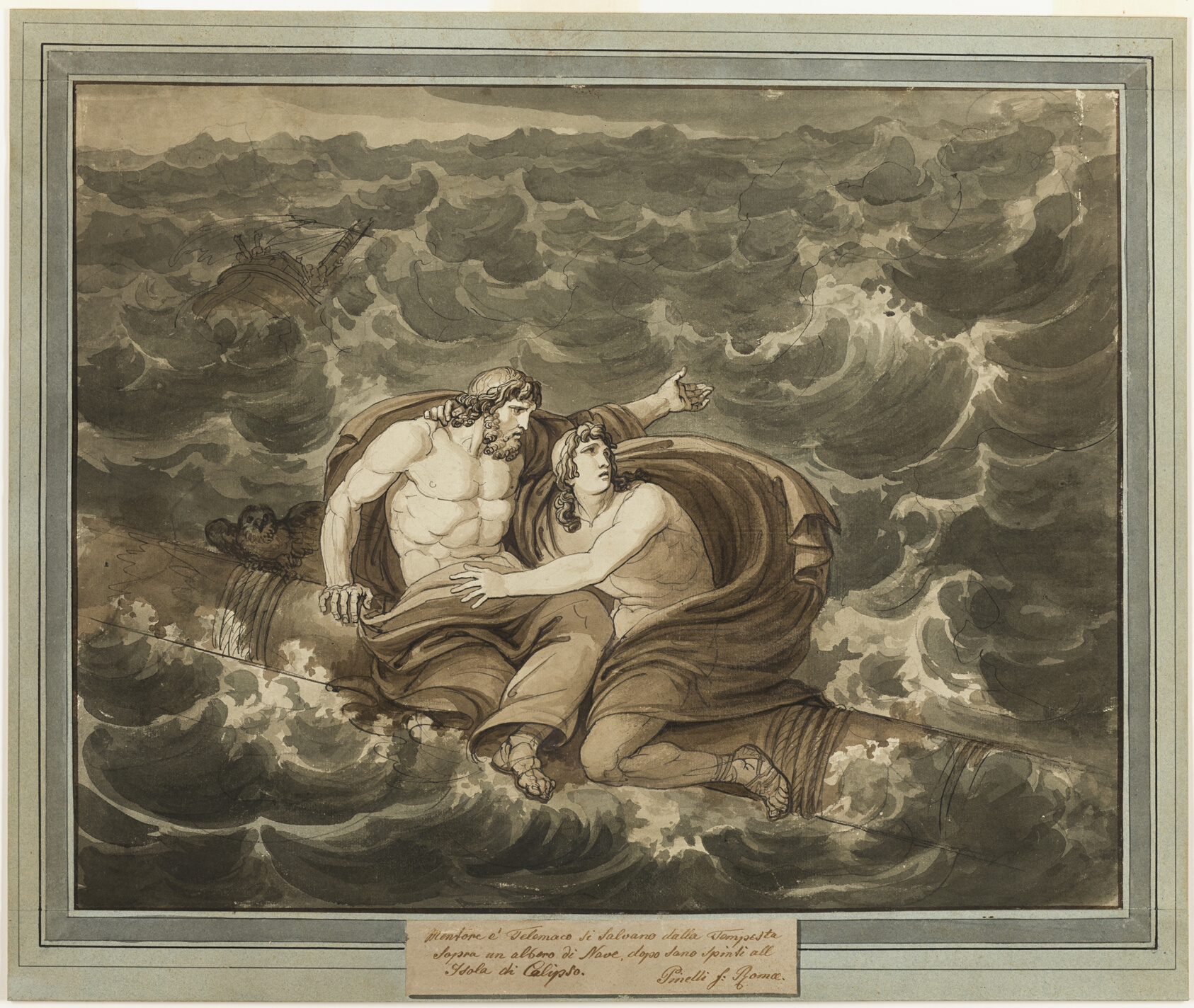
“He [Telemachus] sat down, and up stood Mentor” (2:225).
This is the first time in Homer’s epos The Odyssey that Mentor, Odysseus’s trusted companion, is mentioned. What was his task?
When Odysseus sailed off, this was the friend he asked to guard his house and told the slaves to look to him as master. Mentor addressed the crowd: “Now Ithacans!Listen! …” (2:226)
But the Ithacans did not listen – neither to Mentor, nor to Telemachus. In fact, they mocked both the elderly friend and the young son of Odysseus. Seeing the challenges Mentor and Telemachus as well as Odysseus’ wife Penelope later faced in fighting off the ‘suitors’ who had occupied Odysseus’ household, Athena (Minerva), the Goddess of Wisdom, decided to disguise herself as Mentor. She spoke to Telemachus, who felt disheartened and doubted his own capabilities.
Then Athenacame near him with the voice and guise of Mentorand spoke to him with words that flew like birds: “Telemachus, you will be brave and thoughtful,if your own father’s forcefulness runs through you.How capable he was, in word and deed! Your journey will succeed, if you are his.“
(2: 268)
Thus spoken to, Telemachus proceeds to face the ‘suitors’ in his father’s house and eventually sets forth on his own ship to seek out his father. He is able to take decisions and assume responsability.
Today, mentoring is a common practice in both academia and business. We tend to associate a social relationship with it in which a more experienced senior colleague shares their wisdom with a less experienced younger one. As part of this set-up, It is usually assumed that knowledge resides within the elder who initiates the apprentice into the craft they wish to master.
The classical orgin of the word and that the name originally belonged to a person is often unknown. Even when the connection to Odysseus’ trusted companion is made, it is usally Mentor who is presented as the one who is respected and knowledgable; capacities he only exhibits in Homer’s Odyssey when impersonated by Athena. Mentor held no authority over the suitors, he did not have enough influence on Telemachus to strengthen his mind, and he was not able to protect Penelope the way Odysseus had envisioned. This is why Athena stepped in. The Goddess disguised herself as Mentor, who thereby became a mere bodily vessel for the wisdom that she had.
What can those of us who practice mentoring or who are approached by colleagues for advice learn from the Odyssey?
It is not the wisdom of the mentor that mentorship is about, even if this is what the mentee assumes. To clarify, I approach the relationship between mentor and mentee by drawing on the relationship between analyst and analysand in Lacanian psychoanalysis. Jacques Lacan, the French psychoanalyst, referred to the analyst’s position (assumed by the analysand) as the one who ‘knows’, as the sujet supposé savoir (the subject supposed to know). But the analyst really serves as a vessel that contains nothing of its own. At first, this relationship presents a mirroring opportunity for the analysand, who idealizes the analyst. Later, once the idealization has given way to actual analytical work, the role of the analyst is to keep the space open for the analysand to develop their own, subjective access to what constitutes their symptom,. That is, their unique way to access their knowledge and their truth.
The same, I argue, holds for the mentoring relationship. While there might be occasions in which knowledge will be ‘handed’ from the mentor to the mentee, who equally believes that the mentor ‘has it’, it is far more important to create a space in which the mentee’s own version of truth and their own access to knowledge can be verbalized.
In a mentoring relationship, then, we need to keep a place open for Athena (Minerva) who is neither Mentor personified, nor an abstract force. Rather, she assumes the guise of each and every one of us in a unique way. To bring her forth on the side of the mentee is the actual task of a mentor.
Mentor and Telemachus. Bartolomeo Pinelli, 1781-1835.
* all quotes are from Emily Wilson’s translation of Homer. The Odyssey.
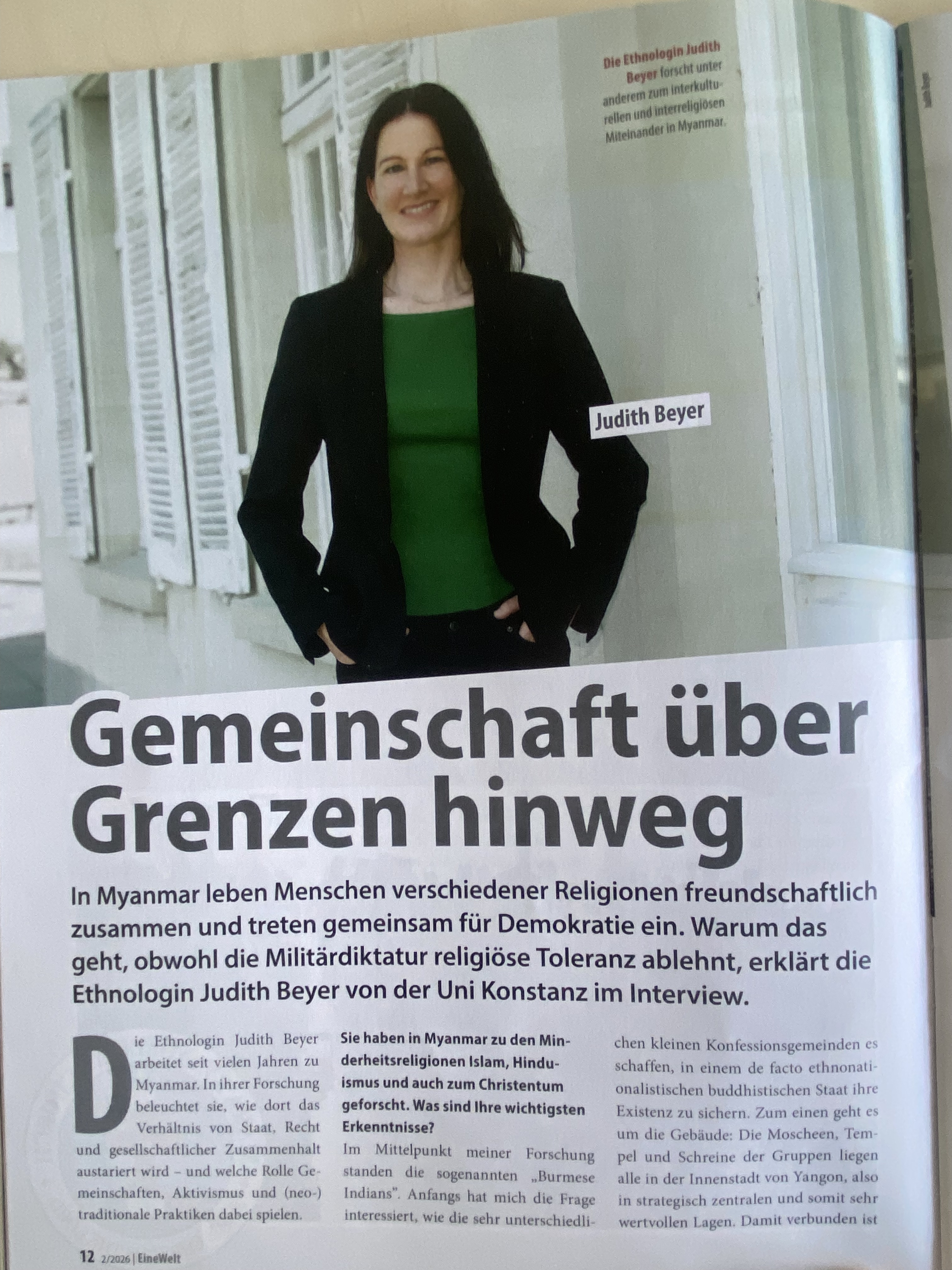
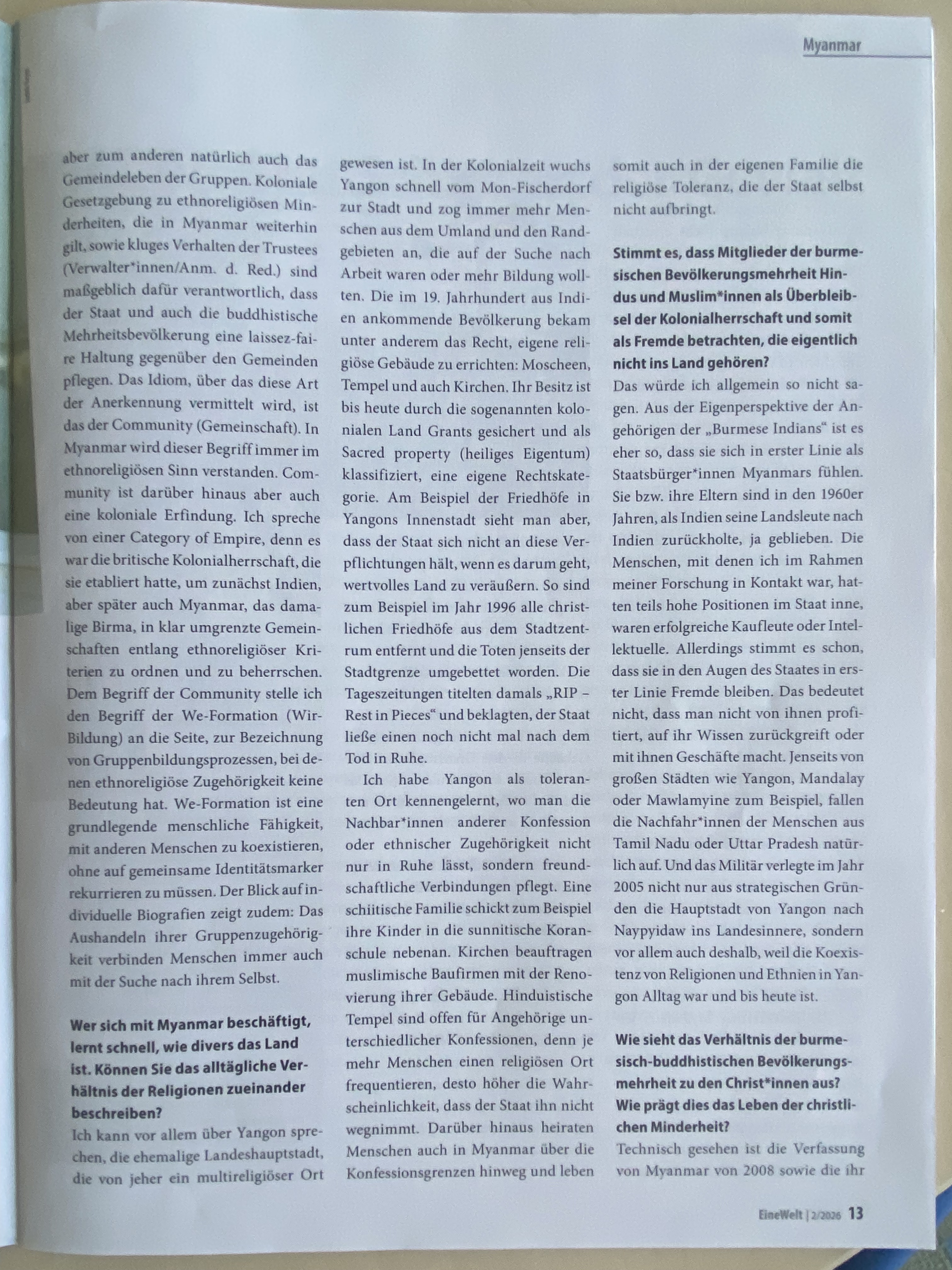
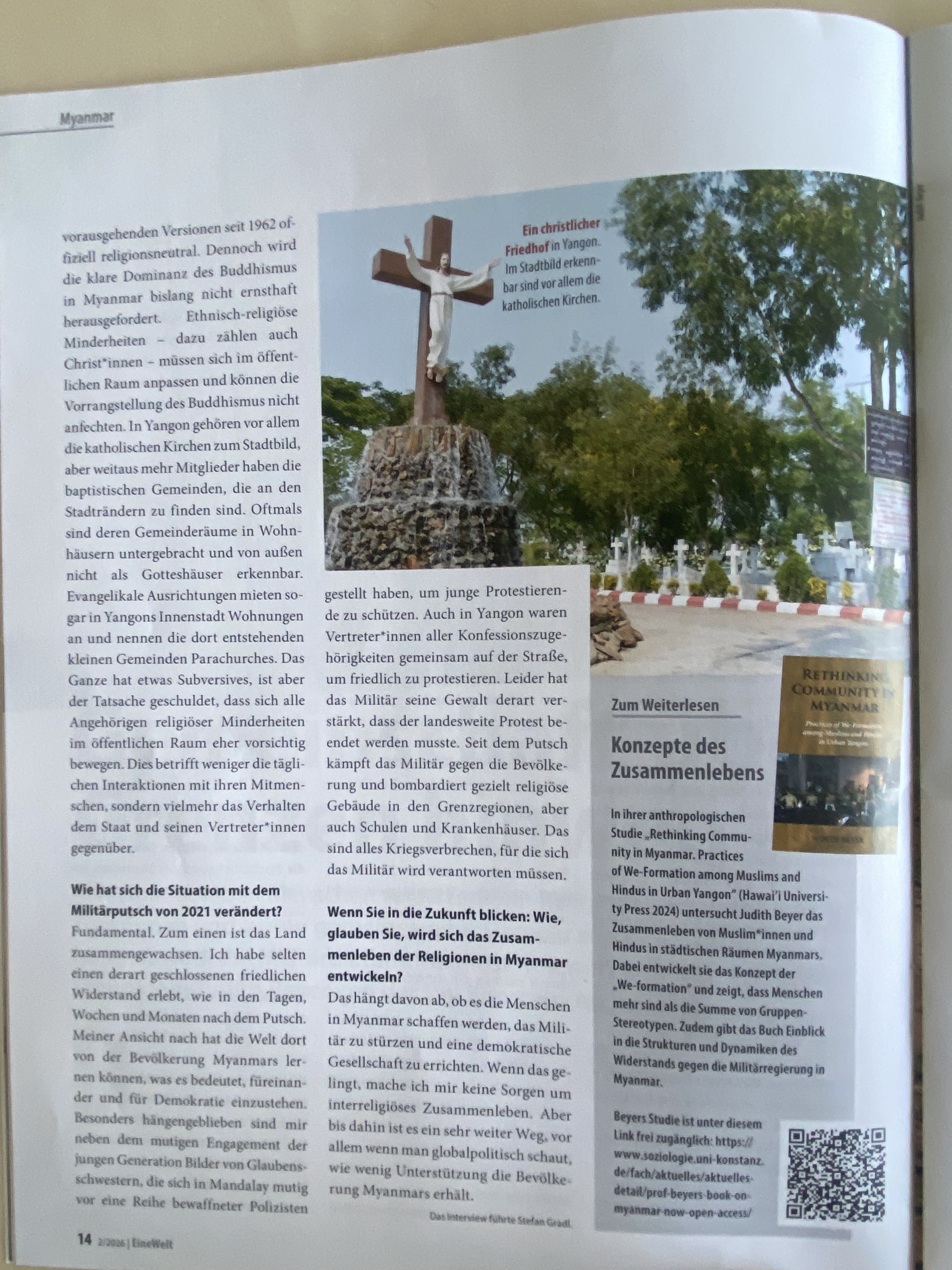
Im Rahmen eines Sonderheftes zu Myanmar mit einem Schwerpunkt auf die Arbeit evangelischer Kirchen im Land im Kontext anhaltender Militärgewalt gegen die Zivilbevölkerung des Landes, habe ich einem Gespräch über meine Arbeit zu ethno-religiösen Minderheiten im Land zugestimmt.
Von Interesse war mein Verständnis religiöser Toleranz unter den Menschen unterschiedlicher Konfessionen, Muslime, Hindus und Christen, und wie sich ihr Leben angesichts des versuchten Putsches im Februar 2021 verändert hat. Auch darüber, was es braucht, um die Demokratisierung des Landes wieder zu ermöglichen, habe ich etwas gesagt: internationale Unterstützung und die Bestrafung der Täter.
Zuletzt ging es um mein Buch “Rethinking Community in Myanmar”, in dem ich das Konzept der “Wir-Formation” entwickle und dieses dem etablierten Begriff der “Gemeinschaft” gegenüberstelle. Während Gemeinschaft (community) sowohl in der Wissenschaft, der Politik, der Geschichte sowie im Alltagskontext meiner burmesischen interlocutors bekannt ist und Verwendung findet, wird mit ihm doch oft die Vorstellung einer korporierten Gruppe mit Mitgliedern verbunden. Vor allem Menschen, die die gleiche Religion oder die gleiche Ethnizität haben. Während dieses Konzept also wirkmächtig ist, so ist es dennoch eingeschränkt, denn Menschen haben — so mein Argument — immer die Möglichkeiten, die Grenzen ihrer ethno-religiösen Mitgliedschaft zu transzendieren und mit allen Menschen, unabhängig von Zugehörigkeiten jeder Art, in Ko-Existenz zu treten. Wir-Formationen verlaufen oft unterhalb der Bewusstseinsschwelle ab, sie sind jedoch beobachtbar, wenn man genau hinschaut. Anhand von Audio- und Videographie habe ich dies in ‘traditionellen’ religiösen Orten in Yangon, der ehemaligen Hauptstadt des Landes getan: in Tempeln, Moscheen und Kirchen, aber auch bei Prozessionen und in Alltagssituationen. Herausgekommen ist ein Ansatz, der existentialistische und ethnomethodologische Sichtweisen auf Mensch-Sein vereint und versucht, den Menschen in einer ganzheitlicheren Art und Weise zu präsentieren: wir sind immer mehr als nur Mitglieder von Gruppen, denen wir uns zurechnen oder in die wir eingerechnet werden! Das Argument, sowie meine Ethnographie aus Yangon kann als open access-Publikation in Gänze gelesen werden!
Der Sonderband Myanmar ist käuflich zu erwerben, den Ausschnitt mit meinem Gespräch stelle ich hier zur Verfügung.
In December 2025, Leila Dedial and myself spoke to anthropologist and podcaster Ian M. Cook and to scholar-at-risk Ibrar Mirzai about the Hilde Domin Training Programme (HDTP) we host at the University of Konstanz, funded by the German Academic Exchange Service (DAAD).
The Hilde Domin Programme, of which the Training Programme is one part, is a scholar-at-risk programme composed of fellows from across the world, who all had to flee their countries of origin. They now study for their MA degree or write their PhD thesis in Germany, while remaining involved in and committed to their home countries. Many came with their families, others had to leave their loved ones behind …
The Hilde Domin Training Programme is a one-year programme for all fellowship holders, to be studied alongside their degrees. It is composed of two semesters of online webinars and three face-to-face workshops which take place at the University of Konstanz. The goal of the programme is to transmit knowledge that will help our fellows better understand Germany and the EU, to acquire new academic and personal skills, take part in professional coaching events and support them in making informed decisions about their future career.
With Ian and Ibrar, Leila and I also discussed the predicaments that come with being a scholar-at-risk in Germany in regard to issues of integration, mental health, ‘imposter syndrome’ and potential risks deriving from changes in the political landscape in Europe.
You can find this first episode of Ian’s new series “Displacing Universities” on the anthropology platform Allegra Lab and also directly on Soundcloud.
I am very proud of the work that my colleague Samia Akhter-Khan, my two Ph.D. students Sarah Riebel and Nickey Diamond, another author from Myanmar (who has to use a pseudonym for reasons of safety), as well as myself have managed to achieve under very difficult circumstances.
This article was born out of necessity to engage with the topic of exile. None of us had ever wanted to study yet alone experience this existential state of being. The empirical material we draw on in this article stems from autoethnographic accounts (Nickey Diamond and Demo Lulin), semi-structured interviews and conversations with around forty exiled activists currently residing in Thailand, the US, the UK, Austria, and Switzerland (Samia Akhter-Khan and myself) as well as extensive ethnographic work with exiled activists in Thailand (Sarah Riebel).
In this article, we put forward the concept of the ‘exiled activist’ to highlight the predicaments and the possibilities that practicing human rights activism from abroad bring with it. From our analysis, we have developed three so-called ‘practitioner points’ that might guide INGOs, NGOs, states and other bodies to properly relate to exiled activists from Myanmar. These are:
1. Develop trauma-informed support systems for exiled activists by integrating psychosocial care and peer-based mental health resources into human rights programming and diaspora organizing.
2. Adapt partnership models to accommodate the shifting positionality of exiled activists, recognizing their need for secure digital platforms, flexible funding, and shared decision-making across borders.
3. Acknowledge and navigate political divisions within diverse groups of exiled activists – such as differing views on the National League for Democracy, the military, or the Rohingya – by avoiding assumptions of unity and instead fostering inclusive collaboration that respects diverse activist trajectories and lived experiences.
We have made our article openaccess so that everyone is able to download it. Currently, we are working on a shorter version in Burmese/Myanma, to also allow those who do not speak English to read about this important topic.
Thank you to all exiled activists who have participated in this study, trusted us and shared their stories – and to the German Academic Exchange Service (DAAD) for the support of scholars at risk over the last years!
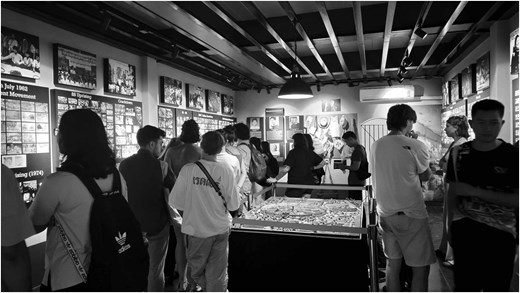
Assistance Association for Political Prisoners Burma Museum, Mae Sot, Thailand. Photograph: Sarah Riebel.
On the occasion of what would have been Aung San’s 111th birthday, I release a video lecture which I have given in late 2021 to anthropology students from Myanmar after the Myanmar military attempted a coup on 1 February 2021.
Some of my own students and tens of thousands more had to go into hiding once the military began occupying their universities and took over their cities. With their professors resigning from their positions out of protest, their education came to a sudden, abrupt halt. Having to leave their dormitories and sitting in their parents’ homes again, or having to flee Yangon, Mandalay and other bigger cities in which they had until then studied, they still longed to continue their studies.
This lecture was an effort to support them in this endeavour, albeit without being able to substitute for what they had lost. Moreover, it became evident over the course of the online sessions, that many could not concentrate due to the ongoing violence and the many new tasks they had to adhere to in order to secure their own living or contribute to the livelihood of their families. It is hard to study while having to cope with trauma.
In the lecture, I discuss the concept of ‘guerilla anthropology’ as a way to educate each other while in hiding or from abroad; education as a subversive act of resistance and as refusal to give in. In the main part of the lecture, I cover both the history of anthropology and the role of history in anthropology.
By 2026, several so-called “virtual universities” have taken over from what had been a first effort of mine and fellow anthropologists back then. They have now build a systematic online education path for thousands of Myanmar students. Moreover, some of my own former students from the Unviersity of Yangon have become educators themselves and now teach schoolchildren in the Myanmar-Thai border region. Others have left the country to pursue their own education – all hope to be able to return to Myanmar one day…
Since I am human, I have an intrinsic motivation to understand. Since I am an anthropologist, I have an intrinsic motivation to understand other humans. Since many humans seem more and more motivated to hand their intrinsic motivation to a machine, I am now intrinsically motivated to not only understand how AI operates and what its effects are, but who the humans behind the technology are and to what they might put AI to use.
Since I am also a university professor, I am faced with the topic of AI almost every day. I have noted three common ways of how academia relates to the issue so far:
a) AI is the future and everything will be great
b) we are doomed and we can’t win against AI
c) who cares about AI ?
So I have started to gather texts on AI, particularly those written by scholars or by journalists engaging with academic literature. The result (so far): AI is stupid and as such maybe not so different from humans after all. But: it feeds off our knowledge and it learns from our mistakes. It also gets better in duping us, luring us in and making us believe that there is indeed ‘someone’ on the other side. There is not.
Instead of a picture: a screenshot of how wordpress suggests to generate an image with AI. No, thank you.
Here is my list of collected texts (tbc.) which I enjoyed reading and which I recommend to everyone, whether you are a) b) or c).
In this article, I interrogate the process how evidence is established in asylum procedure by engaging with anthropological and socio-legal literature on evidence and credibility assessments. Drawing on ethnomethodology, I analyse asylum interviews and show in what ways evidence can be understood as the result of an asymmetrical co-construction. As a result of this procedure, the individual applicant disappears and a ‘case’ is established.
Anthropologists who write country of origin reports based on such ‘case material’ for tribunals and courts can highlight the asymmetries in evidence-making and question the very categorisations through which the state operates. The article contributes to ongoing debates on the role of anthropologists and their knowledge as experts in court.
Before all other forms of membership, we are “all members of the human family”, as the preamble of the Universal Declaration of Human Rights has specified. Thus, the international legal concept of crimes against humanity is crucial because all war crimes are predicated on the fact that those committing these atrocities are enabled once they succeed in establishing difference that makes us forget our human commonality.
We cannot but make do with what the French psychoanalyst Jacques Lacan has called the imaginary order – the way in which we try to relate to others by looking for similarities and differences, mainly in order to acknowledge ourselves. We need the ‘other‘ to sustain ourselves as the I(ndividual) we imagine ourselves to be.
The imaginary order is the order of world-making in the sense of Hannah Arendt (1959) for whom the world is not ‘out there‘, but rather that which arises between people in discourse, as I will develop in an upcoming presentation. We have to keep engaging with others, irrespective of the fact that we will never really understand each other entirely. But we are obliged to keep trying. There is no other way.
“For the world is not humane just because it is made by human beings, and it does not become humane just because the human voice sounds in it, but only when it has become the object of discourse … We humanize what is going on in the world and in ourselves only by speaking of it, and in the course of speaking of it, we learn to be human” (Hannah Arendt, 1959, 24-25)
Human commonality is already there from the beginning, transcending all dichotomies, whereas difference is something we can only ever bring about consciously. What we have in common and what makes us human is that we are split by language, as Lacan argued. If we acknowledge this, we might be able to include the other not as an opposite ‘they’ but as part of our own unconscious: we are always other to ourselves first.
UN Photo In 1950, on the second anniversary of the adoption of the Universal Declaration of Human Rights, students at the UN International Nursery School in New York viewed a poster of the historic document.
2024 has been the deadliest year for migrants trying to cross the Channel in small boats to reach the UK, with 69 deaths reported (Refugee Council 2025). British politicians have been referring to the circumstances under which people migrate to the UK as “the small boat crisis“ and subsequently made a “small boat deal“ with countries such as Ruanda, to which they wanted to ship people to.
I recently bought a small booklet filled with Walter Benjamin’s short stories. Tales out of loneliness is its subtitle. In it, there is a 1-page story entitled How the Boat was Invented and Why It Is Called ‘Boat‘. It follows a similar pattern as Benjamin’s short story on Why the elephant is called ‘elephant‘ that immediately precedes the story about the boat.
The storyteller. Tales out of loneliness. Walter Benjamin. Verso Books 2023.
Here’s how Boat’s story goes:
Before all the other people, there lived one person and he was called Boat. He was the first person, as before him there was only an angel who transformed himself into a person, but that is another story.
So the man called Boat wanted to go on the water — you should know that back then there was a lot more water than today. He tied himself to some planks with ropes, a long plank along the belly, that was the keel. And he took a pointed cap of planks, which was, when he lay in the water, at the front — that was the prow. And he stretched out a leg behind him and navigated with it.
In this manner he lay on the water and navigated and rowed with his arms and moved very easily through the water with his plank cap, because it was pointed. Yes, that is how it was: the man Boat, the first man, made himself into a boat, with which one could travel on water.
And therefore — of course that is quite obvious — because he himself was called Boat, he named what he had made ‘boat‘. And that is why the boat is called ‘boat‘.
(Walter Benjamin, 26 September 1933; published posthumously)
The “small boats crisis” is Boat’s crisis, the crisis of man. This is the elephant in the room that nobody wants to talk about. Because they do not know why the elephant is called ‘elephant‘ either.
Philosophy saves lives.
Paper boat made out of a book page (photo by: Maddy Freddie, pexels.com).