Our collaborative article “Exiled Activists from Myanmar: Predicaments and Possibilities of Human Rights Activism from Abroad“, published in the Journal of Human Rights Practice (Oxford University Press), is finally out! 🎉
I am very proud of the work that my colleague Samia Akhter-Khan, my two Ph.D. students Sarah Riebel and Nickey Diamond, another author from Myanmar (who has to use a pseudonym for reasons of safety), as well as myself have managed to achieve under very difficult circumstances.
This article was born out of necessity to engage with the topic of exile. None of us had ever wanted to study yet alone experience this existential state of being. The empirical material we draw on in this article stems from autoethnographic accounts (Nickey Diamond and Demo Lulin), semi-structured interviews and conversations with around forty exiled activists currently residing in Thailand, the US, the UK, Austria, and Switzerland (Samia Akhter-Khan and myself) as well as extensive ethnographic work with exiled activists in Thailand (Sarah Riebel).
In this article, we put forward the concept of the ‘exiled activist’ to highlight the predicaments and the possibilities that practicing human rights activism from abroad bring with it. From our analysis, we have developed three so-called ‘practitioner points’ that might guide INGOs, NGOs, states and other bodies to properly relate to exiled activists from Myanmar. These are:
1. Develop trauma-informed support systems for exiled activists by integrating psychosocial care and peer-based mental health resources into human rights programming and diaspora organizing.
2. Adapt partnership models to accommodate the shifting positionality of exiled activists, recognizing their need for secure digital platforms, flexible funding, and shared decision-making across borders.
3. Acknowledge and navigate political divisions within diverse groups of exiled activists – such as differing views on the National League for Democracy, the military, or the Rohingya – by avoiding assumptions of unity and instead fostering inclusive collaboration that respects diverse activist trajectories and lived experiences.
We have made our article openaccess so that everyone is able to download it. Currently, we are working on a shorter version in Burmese/Myanma, to also allow those who do not speak English to read about this important topic.
Thank you to all exiled activists who have participated in this study, trusted us and shared their stories – and to the German Academic Exchange Service (DAAD) for the support of scholars at risk over the last years!

Tag Archives: Myanmar
Intro to Anthro for Myanmar Students (and others)
On the occasion of what would have been Aung San’s 111th birthday, I release a video lecture which I have given in late 2021 to anthropology students from Myanmar after the Myanmar military attempted a coup on 1 February 2021.
Some of my own students and tens of thousands more had to go into hiding once the military began occupying their universities and took over their cities. With their professors resigning from their positions out of protest, their education came to a sudden, abrupt halt. Having to leave their dormitories and sitting in their parents’ homes again, or having to flee Yangon, Mandalay and other bigger cities in which they had until then studied, they still longed to continue their studies.
This lecture was an effort to support them in this endeavour, albeit without being able to substitute for what they had lost. Moreover, it became evident over the course of the online sessions, that many could not concentrate due to the ongoing violence and the many new tasks they had to adhere to in order to secure their own living or contribute to the livelihood of their families. It is hard to study while having to cope with trauma.
In the lecture, I discuss the concept of ‘guerilla anthropology’ as a way to educate each other while in hiding or from abroad; education as a subversive act of resistance and as refusal to give in. In the main part of the lecture, I cover both the history of anthropology and the role of history in anthropology.
By 2026, several so-called “virtual universities” have taken over from what had been a first effort of mine and fellow anthropologists back then. They have now build a systematic online education path for thousands of Myanmar students. Moreover, some of my own former students from the Unviersity of Yangon have become educators themselves and now teach schoolchildren in the Myanmar-Thai border region. Others have left the country to pursue their own education – all hope to be able to return to Myanmar one day…
May their dream come true!
Film über meine Forschung: Staatenlosigkeit
Die Universität Konstanz hat einen kurzen Film zu meinem aktuellen Forschungsprojekt zum Thema “Staatenlosigkeit” gedreht.
Der Film kann auf dem youtube-Kanal der Universität Konstanz angeschaut werden.

We-formation. Reflections on methodology, the military coup attempt and how to engage with Myanmar today. Lecture in Paris, 16 May 2023

In this invited lecture, I will discuss my concept of “we-formation” in regard to three different topics: First, as anthropological theory and methodology; Second, as a way to make sense of the resistance against the attempted military coup and third in regard to the possibility of a public anthropology of cooperation in these trying times.
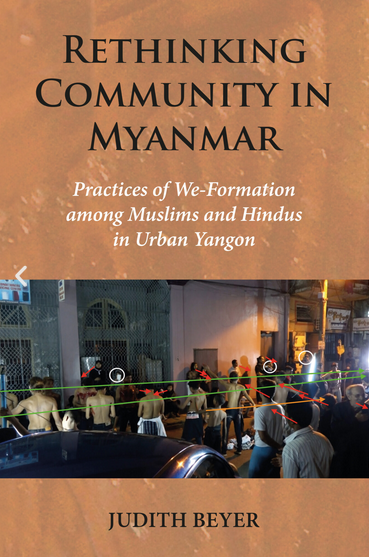
First, I will explore the concept in regard to its theoretical and methodological innovativeness, taking an example from my Yangon ethnography as illustration. We-formation, I argue in my book Rethinking community in Myanmar. Practices of we-formation among Muslims and Hindus in urban Yangon, “springs from an individual’s pre-reflexive self-consciousness whereby the self is not (yet) taken as an intentional object” (8). The concept encompasses individual and intersubjective routines that can easily be overlooked” (20), as welll as more spectacular forms of intercorporeal co-existence and tacit cooperation.
By focusing on individuals and their bodily practices and experiences, as well as on discourses that do not explicitly invoke community but still centre around a we, we-formation sensitizes us to how a sense of we can emerge (Beyer 2023: 20).
Second, I will put my theoretical and methodological analysis of we-formation to work and offer an interpretation of why exactly the attempted military coup of 1 February 2021 is likely to fail (given that the so-called ‘international community’ does not continue making the situation worse). In the conclusion of my book I argue that the “generals’ illegal power grab has not only ended two decades of quasi-democratic rule, it has also united the population in novel ways. As an unintended consequence, it has opened up possibilities of we-formation and enabled new debates about the meaning of community beyond ethno-religious identity” (250).
Third, I will discuss how (not) to cooperate with Myanmar today. Focusing on what is already happening within the country and amongst Burmese activists in exile, but also what researchers of Myanmar from the Global North can do within their own countries of origin to make sure the resistance does not lose momentum. In this third aspect, I take we-formation out of its intercorporeal and pre-reflexive context in which I came to develop the concept during my fieldwork in Yangon and employ it to stress a type of informed anthropological action that, however, does not rely on having a common enemy or on gathering in a new form of ‘community’ that has become reflexive of itself. Rather, it aims at encouraging everyone to think of one’s own indidivual strengths, capabilities and possibilities and put them to work to support those fighting for a free Myanmar.
You can purchase my book on the publisher’s website: NIAS Press.
Here’s the full programme of the Groupe Recherche Birmanie for the spring term 2023:

Mahnwache für Myanmar. Samstag, 27.3.2021 um 14.00h Konstanzer Münster

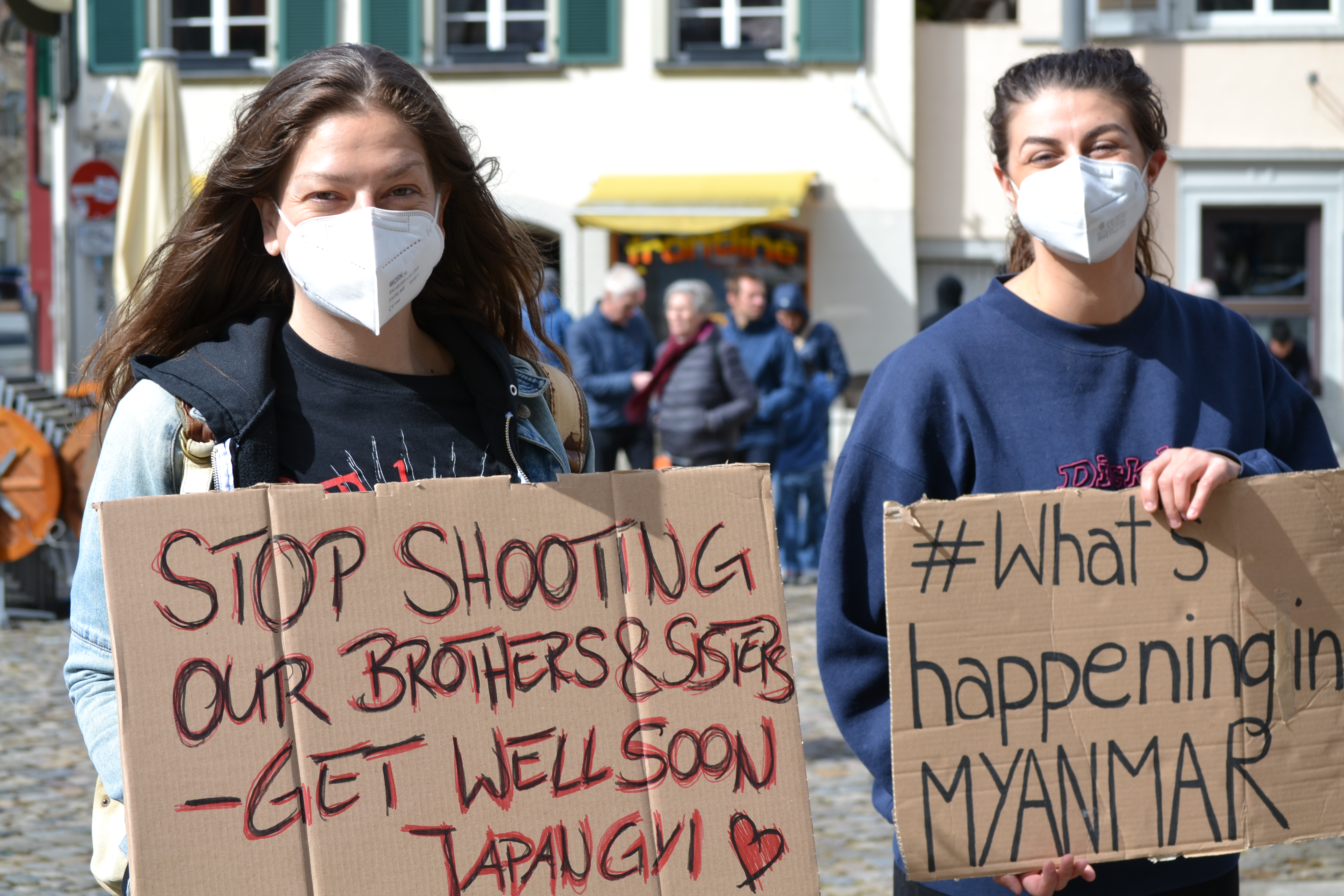
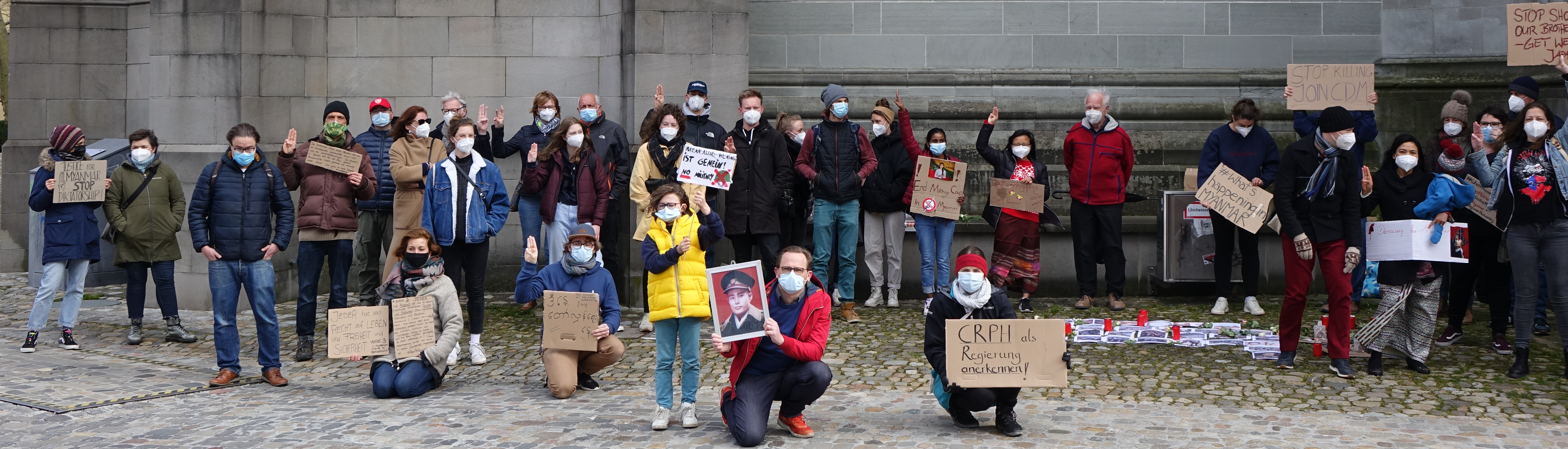
Am Samstag den 27.03.2021 um 14:00 Uhr haben wir im Zuge von bundesweit geplanten Mahnwachen auch in Konstanz unsere Solidarität mit den Menschen in Myanmar ausgedrückt. Wir sind eine diverse Gruppe von Menschen, die beruflich oder privat eine enge Verbindung zu Myanmar haben und den unrechtmäßigen Coup des burmesischen Militärs ablehnen.

Am 1. Februar putschte sich das burmesische Militär, nach fünf Jahren ziviler Regierung, zurück an die Macht. Trotz über 2000 willkürlichen Verhaftungen und mindestens 247 Todesopfern (FAZ 21.03.2021) ist der Widerstand der Bevölkerung nicht zu brechen; es kommt weiterhin täglich zu Massenprotesten. Inzwischen wurde Kriegsrecht in einigen Regionen ausgerufen, was die Situation weiter zuspitzt. Der Ausgang ist offen und der Mut und die Hoffnung der burmesischen Bevölkerung bewundernswert. Mit den bundesweit stattfindenden Mahnwachen soll sowohl den Opfern der Militärjunta gedacht als auch Solidarität mit den Protestierenden und ihren Forderungen nach Demokratie bekundet werden.


Ankündigung im Konstanzer Seemoz am 27.03.2021.
Erwähnt auch in der TAZ unter “Internationale Solidarität“


#corona: Views from an anthropology of the state
This is from my twitter thread which I started on March 9, after having returned from Singapore and Myanmar. I am saving it here for better readability and for those, who do not use social media.
Here are my thoughts on the corona virus from the perspective of an anthropology of the state: Having just returned from 2,5 weeks of short-term fieldwork in Southeast Asia (Singapore and Myanmar) I noticed the following:
When we look at the policies of authoritarian states such as Singapore and Myanmar we can see highly diverse tactics in how to deal with an epidemic or pandemic – Singapore: closes its borders, monitors its citizens, checks every persons temperature at the airport and at hotels. Provides sanitizing gels everywhere, cleans public spaces regularly several times a day. Informs on all media channels how to wash hands, keep distance, when to stay home and whom to call. The population not only cooperates, but even copies the state’s measures (e.g. in restaurants, in gyms, and malls). Singapore reports all cases early. As a result, the growth rate of new cases has slowed down and the number has almost remained the same since February.
Myanmar – in contrast: no checking of temperature at airports, no entry denial to travellers from high-risk countries, no information beyond a couple of posters in downtown Yangon. No cases reported until today. No trust in the government, but a lot of rumours.
Then I return to Germany and I find: people buying toilet paper (?) and pasta in large quantities. People still not understanding how to sneeze and when to stay away from crowds. People stealing sanitizing gels even at my university – with the result that none are provided. Due to Germany’s federal system, there is no centrally communicated measurement in place, but an endless trickle-down of bits and pieces of news – all in the form of recommendations, none binding, in many cases not adhered to. There is a lingering sense of defeatism. There is also a slight sense of panic. The hoarding of toilet paper and the sanitizing gels standing in for trying to substitute danger with purity. The buying of pasta seems to be a post 2WW phenomenon, though. None of it is rational behaviour, but driven by fear.
Authoritarian states such as Singapore, China, but also Israel switch into command mode, and its citizens obey as there is no other option. They fear the state more than the virus. In authoritarian states such as Myanmar (and the current US) there is politics by denial: Business as usual, nothing to see here or to report. And in democratic states such as Germany, it takes an epidemic such as the current one to see where the limits of governmental agency are:
The downside of upholding individual freedom is that we are on our own.
While China’s effort has been written about as “collective”, as in this article, it was really a top-down decision by a few officials that was adhered to because people fear the state. While we in Germany are still enjoying our individual freedom to ignore governmental recommendations, an unintended side-effect of surveillance and micro governance in authoritarian states is that it ultimately aids health care measurements and helps curb epidemics and pandemics. And a side-effect in democracies and other authoritarian states is that the upholding of individual freedom comes at a prize, as does the complete denial of the issue. The two are actually close. That is, when it comes to epidemics, Germany and Myanmar have a lot in common!
March 24: I’ll continue: “Queremos o melhor para população. Se o governo não tem capacidade de dar um jeito, o crime organizado resolve” – This is a statement from organized crime in Rio, Brazil who enforced a nightly lockdown because they would take care of the population, in contrast to the government. Also, ISIS has warned its people not to enter “the land of the epidemic” (aka Europe ) and layed out a “sharia directive” that includes how to wash your hands properly.
We live in interesting times when organized crime and terrorists care more than the state.
tbc…
Harmony Ideology at The Hague. New Blog Post for Public Anthropologist
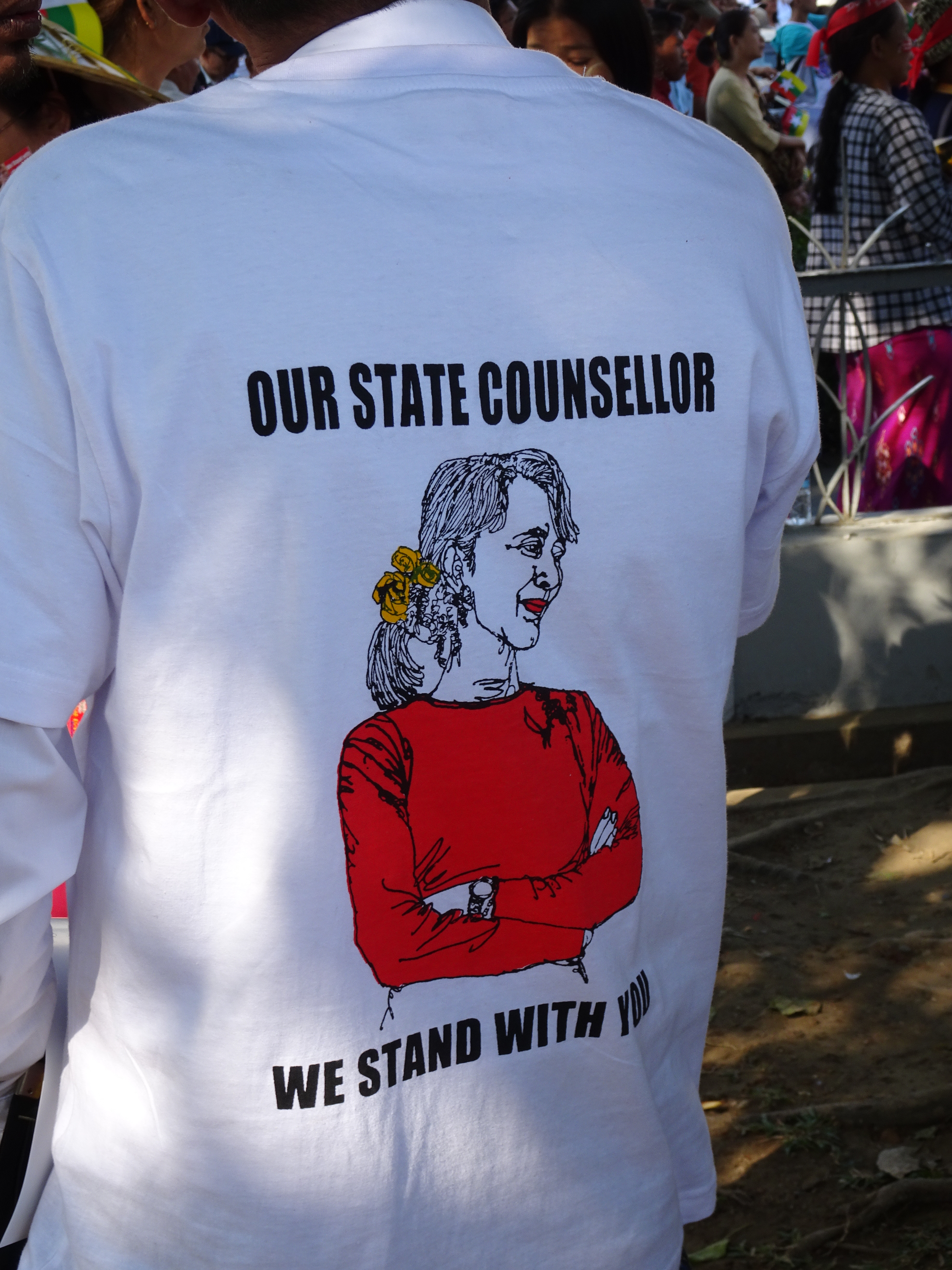
Together with Felix Girke, I have just published another op-ed piece on the genocide case currently pending at the International Court of Justice (ICJ) in The Hague. There, The Republic of The Gambia has filed a case against Myanmar, accusing the country’s army of having committed genocide of Muslim Rohingya. We have published on this issue also at OpenDemocracy, focusing on the figure of Aung San Suu Kyi herself, who has decided to act as the “Agent” of a high-profile team of lawyers. While her status as an ‘icon of democracy’ is unbroken within the country, especially in Western countries, commentators are grappeling with what they perceive to be a sudden and unexpected shift in her personality since she became “state counsellor”. However, as I have argued in 2017 already, this is in line with how she has always been doing politics.
In our blog post for Public Anthropologist, we take a look at Aung San Suu Kyi’s speech at the ICJ on December 11 2019. We argue that she employs “harmony ideology,” a concept coined by the legal anthropologist Laura Nader in the 1990s, based on her work among the Talean Zapotec in southern Mexico in the 1960s. Later, Nader applied her new terminology to so-called alternative dispute resolution (ADR)-cases in the United States of America.
“Harmony ideology”, so Nader, needs to be understood as a counterhegemonic force with which her Zapotec villagers tried to keep the Mexican state at bay. By pretending that they are a harmonious people and capable of dealing with their disputes internally, they tried to fend off any outside interference. In ADR-cases, Nader showed how “harmony ideology” was used to “outsource” dispute cases that judges thought to be too irrelevant for to be decided in state courts. In the case of Myanmar at the ICJ, however, Felix Girke and I argue that
Aung San Suu Kyi acted as if her country were a southern Mexican village, needing protection from illegitimate legal governance that interfered with its internal affairs, while at the same time embodying the very state apparatus that is now internationally accused of having committed genocide against its own population.
While the Talean Zapotec might have had effective measures for local dispute resolution and good reasons to keep the state courts at bay, the atrocities committed against the Rohingya and the poor record of Myanmar to police itself suggest that Suu Kyi’s harmony ideology at the ICJ is sorely misplaced, we argue. Read the full post over at Public Anthropologist.
Yangon, Myanmar
First impressions from Yangon, Myanmar where I will be based until May 2016. The city has changed a lot in the last two years since I visited, mostly in terms of transportation and mobile phone use. What has remained the same are the great street food eateries, the use of loudspeakers to convey religious messages, lottery ticket sales and other important or not-so-important events. I missed the people a lot and its great to find almost everyone in good health and spirits. Nothing beats fieldwork, really! J.