Category Archives: protest

Boat is a man

2024 has been the deadliest year for migrants trying to cross the Channel in small boats to reach the UK, with 69 deaths reported (Refugee Council 2025). British politicians have been referring to the circumstances under which people migrate to the UK as “the small boat crisis“ and subsequently made a “small boat deal“ with countries such as Ruanda, to which they wanted to ship people to.

Before the Labour party came to power, they accused the Tories of “having lost control of small boat migration“. Now, that they are in power, they claim that there is “no nice or easy way of doing it“. Getting rid of people who came by boat…

But what if boat were a man?

I recently bought a small booklet filled with Walter Benjamin’s short stories. Tales out of loneliness is its subtitle. In it, there is a 1-page story entitled How the Boat was Invented and Why It Is Called ‘Boat‘. It follows a similar pattern as Benjamin’s short story on Why the elephant is called ‘elephant‘ that immediately precedes the story about the boat.

The storyteller. Tales out of loneliness. Walter Benjamin. Verso Books 2023.

Here’s how Boat’s story goes:

Before all the other people, there lived one person and he was called Boat. He was the first person, as before him there was only an angel who transformed himself into a person, but that is another story.

So the man called Boat wanted to go on the water — you should know that back then there was a lot more water than today. He tied himself to some planks with ropes, a long plank along the belly, that was the keel. And he took a pointed cap of planks, which was, when he lay in the water, at the front — that was the prow. And he stretched out a leg behind him and navigated with it.

In this manner he lay on the water and navigated and rowed with his arms and moved very easily through the water with his plank cap, because it was pointed. Yes, that is how it was: the man Boat, the first man, made himself into a boat, with which one could travel on water.

And therefore — of course that is quite obvious — because he himself was called Boat, he named what he had made ‘boat‘. And that is why the boat is called ‘boat‘.

(Walter Benjamin, 26 September 1933; published posthumously)

The “small boats crisis” is Boat’s crisis, the crisis of man. This is the elephant in the room that nobody wants to talk about. Because they do not know why the elephant is called ‘elephant‘ either.

Philosophy saves lives.

Paper boat made out of a book page (photo by: Maddy Freddie, pexels.com).

“We are all stuck” – On (not) failing our students

We are way into the winter term in all public universities in France. I am currently on a research sabbatical at the University Paris-Nanterre where I also teach a course on the Introduction to Legal Anthropology.

Half an hour before my lecture is about to start, one student already sits prepared with their laptop in the hallway. I open the door to the lecture room to allow them to sit more comfortably. But it is as freezing in the room as it is in the hallway. There is no heating in the building. I wonder how many of my students might come today given the heavy rainfall …

Ten minutes before my lecture, I check my emails. I see that several students have written to me already. Only one calls in sick, all others are stuck in the outbound RER A train from central Paris to Nanterre. There has been an incident, the students explained: “We are all stuck”. Another one shares a screenshot of the offical traffic announcement and an additional photograph: an official attestation that there has been a disruption. The document carries the title “Attestation de pertubation”

The date and time is neatly printed and I contemplate how fast and effective not being fast and effective can be. I suggest to the student later to use this textual artefact as an entry point to an essay my students are supposed to write at the end of the term on the everyday life of the law.

It is 10.30h and I decide to see who might have shown up despite the rain falling and the train being late. The room is half full already and within the next 20 minutes the rest trickle in. We are almost at full capacity and I am seriously impressed.

It is on the same day that I learn that in France there is no longer an obligation to attend classes in presence if your personal circumstances do not allow you to do so. Students may study long distance at all universities in France for health-related reasons or because they have to work. At the end of my course I will have to grade essays of students whom I will have never seen in person and who will not have attended a single lecture of mine on campus.

I wonder: what kind of anthropologists are we releasing into the world if the only encounter many students have with the discipline is via self-study ? No dialogue with teachers, no spending time with classmates, no campus experience. Not only that the state keeps on moving the universities beyond the bande péripherique into suburbia, by allowing students to study long-distance, it reduces the campus to mere sites of administration. In the name of “flexibility”, students work towards their grades, but are being deprived of what Bell Hooks has called “the most radical space of possibility in the academy”: the classroom.

Universities are easier to manage if fewer people are around. One might be tempted to reframe long-distance studies as “needs-centred”. Paris already suffered from high living costs before the Covid-19 lockdowns struck. After 2021, many never moved back to the city, but remained in their home towns far away. At times, the campus feels deserted – a striking difference to 2018 and 2019 when I last spent some time in Paris on fellowships.

The students who do attend my seminar, always listen attentively and eagerly write down what I am presenting on my slides. I have split the seminar into two parts: the first is a lecture, the second was intended as an interactive space for discussing the weekly reading and give them the possibility to ask questions – in French or English. However, only very few attend the second part of the seminar. I now understand that this is the case because very few have read the text. I was warned by other lecturers that this is indeed the case: “Students do not read texts.” When I inquired why, the answer was always because they are overworked – from having to take too many courses and from having to work in order to finance their studies …

But anthropology is not a subject that can be taught only. It needs to be ingested until it has become part of oneself. Students need to anthropologize themselves throughout their studies in order to be able to later claim “I am an anthropologist” and mean themselves instead of a mere profession. Anthropology needs to become an integral part of one’s own humaneness, ideally, before one can collaborate with others and analyse what one has learned from them in an ethical manner. But the discipline is increasingly expected to be taught in ways that ensure it remains outside of our students’ individual experience.

Our most important task is therefore to get students back into the classroom while at the same time opening that very classroom up to the world. Rather than transmitting a particular kind of ‘knowledge’, we should be transmitting that anthropology provides a multitude of ways of seeing and conceptualizing humanity as such. While taking our students and their current experiences seriously, our task is also to de-self-center their existing worldview and help them get unstuck. We do not need more ‘attestations des pertubations‘, we need ‘pertubations des attestions‘!”

Film über meine Forschung: Staatenlosigkeit

Die Universität Konstanz hat einen kurzen Film zu meinem aktuellen Forschungsprojekt zum Thema “Staatenlosigkeit” gedreht.

Der Film kann auf dem youtube-Kanal der Universität Konstanz angeschaut werden.

We-formation. Reflections on methodology, the military coup attempt and how to engage with Myanmar today. Lecture in Paris, 16 May 2023

In this invited lecture, I will discuss my concept of “we-formation” in regard to three different topics: First, as anthropological theory and methodology; Second, as a way to make sense of the resistance against the attempted military coup and third in regard to the possibility of a public anthropology of cooperation in these trying times.

First, I will explore the concept in regard to its theoretical and methodological innovativeness, taking an example from my Yangon ethnography as illustration. We-formation, I argue in my book Rethinking community in Myanmar. Practices of we-formation among Muslims and Hindus in urban Yangon, “springs from an individual’s pre-reflexive self-consciousness whereby the self is not (yet) taken as an intentional object” (8). The concept encompasses individual and intersubjective routines that can easily be overlooked” (20), as welll as more spectacular forms of intercorporeal co-existence and tacit cooperation.

By focusing on individuals and their bodily practices and experiences, as well as on discourses that do not explicitly invoke community but still centre around a we, we-formation sensitizes us to how a sense of we can emerge (Beyer 2023: 20).

Second, I will put my theoretical and methodological analysis of we-formation to work and offer an interpretation of why exactly the attempted military coup of 1 February 2021 is likely to fail (given that the so-called ‘international community’ does not continue making the situation worse). In the conclusion of my book I argue that the “generals’ illegal power grab has not only ended two decades of quasi-democratic rule, it has also united the population in novel ways. As an unintended consequence, it has opened up possibilities of we-formation and enabled new debates about the meaning of community beyond ethno-religious identity” (250).

Third, I will discuss how (not) to cooperate with Myanmar today. Focusing on what is already happening within the country and amongst Burmese activists in exile, but also what researchers of Myanmar from the Global North can do within their own countries of origin to make sure the resistance does not lose momentum. In this third aspect, I take we-formation out of its intercorporeal and pre-reflexive context in which I came to develop the concept during my fieldwork in Yangon and employ it to stress a type of informed anthropological action that, however, does not rely on having a common enemy or on gathering in a new form of ‘community’ that has become reflexive of itself. Rather, it aims at encouraging everyone to think of one’s own indidivual strengths, capabilities and possibilities and put them to work to support those fighting for a free Myanmar.

You can purchase my book on the publisher’s website: NIAS Press.

Here’s the full programme of the Groupe Recherche Birmanie for the spring term 2023:

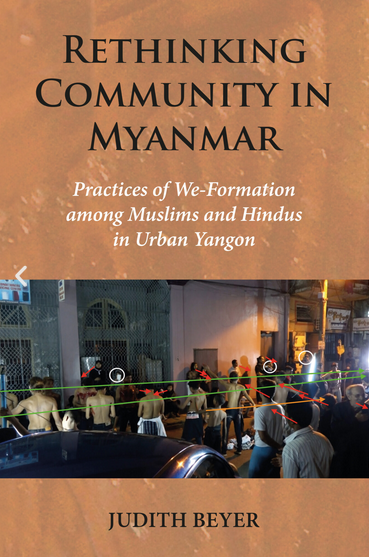
“Rethinking community in Myanmar. Practices of We-Formation among Muslims and Hindus in Urban Yangon” (NIAS Press 2023) has arrived!

‘Community’, I argue in my new anthropological monograph, was actively turned into a category for administrative purposes during the time of British imperial rule. It has been put to work to divide people into ethno-religious selves and others ever since.

Rather than bestowing on community some sort of positivist reality or deconstructing the category until nothing is left, my aim in this book is to shift the angle of approach: I acknowledge that community (for reasons that can usually be traced historically) feels real to and is meaningful for individuals. Their experiences and their struggles to engage with community are no less real. Through their own classificatory practices, my interlocutors — Muslims and Hindus in urban Yangon — demonstrate that they reason and reflect on symbols and meanings in their own culture as much as anthropologists do. But my approach goes beyond a social constructivist concern over how terms such as community are used, and also beyond a representational approach in which actors are subjected to culture as a system of meaning.

When I talk about the work of community (drawing on Nancy 2015), I reflect on the ways in which individuals accommodate ‘community’ in their acts of reasoning, meaning-making and symbolization. The way my interlocutors in Yangon see and talk about themselves has a historical context that begins in nineteenth-century England, encompasses British colonial India and later Burma itself, and extends into presentday
Myanmar. I then widen the emic perspective of my interlocutors and offer a novel way of describing how a we that does not neatly map onto or overlap with a homogeneous social group is generated in various situations.

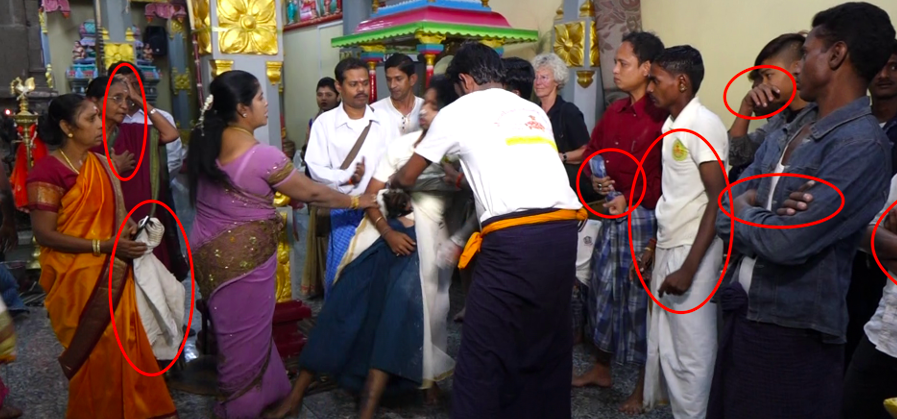
What I call we-formation encompasses individual and intersubjective routines that can easily be overlooked, as well as more spectacular forms such as the intercorporeal aspects of the ritual march I described earlier. Attending to such sometimes minute moments of co-existence or tacit cooperation is difficult, but doing so can help us understand how community continues to have such an impact on the everyday lives of our interlocutors, not to mention on our own analytical ways of thinking about sociality.

By focusing on individuals and their bodily practices and experiences, as well as on discourses that do not explicitly invoke community but still centre around a we, we-formation sensitizes us to how a sense of we can emerge .

You can purchase the book on the publisher’s website: NIAS Press.

Rethinking Community in Myanmar. New Book out soon!

Announced for November 2022 with NIAS Press:

Rethinking Community in Myanmar. Practices of We-Formation among Muslims and Hindus in Urban Yangon.

This is the first anthropological monograph of Muslim and Hindu lives in contemporary Myanmar. In it, I introduce the concept of “we-formation” as a fundamental yet underexplored capacity of humans to relate to one another outside of and apart from demarcated ethno-religious lines and corporate groups. We-formation complements the established sociological concept of community, which suggests shared origins, beliefs, values, and belonging. Community is not only a key term in academic debates; it is also a hot topic among my interlocutors in urban Yangon, who draw on it to make claims about themselves and others.

Invoking “community” is a conscious and strategic act, even as it asserts and reinforces stereotypes of Hindus and Muslims as minorities. In Myanmar, this understanding of community keeps self-identified members of these groups in a subaltern position vis-à-vis the Buddhist majority population. I demonstrate the concept’s enduring political and legal role since being imposed on “Burmese Indians” under colonial British rule. But individuals are always more than members of groups. I draw on ethnomethodology and existential anthropology to reveal how people’s bodily movements, verbal articulations, and non-verbal expressions in communal spaces are crucial elements in practices of we-formation. Through participant observation in mosques and temples, during rituals and processions, and in private homes I reveal a sensitivity to tacit and intercorporeal phenomena that is still rare in anthropological analysis.

Rethinking Community in Myanmar develops a theoretical and methodological approach that reconciles individuality and intersubjectivity and that is applicable far beyond the Southeast Asian context. Its focus on we-formation also offers insights into the dynamics of resistance to the attempted military coup of 2021. The newly formed civil disobedience movement derives its power not only from having a common enemy, but also from each individual’s determination to live freely in a more just society.

Myanmar 10 Monate nach dem Putsch und die Situation der Rohingya – für ARD alpha

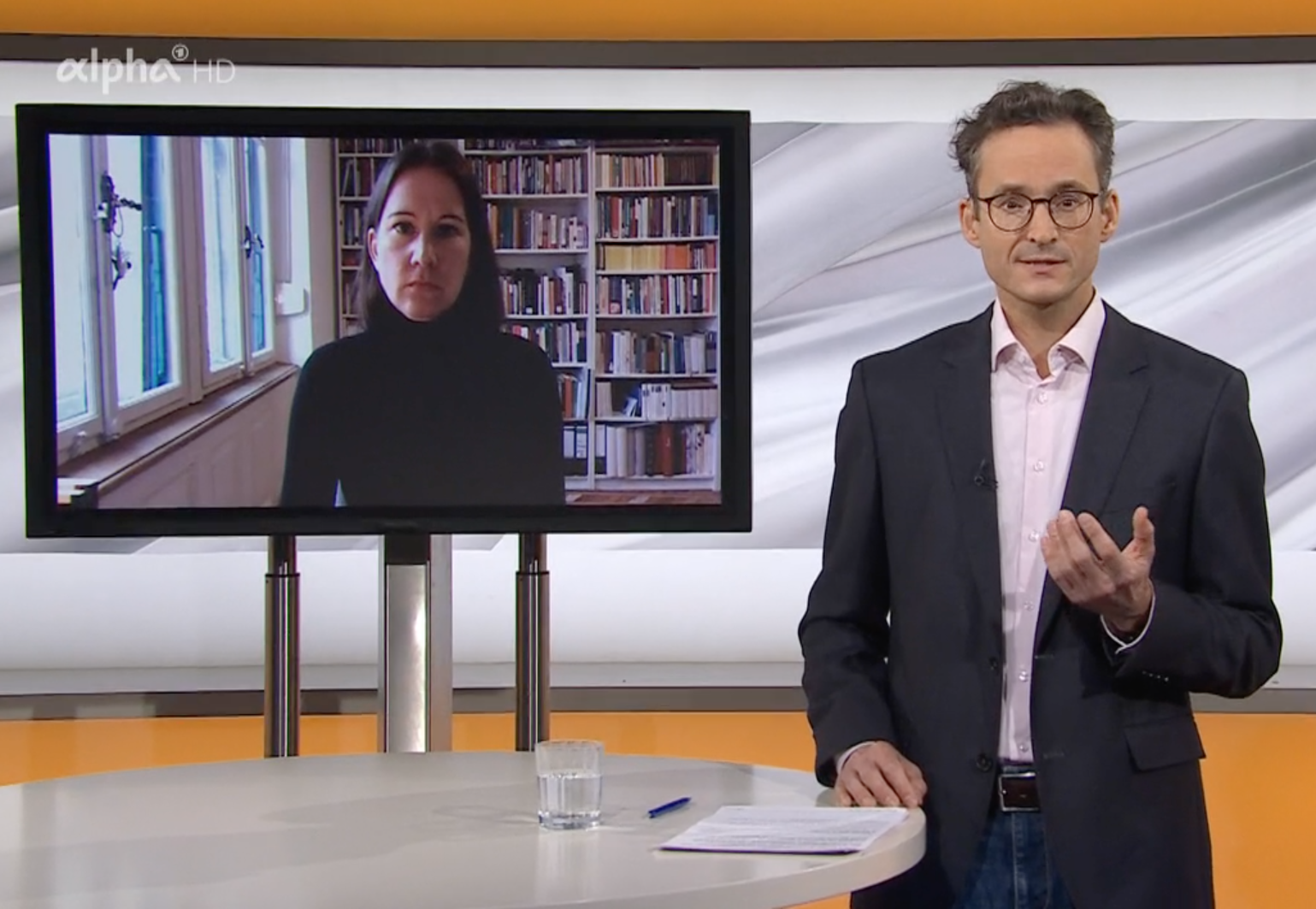
Mit Tilman Seiler habe ich mich nun schon zum zweiten Mal über die Widerstandsbewegung in Myanmar unterhalten, die sich nach dem Militärputsch vom 1. Februar 2021 im ganzen Land gebildet hat. Er fragte, wie erfolgreich diese sei, wie fest im Sattel die “Putschregierung” sitzen würde und auch, was von der Ankündigung des Militärs zu halten sei, es werde Neuwahlen geben nachdem Min Aung Hlaing die im November 2020 stattgefundenen Parlamentswahlen für ungültig erklärt hatte. Meine Prognosen sind realistisch, also recht düster.

Ein zweites Thema betraf die Situation der Rohingya im weltgrößten Flüchtlingscamp in Bangladesh. Hier wollte Herr Seiler wissen, wie die Regierung des angrenzenden Nachbarstaats mit den Geflüchteten umgehen würde und auch, was die internationale Weltgemeinschaft tun könne, um die mittlerweile 1,5 Millionen Rohingya zu unterstützen. Ich berichtete von den laufenden Plänen Bangladeshs, circa 100.000 Rohingya auf die eine vorgelagerte künstliche Insel in der Bengalischen See zu verlagern und sagte auch, dass dies im großen Fall gegen den Willen der Menschen dort geschehe.

Darüber hinaus erinnerte ich daran, dass vor allem im Fall staatenloser Geflüchteter wir “bei uns vor der Haustür” mit der Unterstützung beginnen können, nämlich indem man das eigene Asylsystem reformiert, welches bei Staatenlosen in den meisten Fällen immer noch unzureichend greift: Menschen, die keine offiziellen Dokumente zu ihrer Identifikation vorweisen können, haben es hier besonders schwer.

Das zehnminütige Gespräch ist in der ARD alpha-Mediathek zu finden.

Teaching Hannah Arendt in 2021

Hannah Arendt is one of the best-known political theorists of the 20th century. Her books and her theoretical arguments emerged in dialogue with ancient philosophers (Socrates, Plato, Aristotle) ​​and modern German thinkers (Kant, Hegel), as well as with her own university teachers (Heidegger, Husserl, Jaspers). Arendt never saw herself as a philosopher, but as a theoretician of the political. The topics she dealt with are today more topical than ever before and her books are being read across disciplines.

Hannah Arendt wrote on totalitarianism, statelessness, human community, and freedom and responsibility. In her work she processed her own experience as a Jew in Germany, as a stateless person in World War II, as a migrant in the USA, as a woman in male-dominated academia and as an attentive observer of an increasingly globalized post-war world.

This semester I am teaching some of her main theoretical themes to a group of BA students at the University of Kontsanz. We will not only embed Arendt’s texts in their historical context, but also to think through and with her arguments using current examples — ranging from the covid pandemic to state terror in Myanmar. Hannah Arendt was interested in the basic conditions of human existence: whenever these are questioned or radically transformed, her work offers a fruitful starting point.

“Why read Hannah Arendt now?” (2018) asks the author Richard Bernstein in his recent book. Answer: because she is “the thinker of the hour” (according to the German translation of the book).

Here is the Syllabus to my course (in German).

Staatsterror in Myanmar. Neuer Artikel für “Blätter”

Zusammen mit Felix Girke habe ich einen neuen Artikel zum Thema “Staatsterror in Myanmar” für Blätter für deutsche und internationale Politik verfasst.

Darin diskutieren wir wer die zivile Widerstandsbewegung Civil Disobedience Movement (CDM) trägt, was deren Ziele sind und warum sie auch angesichts des zunehmenen Terrors seitens des Militärs nicht aufgibt.

Wir setzen die aktuelle soziale Bewegung in Bezug zu früheren Protest- und Widerstandsbewegungen und gehen bis in die Kolonialzeit des Landes zurück. Neben der zentralen Bedeutung von Aung San für die Unabhängigkeitsbewegung der 1920ger und 1930ger Jahre machen wir deutlich, dass in allen Jahrzehnten die Bewegungen vor allem von Studierenden getragen wurden.

Der Verfassung von 2008 widmen wir besondere Aufmerksamkeit, denn nur über sie konnte das Militär auch in den vergangenen Jahren in einer zunehmend demokratischen und offenen Gesellschaft weiterhin die Macht auf sich zentrieren und letztendlich durch ein Uminterpretieren einer Ausnahmeklausel, wieder an sich reissen.

Wir sehen die gesetzten Ziele der CDM als Herkulesaufgabe an, die vor allem von den Menschen im Land zu stemmen sein wird, da die internationalen Organe wie die Vereinten Nationen zunehmend lethargisch reagieren, vor allem mit China und Russland als Vetomächten. Angesichts des zunehmenden Terrors, der sich nicht nur gegen Demonstrierende, sondern auch Unbeteiligte wie Frauen und Kinder richtet, werden die Rufe der Bevölkerung nach Intervention aus dem Ausland immer lauter.