Category Archives: outreach

Help Myanmar!

The people of Myanmar are the most resilient people I have ever met.
But now, after this devastating earthquake, and with ongoing relentless attacks from the military since the attempted coup of 1 February 2021, they are exhausted and really need our support.

This is easier said than done. When a military dictator, notorious for shooting civilians in broad daylight, for bombing innocent children in their schools out of airplanes, for planting mines across the entire country which will cause suffering for decades to come, suddenly begs the “international community” for any humanitarian aid possible, we need to be very careful.

While international aid and financial support is of utmost importance at this moment, it can not go to the “state” of Myanmar, a structural position currently occupied by the military. As there is no legitimate government inside the country, there will be no way to ensure that the money reaches those who need it.

Instead, we can be sure that humanitarian aid will be diverted by the generals. So, how can you support those suffering?

Here are three initiatives, the first two are known for having done great work since at least the attempted coup, the third one is a personal recommendation:

1. Better Burma (https://lnkd.in/erq79zv6)

2. Advance Myanmar (https://lnkd.in/eQiC_8ut)

3. My PhD student from Mandalay, Nickey Diamond (Ye Myint Win), is collecting funds (https://lnkd.in/eNgZdGjD)

Please repost this and – if you can afford it – please help the people of Myanmar – they deserve it!

Thank you. ကျေးဇူးပါ။

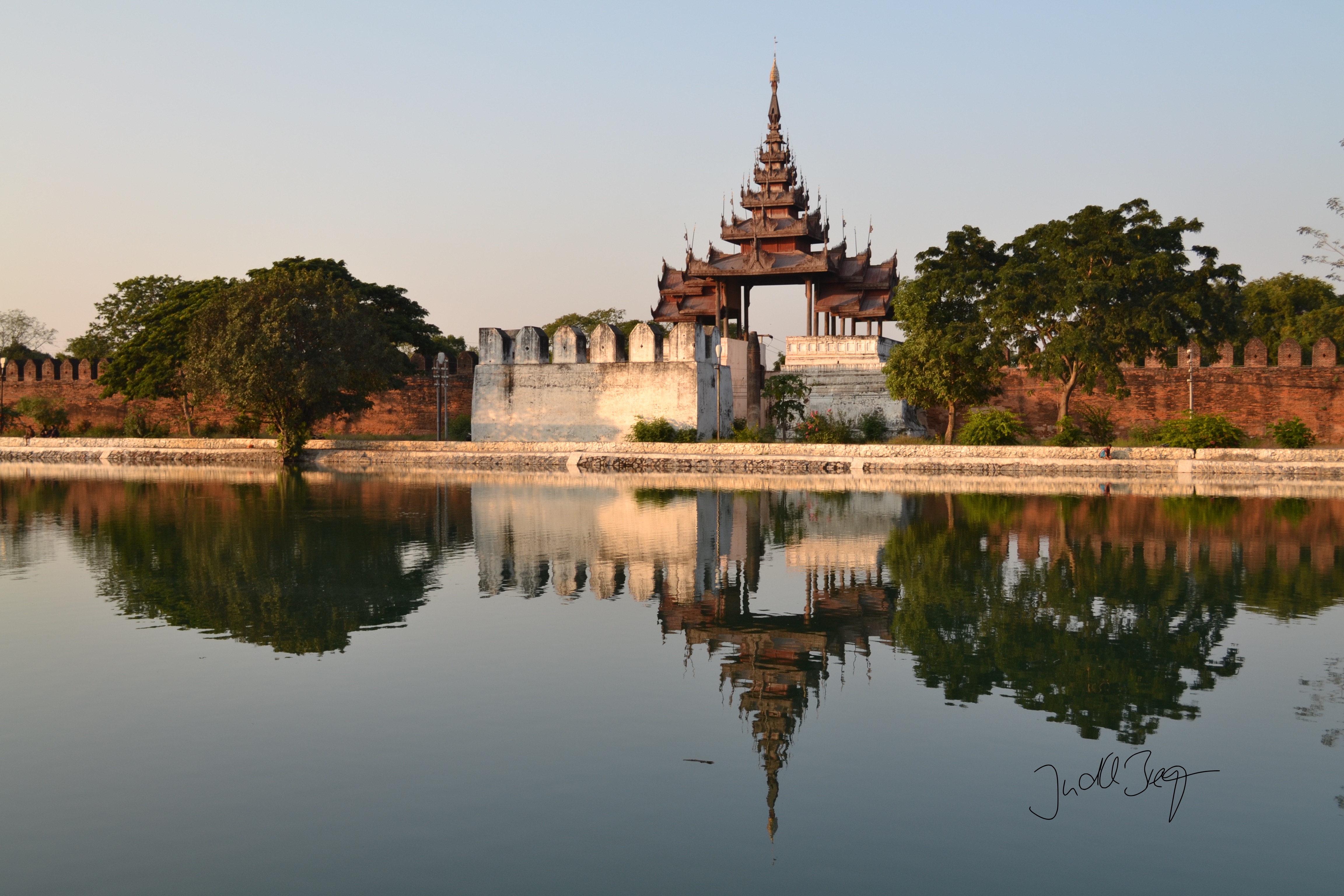
(photo: Judith Beyer. December 2013, Mandalay Palace)


Research Colloquium at Université Paris-Nanterre

This winter term, I will be spending some time with my anthropology colleagues at Paris-Nanterre as part of the Laboratoire d’Ethnologie et de Sociologie comparative (LESC), part of the Centre National de la Recherche Scientifique (CNRS).

One part of my research stay is devoted to working on my current project: “Towards an anthropology of statelessness”. I will be speaking at the Department’s Colloquium in December (see plan below). I will also be teaching a course in legal anthropology … more about this one later.

The colloquium is free and open to the public, everyone is welcome.

Who gets to be ‘Myanmar’ at the ICJ?

The Myanmar military will appear at the International Court of Justice (ICJ) in The Hague on 21 February 2022. I argue that their main interest does not lie in defending the country against genocide allegations. Read the full post at Allegra Lab.

In the case of The Gambia vs Myanmar currently pending at the International Court of Justice (ICJ), Myanmar has been accused of having violated the UN Genocide Convention of 1948 by committing serious crimes against the Rohingya, a predominantly Muslim ethnic group. In 2017, 800.000 Rohingya fled Myanmar to neighbouring Bangladesh in an effort to escape the military’s atrocities.

The army’s attempted military coup of February 202

The case did not proceed after the Myanmar military attempted a coup on 1 February 2021. That night, Aung San Suu Kyi and President Win Myint were arrested and have since been accused of corruption, violations of the telecoms law, a state secrets act as well as covid-19 regulations. They are currently facing several years of imprisonment. The generals declared the November 2020 parliamentary elections as fraudulent and put a state of emergency in place. Senior General Min Aung Hlaing is now heading the country. But not only the State Counsellor and the President, but the entire population of Myanmar has been held hostage: since February 2021, over 1.500 people have been murdered, thousands have been arrested and 450.000 people have become internally displaced, adding to the already high numbers of IDPs.

The National Unity Government

Members of the parliament elected in November 2020 formed the National Unity Government (NUG) while in hiding, now operating from undisclosed locations. They have established working relations with many states and international organizations, including the UN, where Ambassador U Kyaw Moe Tun supports the NUG and has been able to continue representing his country even though the military fired and charged him with high treason. While the military regime has received backing from China and Russia, most other countries have cut diplomatic and also economic ties with Myanmar under the current leadership. The question of who is representing Myanmar in the international community is a contested one which needs to be kept in mind when the case in The Hague continues on 21 February 2022.

Trying to benefit from a genocide accusation

Historically, the army has shown no interest in complying with international legal norms. The “rule of law”-paradigm has been a particular red rag for the Generals. Still, the Myanmar military will likely send delegates to attend the upcoming proceedings in The Hague. At the same time, the National Unity Government (NUG) has declared that United Nations Ambassador U Kyaw Moe Tun is the only person authorised to represent the country in The Hague.

However, for the generals, defending the country against the genocide accusation is largely a means to an end: they will use this opportunity to conduct themselves as the legitimate representatives of the Republic of the Union of Myanmar on a global stage. One should not fall for this trick, or not again: Already in April 2021 the military managed the feat that a general participated in an online-event of the UN Commission on Narcotic Drugs (CND), thereby bypassing the UN Secretary General’s own advice not to cooperate with the junta.

The ICJ is one of the principal legal organs for investigating violations of the 1948 UN Genocide Convention, to which Myanmar is a signatory. To invite the junta to represent the country means to offer them the chance to use the court as a platform for strategic litigation where no longer the crime, but the performance of legitimacy will be key: When the ICJ reopens the case against Myanmar, the Rohingya genocide is not a primary concern of the generals. Rather, it is to be ‘Myanmar’. The ICJ has a historical opportunity to avoid such an ethical, political and legal failure.

Read the full post at Allegra Lab.

Staatsterror in Myanmar. Neuer Artikel für “Blätter”

Zusammen mit Felix Girke habe ich einen neuen Artikel zum Thema “Staatsterror in Myanmar” für Blätter für deutsche und internationale Politik verfasst.

Darin diskutieren wir wer die zivile Widerstandsbewegung Civil Disobedience Movement (CDM) trägt, was deren Ziele sind und warum sie auch angesichts des zunehmenen Terrors seitens des Militärs nicht aufgibt.

Wir setzen die aktuelle soziale Bewegung in Bezug zu früheren Protest- und Widerstandsbewegungen und gehen bis in die Kolonialzeit des Landes zurück. Neben der zentralen Bedeutung von Aung San für die Unabhängigkeitsbewegung der 1920ger und 1930ger Jahre machen wir deutlich, dass in allen Jahrzehnten die Bewegungen vor allem von Studierenden getragen wurden.

Der Verfassung von 2008 widmen wir besondere Aufmerksamkeit, denn nur über sie konnte das Militär auch in den vergangenen Jahren in einer zunehmend demokratischen und offenen Gesellschaft weiterhin die Macht auf sich zentrieren und letztendlich durch ein Uminterpretieren einer Ausnahmeklausel, wieder an sich reissen.

Wir sehen die gesetzten Ziele der CDM als Herkulesaufgabe an, die vor allem von den Menschen im Land zu stemmen sein wird, da die internationalen Organe wie die Vereinten Nationen zunehmend lethargisch reagieren, vor allem mit China und Russland als Vetomächten. Angesichts des zunehmenden Terrors, der sich nicht nur gegen Demonstrierende, sondern auch Unbeteiligte wie Frauen und Kinder richtet, werden die Rufe der Bevölkerung nach Intervention aus dem Ausland immer lauter.

Radiointerview für Saarländischer Rundfunk. SR2 Kulturradio

Rund acht Wochen nach dem Militärputsch findet der zivile Widerstand auf den Straßen von Myanmar vor allem in der Nacht statt – und auch in den sozialen Medien. Ich habe mit SR-Politikredakteurin und Moderatorin Katrin Aue über die Lage vor Ort gesprochen. Das Interview findet sich unter dem Titel “Die Menschen wollen nicht in einer Militärdiktatur leben“.

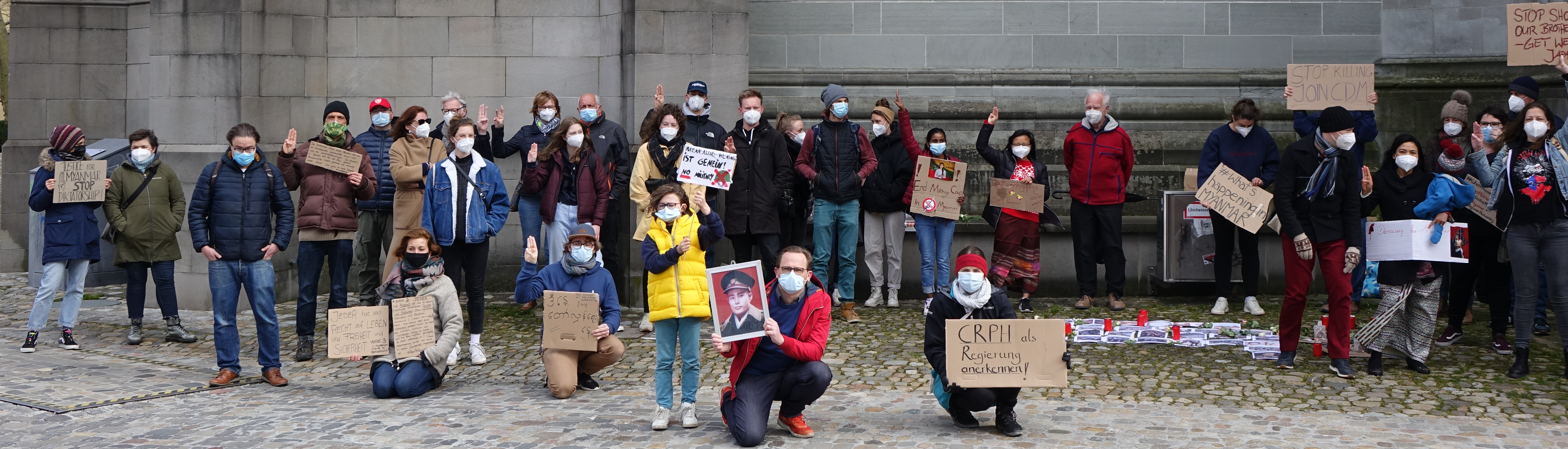
Mahnwache für Myanmar. Samstag, 27.3.2021 um 14.00h Konstanzer Münster

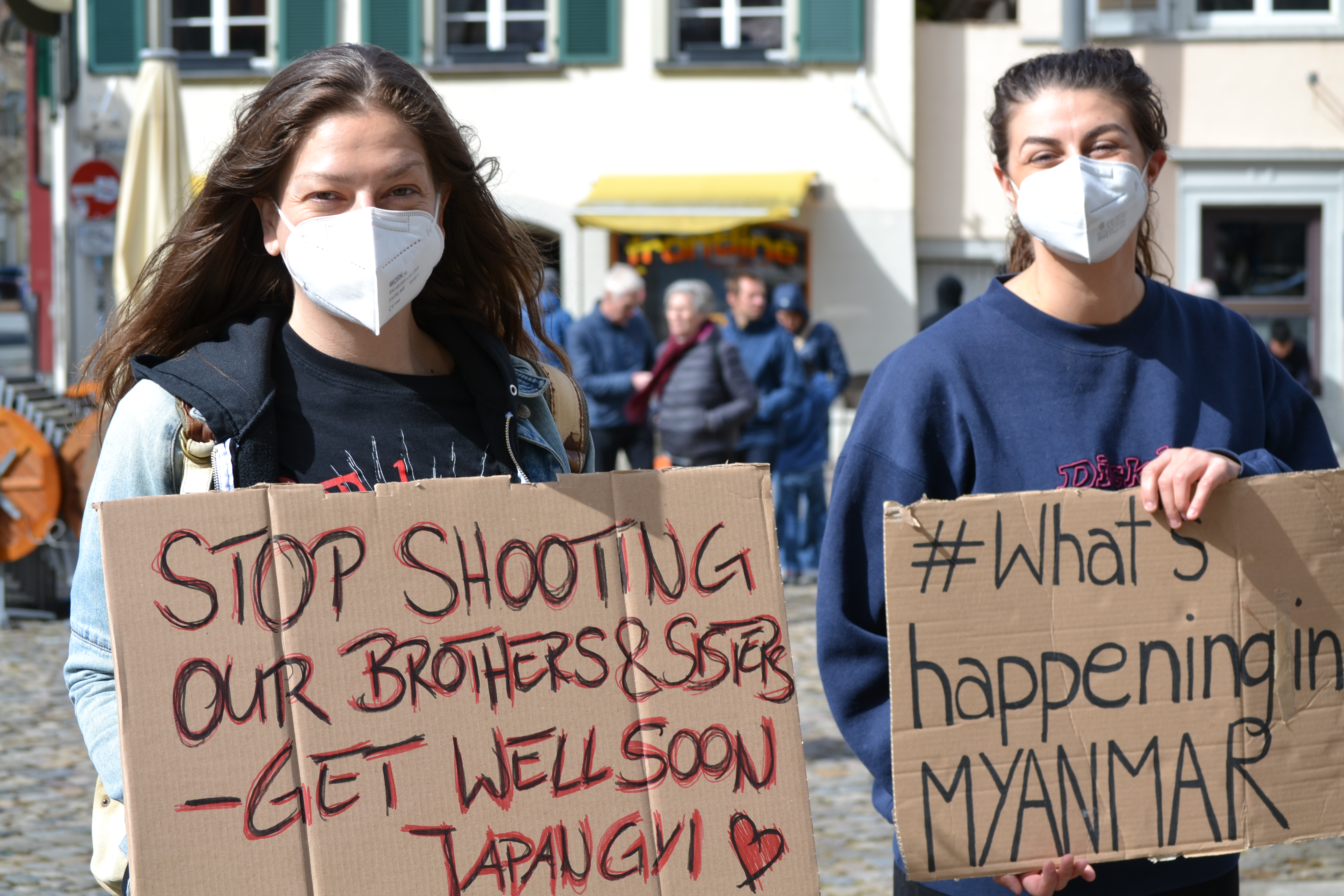
Am Samstag den 27.03.2021 um 14:00 Uhr haben wir im Zuge von bundesweit geplanten Mahnwachen auch in Konstanz unsere Solidarität mit den Menschen in Myanmar ausgedrückt. Wir sind eine diverse Gruppe von Menschen, die beruflich oder privat eine enge Verbindung zu Myanmar haben und den unrechtmäßigen Coup des burmesischen Militärs ablehnen.

Am 1. Februar putschte sich das burmesische Militär, nach fünf Jahren ziviler Regierung, zurück an die Macht. Trotz über 2000 willkürlichen Verhaftungen und mindestens 247 Todesopfern (FAZ 21.03.2021) ist der Widerstand der Bevölkerung nicht zu brechen; es kommt weiterhin täglich zu Massenprotesten. Inzwischen wurde Kriegsrecht in einigen Regionen ausgerufen, was die Situation weiter zuspitzt. Der Ausgang ist offen und der Mut und die Hoffnung der burmesischen Bevölkerung bewundernswert. Mit den bundesweit stattfindenden Mahnwachen soll sowohl den Opfern der Militärjunta gedacht als auch Solidarität mit den Protestierenden und ihren Forderungen nach Demokratie bekundet werden.

Ansprechpartnerin ist Sarah Riebel, MA, Doktorandin in meiner Arbeitsgruppe an der Universität Konstanz. Sie kann bei Fragen kontaktiert werden unter sarah_riebel[at]web.de

Ankündigung im Konstanzer Seemoz am 27.03.2021.

Erwähnt auch in der TAZ unter “Internationale Solidarität

Mahnwache Myanmar in Konstanz. 27 März 2021. Copyright: Judith Beyer

Radio Interview for rbb/inforadio

This morning I was interviewed for the German radio station rbb/inforadio on the ongoing state of exception in Myanmar. In the feature “Vom Militär verhängter Ausnahmezustand in Myanmar” I was asked to talk about how the crisis affects me personally as a scholar, but I tried to emphasize what I find most striking in the way the population deals with the emergency: I continue to be deeply impressed by their determination to remain on the streets and to fight the military regime despite the increase in violence. I have clearly stated that all military operations are most likely mounting to crimes against humanity and go against international humanitarian law.

The reporter asked about the possibility for mediation and I stated very clearly that the population of Myanmar would consider this a betrayal to their cause as none of them is willing to enter into negotiations with the military regime. Instead, it is of utmost importance for Germany, for the EU and the UN to not legitimize the military-imposed “State Administration Council” (SAC). Instead, I emphasized that Germany should grant political asylum to individuals who are in danger of persecution, that communication should be established with the Committee Representing the Pyidaungsu Hluttaw (CRPH), that the Civil Disobedience Movement (CDM) should be supported as well as local journalists who are currently risking their lives in reporting the atrocities.

You can read a short summary and listen to the interview on “Vom Militär verhängter Ausnahmezustand in Myanmar“on the radio’s website.

Myanmar — das Ende der Demokratie? Interview für ARD alpha-Demokratie

Am 02. März 2021 war Myanmar das Thema der Sendung ARD alpha-Demokratie. Ich war als Expertin zugeschaltet und habe Fragen zur aktuellen zivilen Widerstandsbewegung (CDM) beantwortet, aber auch zu ökonomischen, sozialen und (geo-)politischen Hintergründen, sowie zur Rolle der Staatsrätin Aung San Suu Kyi.

Die Sendung “Myanmar — das Ende der Demokratie?” ist online.

On atrocities committed by the Myanmar military on Feb 28. For Al Jazeera English.

I spoke to Al Jazeera again after what turned out to be the deadliest day in Myanmar since the coup d’êtat on Feb 1st, 2021. They wanted to know how activists in Myanmar coordinate with others in the region and I explained what the “Milk Tea Alliance” is.

I was also very clear about the need for action beyond statements of “grave concern” from the international community and that people in the streets in Myanmar expect more from the outside world.

For more updates on the situation in Myanmar, please follow my twitter threads.

Wer in Myanmar protestiert. Interview für Radio Eins

Wer sind die Menschen, die zur Zeit in Myanmar auf die Straße gehen, um gegen den Militärputsch vom 01. Februar 2021 zu protestieren? In einem Radiointerview mit Radio Eins rbb in deren Reihe “Die Profis” (“Die Sendung mit der Maus für Erwachsene”), bei der es vor allem um Stimmen aus der Wissenschaft geht, erkläre ich “Wer in Myanmar protestiert“, sowie weitere Hintergründe der aktuellen Situation in Myanmar und was die “internationale Gemeinschaft” tun kann, um die Menschen zu unterstützen.