




At the 15th International Burma Studies Conference, hosted at the University of Zurich, (9-11 June 2023), I launched my book Rethinking Community in Myanmar. Practices of We-Formation Among Muslims and Hindus in Urban Yangon.
Informal book launch in good company — while missing many from Myanmar
I wanted to celebrate the publication of my monograph: 10 years in the making if I count from the first days of fieldwork in 2012-2013. Good anthropological monographs take time and they are never the result of one indiviual only, even though writing can be a solitary process, particularly towards the end. I wanted to use the occasion of having over 200 Myanmar specialists gathering in one place, to say “Thank you” publicly to all the important people who could not be present in Zurich, but also to those who were able to share a glass of wine with me that day.
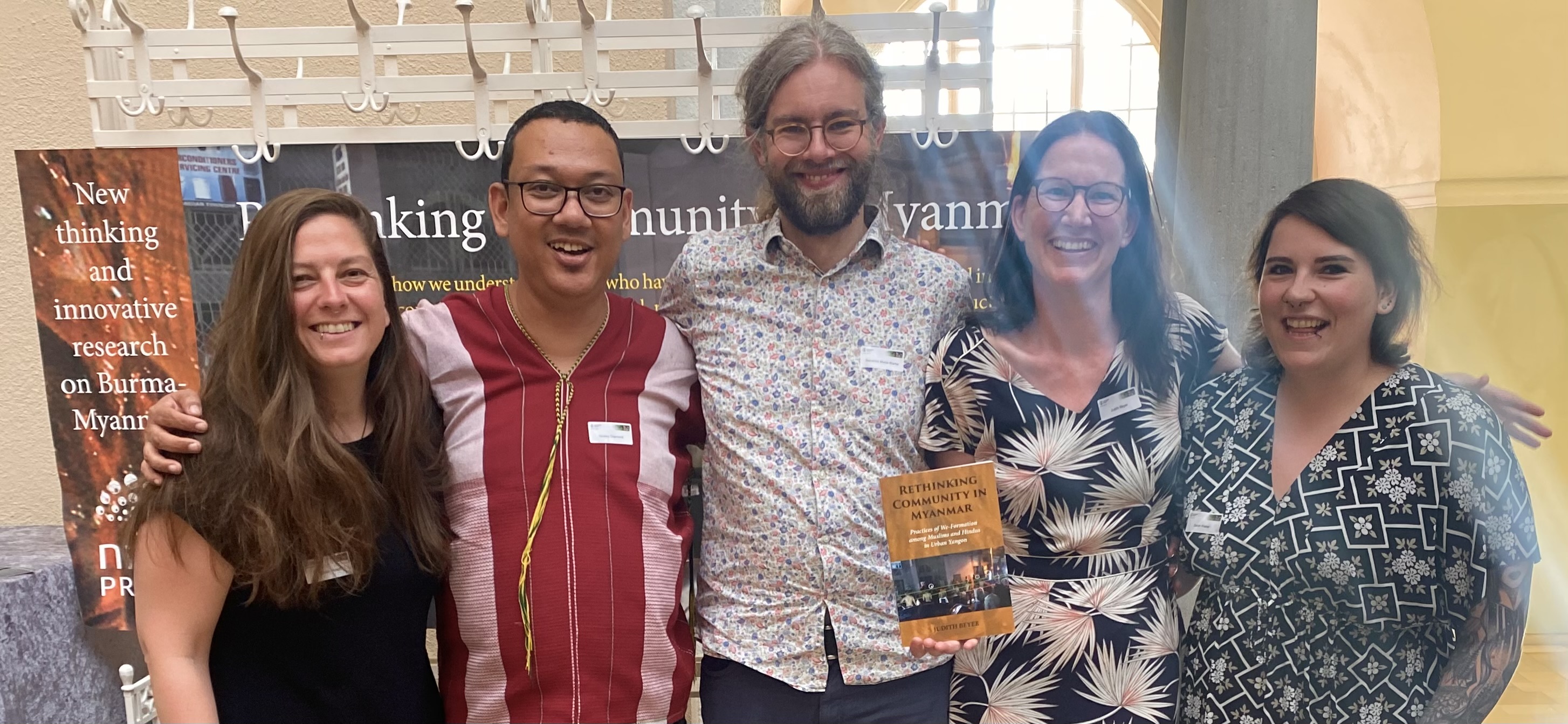
I set out by thanking my Muslim and Hindu interlocutors in Myanmar — there can neither be an anthropology nor an ethnography without the people ‘in’ (paraphrasing Tim Ingold). I owe them everything and I am glad that there will be an open access version of my book coming out towards the end of this year that will allow at least some of my interlocutors to download the book in Myanmar — I cannot bring it to them at the moment; not so much because it would be dangerous for me (it might be), but because I simply cannot take the risk of putting them into danger once I have left the country or their houses …
I then thanked my four research assistants — my KRA (Kachin Research Army) — and I explained to the audience of Burma/Myanmar experts that I profited enormously from them having conversations with my interlocutors about what it means to be a member of a minority in a majority Buddhist country. Listening in — as I am currently developing also in another context — is a methodologically fruitful approach to conduct fieldwork or carry out digital ethnography where fieldwork is not possible, because it decenters the anthropologist. What I am interested in mostly is “free-flowing talk” where my interlocutors do not try to guess what it is I want from them (in terms of what they might be expected to tell me), but where I can simply follow them having conversations with one another. Since all of my research assistants were Christian Kachin women, it was not religion they shared with my interlocutors (who were Muslims and Hindus), but the experience of being ‘slotted in’ as members of ‘communities’.
I also thanked my colleagues in Myanmar who had been professors of Anthropology at the University of Yangon prior to the attempted military coup in February 2021. Thanks to them, my PhD students received research visa, thanks to them, I had the opportunity of teaching and learning from young anthropology students, and thanks to them I learned a lot about the history of the discipline in Myanmar and about the history of the University of Yangon. I truly hope that one day they will be able to return to their professional jobs — which they cherished a lot, and to their students whom they loved.
None of these people could be with my family, my PhD students, and the other Myanmar scholars that day.
Thanking those who were there
I was happy to be surrounded by many friends, who had helped in different ways to bring this book to fruition: many of my colleagues had read draft chapters, some had written reviews or are going to write them. Alicia Turner gave some introductory words — she knows the book very well as she has written the most constructive and helpful review that made the final product so much better!
The managing editor of NIAS Press, Gerald Jackson, had come from Copenhagen to Zurich with his research assistant Julia Heinle and with a lot of amazing books on Southeast Asia and on Myanmar in tow. He took my book project on board and steered it smoothly through the production process in not even two years from the submission date!
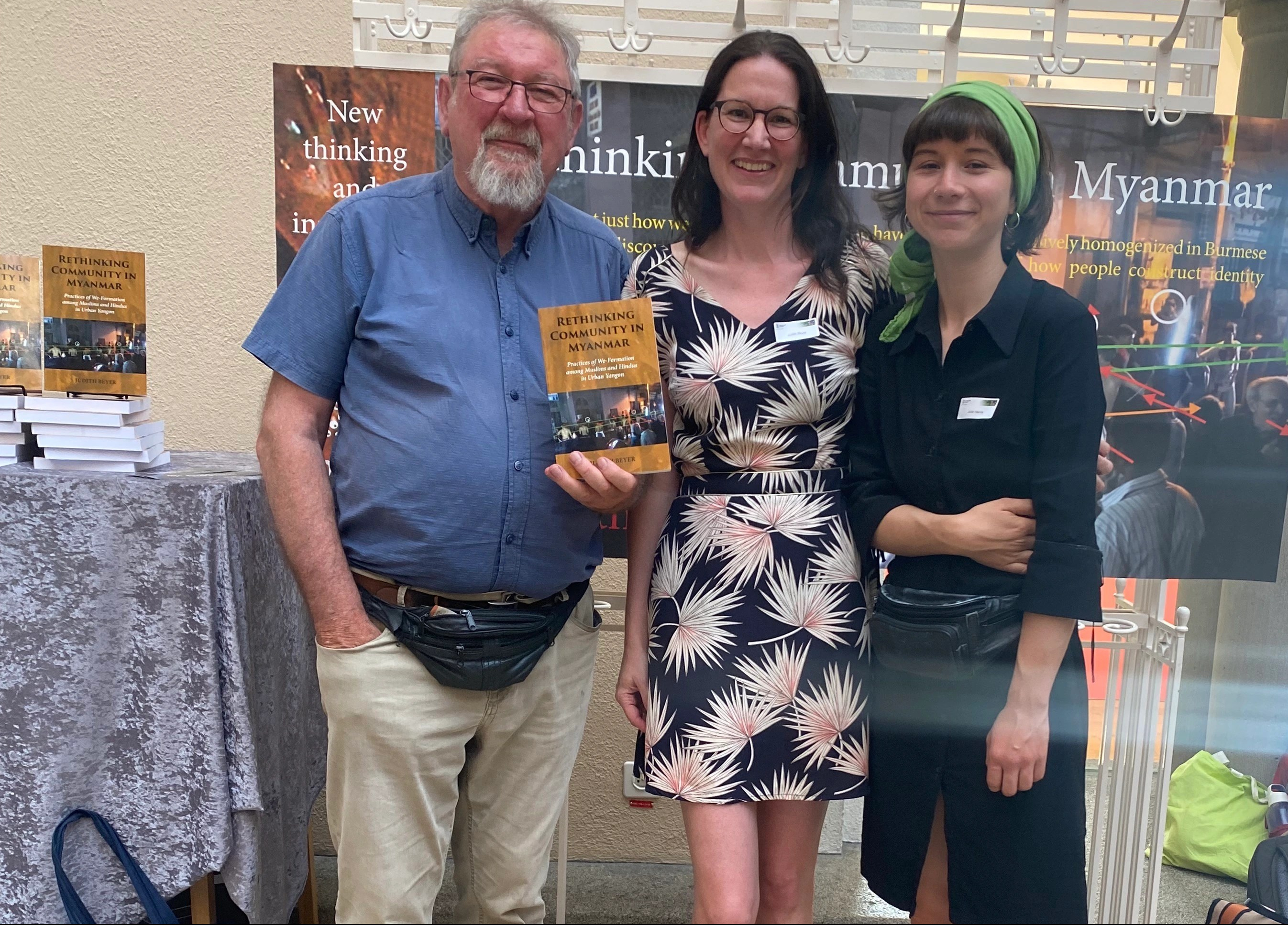
My PhD students who are working on Myanmar, were all present, too. We discussed my material just as much as we discussed theirs. They all completed long-term ethnographic fieldwork in or on Myanmar and I can’t wait to see their own books!
And — last but not least — my family — who accompanied me from 2012 onwards and carried out their own research projects in Yangon: on the politics of cultural heritage in one case and on what it means to go to a local school in Chinatown in Yangon in the other case.
Thank you to everyone who was there that evening — be it in spirit or in the flesh — I am very grateful for the support I have received in the last decade. I hope the book will be useful to many.

In this invited lecture, I will discuss my concept of “we-formation” in regard to three different topics: First, as anthropological theory and methodology; Second, as a way to make sense of the resistance against the attempted military coup and third in regard to the possibility of a public anthropology of cooperation in these trying times.
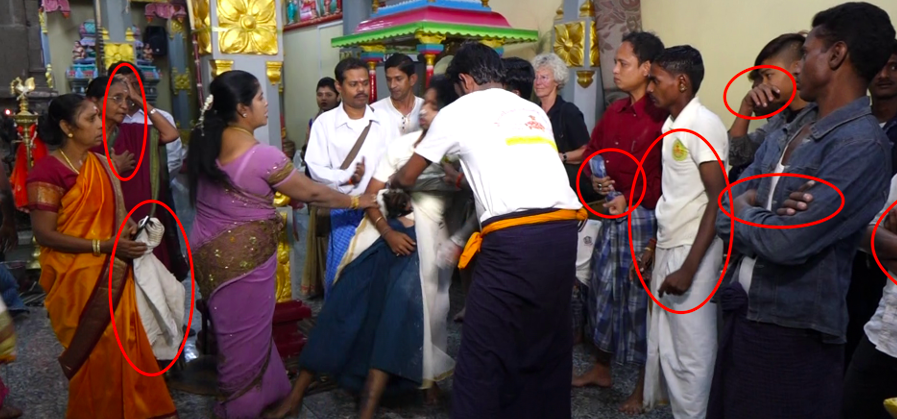
First, I will explore the concept in regard to its theoretical and methodological innovativeness, taking an example from my Yangon ethnography as illustration. We-formation, I argue in my book Rethinking community in Myanmar. Practices of we-formation among Muslims and Hindus in urban Yangon, “springs from an individual’s pre-reflexive self-consciousness whereby the self is not (yet) taken as an intentional object” (8). The concept encompasses individual and intersubjective routines that can easily be overlooked” (20), as welll as more spectacular forms of intercorporeal co-existence and tacit cooperation.
By focusing on individuals and their bodily practices and experiences, as well as on discourses that do not explicitly invoke community but still centre around a we, we-formation sensitizes us to how a sense of we can emerge (Beyer 2023: 20).

Second, I will put my theoretical and methodological analysis of we-formation to work and offer an interpretation of why exactly the attempted military coup of 1 February 2021 is likely to fail (given that the so-called ‘international community’ does not continue making the situation worse). In the conclusion of my book I argue that the “generals’ illegal power grab has not only ended two decades of quasi-democratic rule, it has also united the population in novel ways. As an unintended consequence, it has opened up possibilities of we-formation and enabled new debates about the meaning of community beyond ethno-religious identity” (250).
Third, I will discuss how (not) to cooperate with Myanmar today. Focusing on what is already happening within the country and amongst Burmese activists in exile, but also what researchers of Myanmar from the Global North can do within their own countries of origin to make sure the resistance does not lose momentum. In this third aspect, I take we-formation out of its intercorporeal and pre-reflexive context in which I came to develop the concept during my fieldwork in Yangon and employ it to stress a type of informed anthropological action that, however, does not rely on having a common enemy or on gathering in a new form of ‘community’ that has become reflexive of itself. Rather, it aims at encouraging everyone to think of one’s own indidivual strengths, capabilities and possibilities and put them to work to support those fighting for a free Myanmar.
You can purchase my book on the publisher’s website: NIAS Press.
Here’s the full programme of the Groupe Recherche Birmanie for the spring term 2023:

Für die Bundeszentrale für politische Bildung (BPB) habe ich einen kurzen Artikel zum buddhistischen Mönch Wirathu geschrieben, der in Myanmar und weit darüber hinaus durch seine Hassreden gegen die muslimische Minderheit des Landes in Verruf geriet.

In dem Artikel “Nationalismus oder Terrorismus? Das Beispiel des burmesischen Mönchs Wirathu” argumentiere ich, dass entgegen der öffentlichen Darstellung, Wirathu kein Terrorist, sondern Ethnonationalist ist, da er ethno-religiöse Identitätsmarker instrumentalisiert. Das Beispiel Wirathus zeigt, dass auch im Namen des Buddhismus Gewalttaten begangen werden und sich sogar buddhistische Mönche radikalisieren können wie es auch aus anderen Ländern bekannt ist. Die Ursachen dafür sind weniger in den Quellentexten der jeweiligen Religionen oder in den Biografien von Individuen zu finden, sondern in den historischen und aktuellen politischen Kontexten, in denen Religion und Ethnizitat als Argumente von Akteuren ins Feld geführt werden, um Gewalttaten gegen Minderheiten zu rechtfertigen.
Der Sammelband umfasst 488 Seiten und kann für nur 7.00EUR direkt bei der Bundeszentrale für politische Bildung bestellt werden.

Judith Beyer (2021). Nationalismus oder Terrorismus? Das Beispiel des burmesischen Mönchs Wirathu. In: Terrorismus im 21. Jahrhundert. Perspektiven, Kontroversen, blinde Flecken, herausgegeben von Jana Kärgel. S. 332-333. Bonn: Bundeszentrale für politische Bildung.
Myanmar’s immediate neighbours have reacted very reluctantly in regard to the military coup that began on February 1 2021. Whereas ASEAN member-states have largely declared the coup an “internal affair” into which they would rather not get involved, China said it had “noted” the events and urged the country to uphold “stability”.
Stability, however, is not a neutral or entirely positive concept I argue in this German-language article for the daily newspaper TAZ: it is possible to justify not only repression and coups in Myanmar with it, but even the recent genocide of the ethnic Rohingya.
Stability has been a key metaphor during previous military dictatorships as well: Until 2010, for example, the second out of four so-called “national causes” that the military government under General Than Swe promoted under the title “The People’s Desires” read “Oppose those trying to jeopardize the stability of the state and the progress of the nation.”
It had also been Aung San Suu Kyi herself who, in December 2019 in her role as a member of her country’s delegation at the International Court of Justice (ICJ) left the more legalistic arguments to the specialists for international law, and challenged the legitimacy of the case on the basis of harmony ideology.
In the name of stability,she argued that the principal judicial organ of the United Nations should refrain from interfering in Myanmar’s domestic affairs.
In my recent article, I thus hold that invoking ‘stability’ is more in line with what the military government is advocating than it it is supportive of the civil resistance that is currently beginning to form.
Read the full post in TAZ.

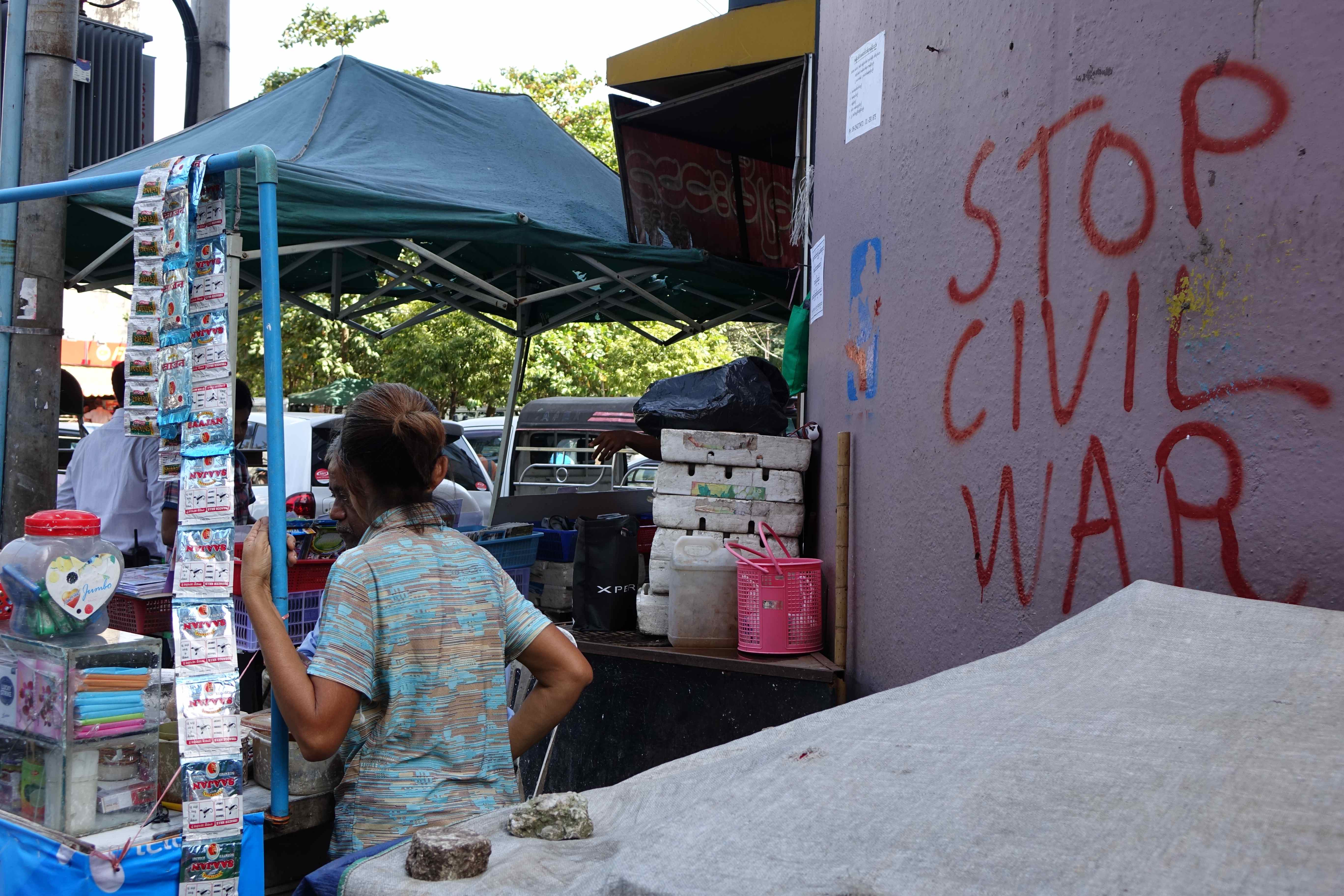
 First impressions from Yangon, Myanmar where I will be based until May 2016. The city has changed a lot in the last two years since I visited, mostly in terms of transportation and mobile phone use. What has remained the same are the great street food eateries, the use of loudspeakers to convey religious messages, lottery ticket sales and other important or not-so-important events. I missed the people a lot and its great to find almost everyone in good health and spirits. Nothing beats fieldwork, really! J.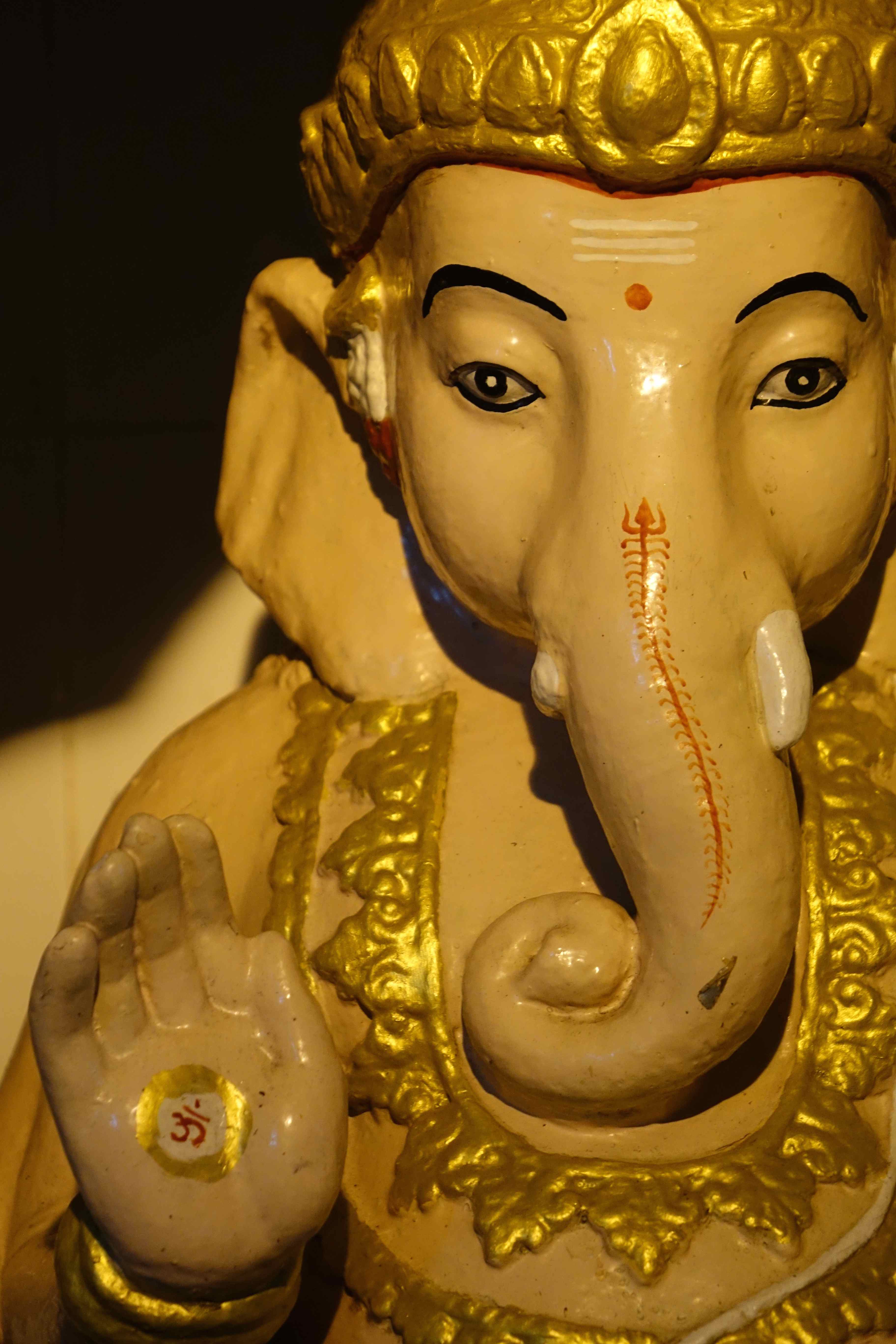




Radio Interview for Radio France International. ‘Buddhist Nationalism in Myanmar.’ May 27, 2015. available here (2 parts):

 judith beyer