Tag Archives: theory

Open Acess: “Asylum Interviews in the UK”. Published in Social Anthropology

My new article “Asylum Interviews in the UK. The problem of evidence and the possibility of applied anthropology” has just been published with Social Anthropology / Anthropologie Sociale (33/3: 51-65).

In this article, I interrogate the process how evidence is established in asylum procedure by engaging with anthropological and socio-legal literature on evidence and credibility assessments. Drawing on ethnomethodology, I analyse asylum interviews and show in what ways evidence can be understood as the result of an asymmetrical co-construction. As a result of this procedure, the individual applicant disappears and a ‘case’ is established.

Anthropologists who write country of origin reports based on such ‘case material’ for tribunals and courts can highlight the asymmetries in evidence-making and question the very categorisations through which the state operates. The article contributes to ongoing debates on the role of anthropologists and their knowledge as experts in court.

It is open access and can be downloaded here.

“We are all stuck” – On (not) failing our students

We are way into the winter term in all public universities in France. I am currently on a research sabbatical at the University Paris-Nanterre where I also teach a course on the Introduction to Legal Anthropology.

Half an hour before my lecture is about to start, one student already sits prepared with their laptop in the hallway. I open the door to the lecture room to allow them to sit more comfortably. But it is as freezing in the room as it is in the hallway. There is no heating in the building. I wonder how many of my students might come today given the heavy rainfall …

Ten minutes before my lecture, I check my emails. I see that several students have written to me already. Only one calls in sick, all others are stuck in the outbound RER A train from central Paris to Nanterre. There has been an incident, the students explained: “We are all stuck”. Another one shares a screenshot of the offical traffic announcement and an additional photograph: an official attestation that there has been a disruption. The document carries the title “Attestation de pertubation”

The date and time is neatly printed and I contemplate how fast and effective not being fast and effective can be. I suggest to the student later to use this textual artefact as an entry point to an essay my students are supposed to write at the end of the term on the everyday life of the law.

It is 10.30h and I decide to see who might have shown up despite the rain falling and the train being late. The room is half full already and within the next 20 minutes the rest trickle in. We are almost at full capacity and I am seriously impressed.

It is on the same day that I learn that in France there is no longer an obligation to attend classes in presence if your personal circumstances do not allow you to do so. Students may study long distance at all universities in France for health-related reasons or because they have to work. At the end of my course I will have to grade essays of students whom I will have never seen in person and who will not have attended a single lecture of mine on campus.

I wonder: what kind of anthropologists are we releasing into the world if the only encounter many students have with the discipline is via self-study ? No dialogue with teachers, no spending time with classmates, no campus experience. Not only that the state keeps on moving the universities beyond the bande péripherique into suburbia, by allowing students to study long-distance, it reduces the campus to mere sites of administration. In the name of “flexibility”, students work towards their grades, but are being deprived of what Bell Hooks has called “the most radical space of possibility in the academy”: the classroom.

Universities are easier to manage if fewer people are around. One might be tempted to reframe long-distance studies as “needs-centred”. Paris already suffered from high living costs before the Covid-19 lockdowns struck. After 2021, many never moved back to the city, but remained in their home towns far away. At times, the campus feels deserted – a striking difference to 2018 and 2019 when I last spent some time in Paris on fellowships.

The students who do attend my seminar, always listen attentively and eagerly write down what I am presenting on my slides. I have split the seminar into two parts: the first is a lecture, the second was intended as an interactive space for discussing the weekly reading and give them the possibility to ask questions – in French or English. However, only very few attend the second part of the seminar. I now understand that this is the case because very few have read the text. I was warned by other lecturers that this is indeed the case: “Students do not read texts.” When I inquired why, the answer was always because they are overworked – from having to take too many courses and from having to work in order to finance their studies …

But anthropology is not a subject that can be taught only. It needs to be ingested until it has become part of oneself. Students need to anthropologize themselves throughout their studies in order to be able to later claim “I am an anthropologist” and mean themselves instead of a mere profession. Anthropology needs to become an integral part of one’s own humaneness, ideally, before one can collaborate with others and analyse what one has learned from them in an ethical manner. But the discipline is increasingly expected to be taught in ways that ensure it remains outside of our students’ individual experience.

Our most important task is therefore to get students back into the classroom while at the same time opening that very classroom up to the world. Rather than transmitting a particular kind of ‘knowledge’, we should be transmitting that anthropology provides a multitude of ways of seeing and conceptualizing humanity as such. While taking our students and their current experiences seriously, our task is also to de-self-center their existing worldview and help them get unstuck. We do not need more ‘attestations des pertubations‘, we need ‘pertubations des attestions‘!”

Research Colloquium at Université Paris-Nanterre

This winter term, I will be spending some time with my anthropology colleagues at Paris-Nanterre as part of the Laboratoire d’Ethnologie et de Sociologie comparative (LESC), part of the Centre National de la Recherche Scientifique (CNRS).

One part of my research stay is devoted to working on my current project: “Towards an anthropology of statelessness”. I will be speaking at the Department’s Colloquium in December (see plan below). I will also be teaching a course in legal anthropology … more about this one later.

The colloquium is free and open to the public, everyone is welcome.

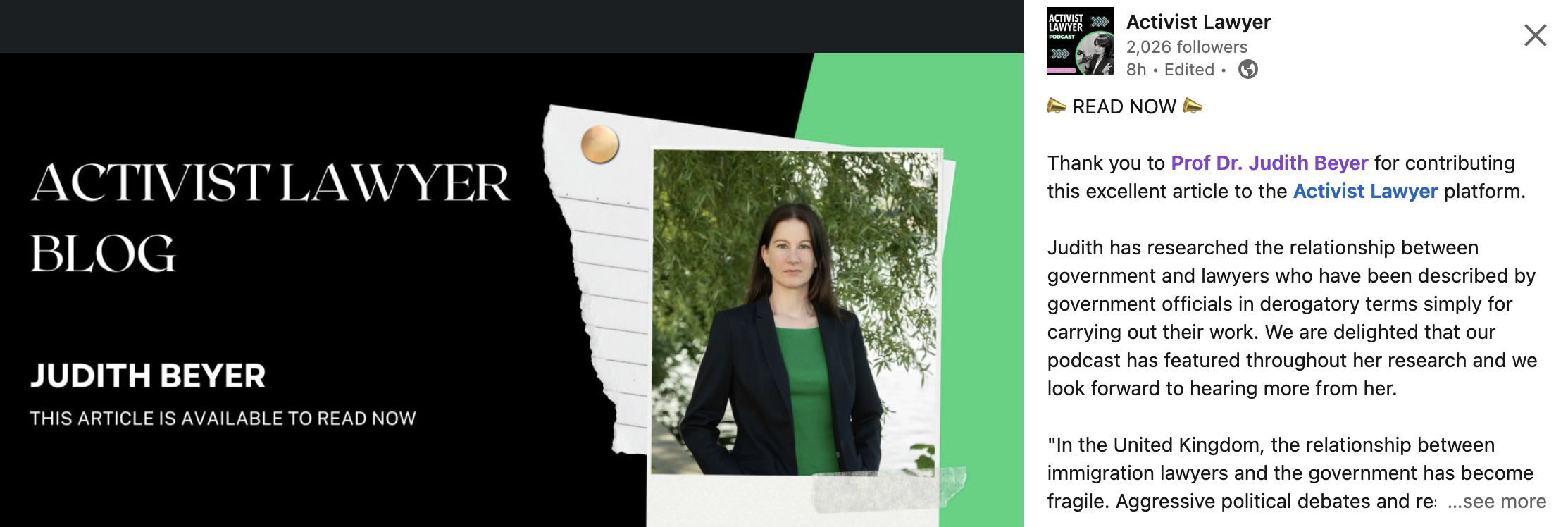
New post for the “Activist Lawyer”-platform

In contemporary Britain, it is no longer only migrants who are being targeted by the government, but those who fend for them just as well.

In “‘Illegal’ migration and the Othering of activist lawyers in the UK“, I argue that human rights solicitors, who pride themselves in fending for their marginalized clients, have become targets of state officials who began to call them “activist lawyers” in 2020.
The current populist atmosphere in British politics regarding the topic of “illegal migration” not only others those who seek asylum, but also their immigration lawyers and NGO workers who are committed to supporting their clients in their asylum claims. Those lawyers who began to publicly reclaim the term “activist lawyers”, a term initially hurled at them as a slur, effectively managed to strip the state’s vocabulary of its negative attributes. What makes the term “activist lawyers” and the way it is being handled by im/migration and human rights lawyers particularly interesting is that it is no longer exclusionary words about others that lawyers are dealing with here, but words about themselves.

Through this reversal, lawyers brought the former slur in line with their profession’s ethical stance as well as their own personal biographies. The podcast and platform “Activist Lawyer”, hosted by the human rights solicitor Sarah Henry, has been covering this development since 2020 and features many interesting audio formats as well as texts. Make sure you visit “Activist Lawyer – and read my full text here.

New publications on legal pluralism and community

Two new publications came out this month — one on my last research with ethno-religious minorities in urban Yangon in Myanmar, the other based on long-term fieldwork in Central Asia, in rural Kyrgyzstan.

In “Legal Pluralism in Central Asia“, published for an edited volume on the Central Asian World by Routledge, I put forward the argument of a rhetorical emergence of legal pluralism, combining literature from legal and linguistic anthropology.
I argue that
“we should understand legal pluralism not as the precondition that allows for cases to be dealt with and adjudicated in a plural legal manner; rather, it should be considered a possible outcome whose rhetorical emergence empirically varies from case to case. Depending on the situation, legal pluralism does not define the set-up of a case from the beginning, but rather becomes created intersubjectively in situ by the disputing parties involved in the case” (410).
I conclude with a caution:
“As anthropologists, we should refrain from advocating legal pluralism in such contexts [where claims about ‘custom’ are competitive rather than descriptive] as a more “culture- friendly” or encompassing way to deal with questions of order, sanctioning or indeed harmony, since “Plurality may actually reinforce structures of inequality as the plurality of forums available decreases the binding power of any law” (418, von Benda- Beckmann et al., 2009, p. 12).

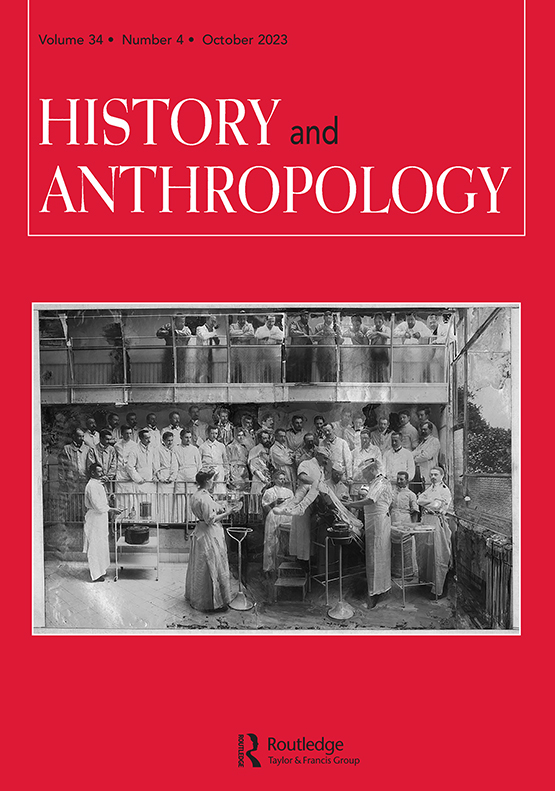
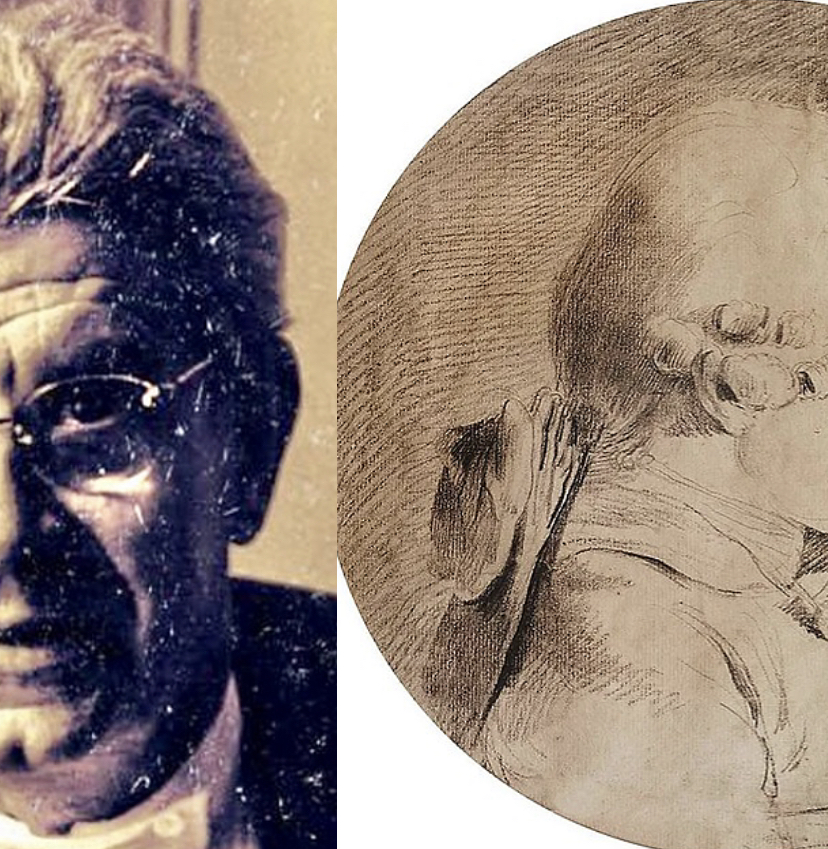
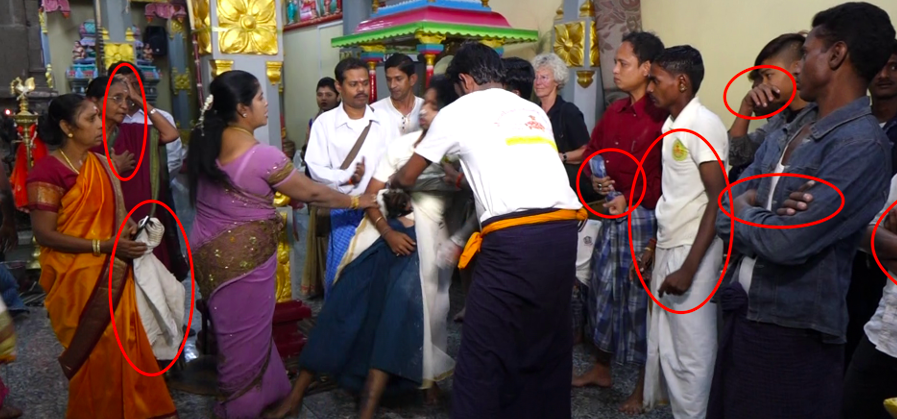
In “Community as a category of empire“, published for History and Anthropology, I argue that ‘community’ is a category that is inextricably bound up with the historical development of the British empire. It was in this context that modern social theory took root, including, eventually, publications on community in anthropology and sociology that profoundly influenced nineteenth- and twentieth-century thought and that continue to shape everyday understandings of the category within and beyond academia. I first elaborate what type of work the category ‘community’ was intended to do in the British empire. I then introduce two key figures who were responsible for designing, distributing and implementing two contrasting imperial theories of community. Subsequently, I sketch the migratory history of the category following the ancestors of today’s so-called ‘Burmese Indians’ across the Bay of Bengal from India to Burma. The final part of the article presents the repercussions ‘community’ has in contemporary Myanmar, drawing on recent legislation around ‘race and religion’ as well as my own ethnographic data from religious processions of ethno-religious minorities who find themselves in a subaltern position vis-à-vis the Buddhist majority population and an ethnonationalist state.

Film über meine Forschung: Staatenlosigkeit

Die Universität Konstanz hat einen kurzen Film zu meinem aktuellen Forschungsprojekt zum Thema “Staatenlosigkeit” gedreht.

Der Film kann auf dem youtube-Kanal der Universität Konstanz angeschaut werden.

New publication: Perversion and the state

This is a peer-reviewed journal article that developed out of two years of Cartel work within the Lacan Circle of Australia (Melbourne). I presented the topic in 2021 and worked on this publication in which I combine psychoanalytical theory with an anthropological outlook on contemporary politics.

In this article I explore the psychoanalytical underpinnings of the recent purchase of the original manuscript of Marquis de Sade’s 120 Days of Sodom by the French state from the perspective of Jacques Lacan’s concept of perversion. I argue that in declaring de Sade’s book national heritage, the French state has tried to empty the text of its transgressive characteristics and reduced it to a fetish object. By placing the textual artefact inside the National Library of France, where it remains inaccessible, it has installed this object at the centre of the State in an effort to prop itself up while at the same time trying to veil a void. While this case is spectacular, we can abstract from it a distinguishing characteristic of the 21st century: the installation of fetish objects in an increasingly deserted symbolic order as well as the reappearance of the Name-of-the-Father in the imaginary order where the State acts as if it was the progenitor. This article aims to demonstrate the usefulness of Lacan’s teaching on perversion for a critical psychoanalysis that is “in the world”.

Jacques Lacan wrote “On Kant with Sade” in 1963; six years after the French state dropped a ban on Marquis de Sade’s book “120 Days of Sodom” (1904). Since 2021, the book is part of France’s “national heritage”.

The article is accessible through open access on the website of the European Journal of Psychoanalysis.

I am currently beginning new work in a Cartel on “Brave Waste World” that is devoted to studying Lacan’s teachings in regard to the concepts of waste, the exiled and the world. The topic of my Cartel contribution is “Waste of the world. On statelessness.”

We-formation. Reflections on methodology, the military coup attempt and how to engage with Myanmar today. Lecture in Paris, 16 May 2023

In this invited lecture, I will discuss my concept of “we-formation” in regard to three different topics: First, as anthropological theory and methodology; Second, as a way to make sense of the resistance against the attempted military coup and third in regard to the possibility of a public anthropology of cooperation in these trying times.

First, I will explore the concept in regard to its theoretical and methodological innovativeness, taking an example from my Yangon ethnography as illustration. We-formation, I argue in my book Rethinking community in Myanmar. Practices of we-formation among Muslims and Hindus in urban Yangon, “springs from an individual’s pre-reflexive self-consciousness whereby the self is not (yet) taken as an intentional object” (8). The concept encompasses individual and intersubjective routines that can easily be overlooked” (20), as welll as more spectacular forms of intercorporeal co-existence and tacit cooperation.

By focusing on individuals and their bodily practices and experiences, as well as on discourses that do not explicitly invoke community but still centre around a we, we-formation sensitizes us to how a sense of we can emerge (Beyer 2023: 20).

Second, I will put my theoretical and methodological analysis of we-formation to work and offer an interpretation of why exactly the attempted military coup of 1 February 2021 is likely to fail (given that the so-called ‘international community’ does not continue making the situation worse). In the conclusion of my book I argue that the “generals’ illegal power grab has not only ended two decades of quasi-democratic rule, it has also united the population in novel ways. As an unintended consequence, it has opened up possibilities of we-formation and enabled new debates about the meaning of community beyond ethno-religious identity” (250).

Third, I will discuss how (not) to cooperate with Myanmar today. Focusing on what is already happening within the country and amongst Burmese activists in exile, but also what researchers of Myanmar from the Global North can do within their own countries of origin to make sure the resistance does not lose momentum. In this third aspect, I take we-formation out of its intercorporeal and pre-reflexive context in which I came to develop the concept during my fieldwork in Yangon and employ it to stress a type of informed anthropological action that, however, does not rely on having a common enemy or on gathering in a new form of ‘community’ that has become reflexive of itself. Rather, it aims at encouraging everyone to think of one’s own indidivual strengths, capabilities and possibilities and put them to work to support those fighting for a free Myanmar.

You can purchase my book on the publisher’s website: NIAS Press.

Here’s the full programme of the Groupe Recherche Birmanie for the spring term 2023:

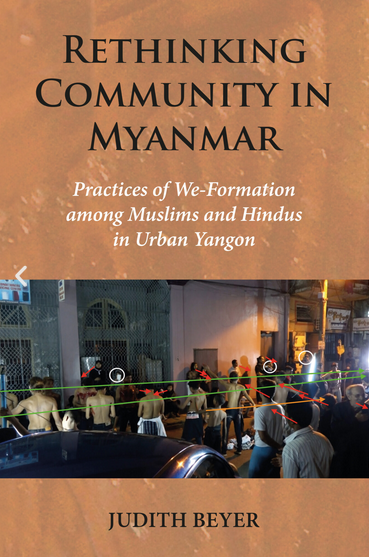
“Rethinking community in Myanmar. Practices of We-Formation among Muslims and Hindus in Urban Yangon” (NIAS Press 2023) has arrived!

‘Community’, I argue in my new anthropological monograph, was actively turned into a category for administrative purposes during the time of British imperial rule. It has been put to work to divide people into ethno-religious selves and others ever since.

Rather than bestowing on community some sort of positivist reality or deconstructing the category until nothing is left, my aim in this book is to shift the angle of approach: I acknowledge that community (for reasons that can usually be traced historically) feels real to and is meaningful for individuals. Their experiences and their struggles to engage with community are no less real. Through their own classificatory practices, my interlocutors — Muslims and Hindus in urban Yangon — demonstrate that they reason and reflect on symbols and meanings in their own culture as much as anthropologists do. But my approach goes beyond a social constructivist concern over how terms such as community are used, and also beyond a representational approach in which actors are subjected to culture as a system of meaning.

When I talk about the work of community (drawing on Nancy 2015), I reflect on the ways in which individuals accommodate ‘community’ in their acts of reasoning, meaning-making and symbolization. The way my interlocutors in Yangon see and talk about themselves has a historical context that begins in nineteenth-century England, encompasses British colonial India and later Burma itself, and extends into presentday
Myanmar. I then widen the emic perspective of my interlocutors and offer a novel way of describing how a we that does not neatly map onto or overlap with a homogeneous social group is generated in various situations.

What I call we-formation encompasses individual and intersubjective routines that can easily be overlooked, as well as more spectacular forms such as the intercorporeal aspects of the ritual march I described earlier. Attending to such sometimes minute moments of co-existence or tacit cooperation is difficult, but doing so can help us understand how community continues to have such an impact on the everyday lives of our interlocutors, not to mention on our own analytical ways of thinking about sociality.

By focusing on individuals and their bodily practices and experiences, as well as on discourses that do not explicitly invoke community but still centre around a we, we-formation sensitizes us to how a sense of we can emerge .

You can purchase the book on the publisher’s website: NIAS Press.

New blog post: Statelessness, expert activists and the ‘practitioner-scholar dilemma’ for the Critical Statelessness Studies (CSS) Blog Series

I published a new blog post for the Critical Statelessness Studies (CSS) Blog Series of the University of Melbourne.

I describe and analyse a central characteristic of many ‘expert activists’ working in the field of statelessness: they struggle with what I call a ‘practitioner-scholar dilemma’. Despite the fact that they often do cross disciplinary boundaries and fields of practice in combining scholarly and activist work, they position themselves on one side of an imagined divide. Drawing on Gramsci, I argue that the ‘practitioner-scholar dilemma’ originates in the way the state system structures the very possibilities of engagement with the issue of statelessness. I credit one newly emerging group of expert activists with the possibility to overcome this dilemma…

The article is accessible online on the CSS Blog serie’s website.