Category Archives: teaching

#Contra AI 🤖 – Arguments against AI

Since I am human, I have an intrinsic motivation to understand. Since I am an anthropologist, I have an intrinsic motivation to understand other humans. Since many humans seem more and more motivated to hand their intrinsic motivation to a machine, I am now intrinsically motivated to not only understand how AI operates and what its effects are, but who the humans behind the technology are and to what they might put AI to use.

Since I am also a university professor, I am faced with the topic of AI almost every day. I have noted three common ways of how academia relates to the issue so far:

a) AI is the future and everything will be great

b) we are doomed and we can’t win against AI

c) who cares about AI ?

So I have started to gather texts on AI, particularly those written by scholars or by journalists engaging with academic literature. The result (so far): AI is stupid and as such maybe not so different from humans after all. But: it feeds off our knowledge and it learns from our mistakes. It also gets better in duping us, luring us in and making us believe that there is indeed ‘someone’ on the other side. There is not.

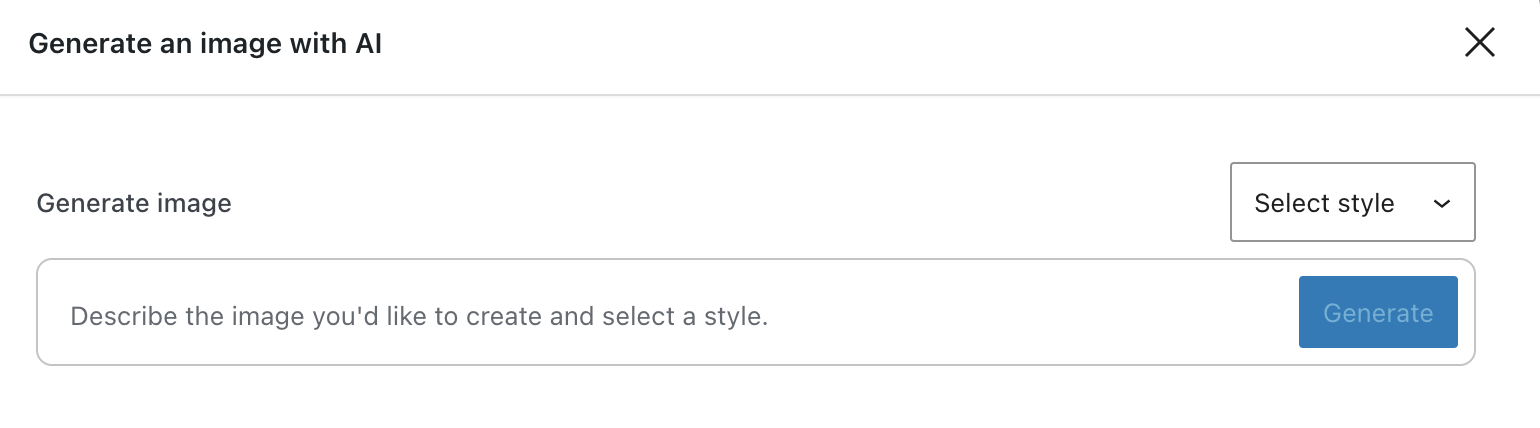
Instead of a picture: a screenshot of how wordpress suggests to generate an image with AI. No, thank you.

Here is my list of collected texts (tbc.) which I enjoyed reading and which I recommend to everyone, whether you are a) b) or c).

Order on fair use

Shutdown resistance in reasoning models

Expressing stigma and inappropriate responses prevents LLMs from safely replacing mental health providers.

Your Brain on ChatGPT: Accumulation of Cognitive Debt when Using an AI Assistant for Essay Writing Task

What Happens After A.I. Destroys College Writing?

Why we fear AI: On the Interpretation of Nightmares

Writing is thinking

Surface Fairness, Deep Bias: A Comparative Study of Bias in Language Models

Geoffrey Hinton’s speech at the Nobel Prize banquet, 10 December 2024

Echte Emotionen. Generative KI und rechte Weltbilder

Assuring an accurate research record

Lawyer caught using AI-generated false citations in court case penalised in Australian first

Why Even Try if You Have A.I.?

Statelessness Studies In An Age Of Artificial Intelligence: Challenges, Opportunities & Setting A Future Agenda

Help Sheet: Resisting AI Mania in Schools

Against the Uncritical Adoption of ‘AI’ Technologies in Academia

Putting ChatGPT on the Couch

Large Language Muddle

When Knowledge Is Free, What Are Professors For?

Largest study of its kind shows AI assistants misrepresent news content 45% of the time – regardless of language or territory

What Machines Don’t Know

Kritik der Digitalisierung. Technik, Rationalität und Kunst

Nature: Major AI conference flooded with peer reviews written fully by AI

to be continued …

“We are all stuck” – On (not) failing our students

We are way into the winter term in all public universities in France. I am currently on a research sabbatical at the University Paris-Nanterre where I also teach a course on the Introduction to Legal Anthropology.

Half an hour before my lecture is about to start, one student already sits prepared with their laptop in the hallway. I open the door to the lecture room to allow them to sit more comfortably. But it is as freezing in the room as it is in the hallway. There is no heating in the building. I wonder how many of my students might come today given the heavy rainfall …

Ten minutes before my lecture, I check my emails. I see that several students have written to me already. Only one calls in sick, all others are stuck in the outbound RER A train from central Paris to Nanterre. There has been an incident, the students explained: “We are all stuck”. Another one shares a screenshot of the offical traffic announcement and an additional photograph: an official attestation that there has been a disruption. The document carries the title “Attestation de pertubation”

The date and time is neatly printed and I contemplate how fast and effective not being fast and effective can be. I suggest to the student later to use this textual artefact as an entry point to an essay my students are supposed to write at the end of the term on the everyday life of the law.

It is 10.30h and I decide to see who might have shown up despite the rain falling and the train being late. The room is half full already and within the next 20 minutes the rest trickle in. We are almost at full capacity and I am seriously impressed.

It is on the same day that I learn that in France there is no longer an obligation to attend classes in presence if your personal circumstances do not allow you to do so. Students may study long distance at all universities in France for health-related reasons or because they have to work. At the end of my course I will have to grade essays of students whom I will have never seen in person and who will not have attended a single lecture of mine on campus.

I wonder: what kind of anthropologists are we releasing into the world if the only encounter many students have with the discipline is via self-study ? No dialogue with teachers, no spending time with classmates, no campus experience. Not only that the state keeps on moving the universities beyond the bande péripherique into suburbia, by allowing students to study long-distance, it reduces the campus to mere sites of administration. In the name of “flexibility”, students work towards their grades, but are being deprived of what Bell Hooks has called “the most radical space of possibility in the academy”: the classroom.

Universities are easier to manage if fewer people are around. One might be tempted to reframe long-distance studies as “needs-centred”. Paris already suffered from high living costs before the Covid-19 lockdowns struck. After 2021, many never moved back to the city, but remained in their home towns far away. At times, the campus feels deserted – a striking difference to 2018 and 2019 when I last spent some time in Paris on fellowships.

The students who do attend my seminar, always listen attentively and eagerly write down what I am presenting on my slides. I have split the seminar into two parts: the first is a lecture, the second was intended as an interactive space for discussing the weekly reading and give them the possibility to ask questions – in French or English. However, only very few attend the second part of the seminar. I now understand that this is the case because very few have read the text. I was warned by other lecturers that this is indeed the case: “Students do not read texts.” When I inquired why, the answer was always because they are overworked – from having to take too many courses and from having to work in order to finance their studies …

But anthropology is not a subject that can be taught only. It needs to be ingested until it has become part of oneself. Students need to anthropologize themselves throughout their studies in order to be able to later claim “I am an anthropologist” and mean themselves instead of a mere profession. Anthropology needs to become an integral part of one’s own humaneness, ideally, before one can collaborate with others and analyse what one has learned from them in an ethical manner. But the discipline is increasingly expected to be taught in ways that ensure it remains outside of our students’ individual experience.

Our most important task is therefore to get students back into the classroom while at the same time opening that very classroom up to the world. Rather than transmitting a particular kind of ‘knowledge’, we should be transmitting that anthropology provides a multitude of ways of seeing and conceptualizing humanity as such. While taking our students and their current experiences seriously, our task is also to de-self-center their existing worldview and help them get unstuck. We do not need more ‘attestations des pertubations‘, we need ‘pertubations des attestions‘!”

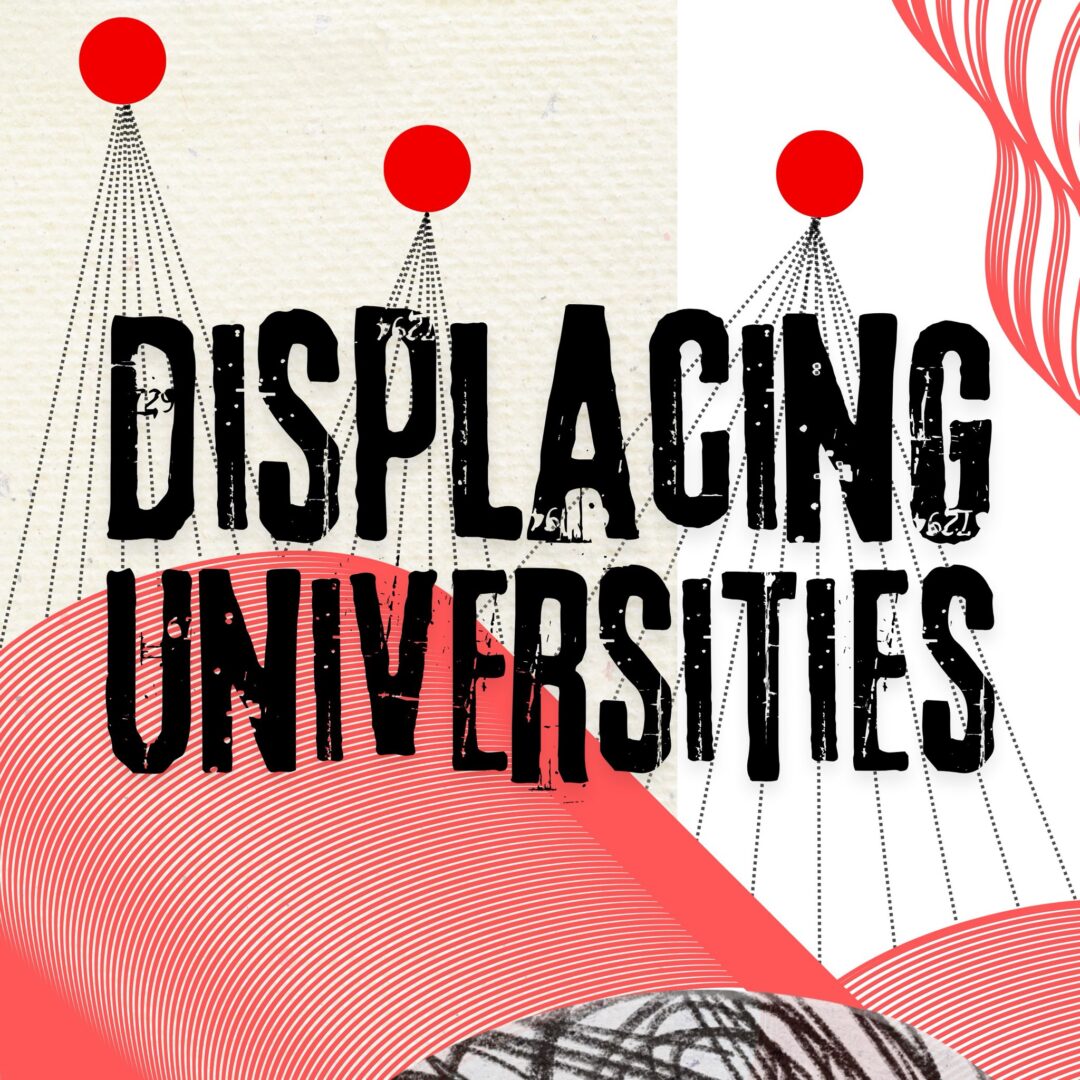
Research Colloquium at Université Paris-Nanterre

This winter term, I will be spending some time with my anthropology colleagues at Paris-Nanterre as part of the Laboratoire d’Ethnologie et de Sociologie comparative (LESC), part of the Centre National de la Recherche Scientifique (CNRS).

One part of my research stay is devoted to working on my current project: “Towards an anthropology of statelessness”. I will be speaking at the Department’s Colloquium in December (see plan below). I will also be teaching a course in legal anthropology … more about this one later.

The colloquium is free and open to the public, everyone is welcome.

We-formation. Reflections on methodology, the military coup attempt and how to engage with Myanmar today. Lecture in Paris, 16 May 2023

In this invited lecture, I will discuss my concept of “we-formation” in regard to three different topics: First, as anthropological theory and methodology; Second, as a way to make sense of the resistance against the attempted military coup and third in regard to the possibility of a public anthropology of cooperation in these trying times.

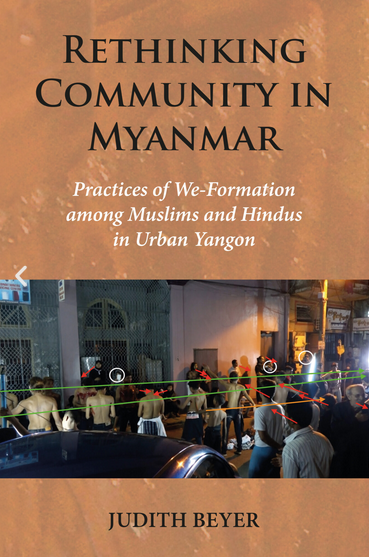
First, I will explore the concept in regard to its theoretical and methodological innovativeness, taking an example from my Yangon ethnography as illustration. We-formation, I argue in my book Rethinking community in Myanmar. Practices of we-formation among Muslims and Hindus in urban Yangon, “springs from an individual’s pre-reflexive self-consciousness whereby the self is not (yet) taken as an intentional object” (8). The concept encompasses individual and intersubjective routines that can easily be overlooked” (20), as welll as more spectacular forms of intercorporeal co-existence and tacit cooperation.

By focusing on individuals and their bodily practices and experiences, as well as on discourses that do not explicitly invoke community but still centre around a we, we-formation sensitizes us to how a sense of we can emerge (Beyer 2023: 20).

Second, I will put my theoretical and methodological analysis of we-formation to work and offer an interpretation of why exactly the attempted military coup of 1 February 2021 is likely to fail (given that the so-called ‘international community’ does not continue making the situation worse). In the conclusion of my book I argue that the “generals’ illegal power grab has not only ended two decades of quasi-democratic rule, it has also united the population in novel ways. As an unintended consequence, it has opened up possibilities of we-formation and enabled new debates about the meaning of community beyond ethno-religious identity” (250).

Third, I will discuss how (not) to cooperate with Myanmar today. Focusing on what is already happening within the country and amongst Burmese activists in exile, but also what researchers of Myanmar from the Global North can do within their own countries of origin to make sure the resistance does not lose momentum. In this third aspect, I take we-formation out of its intercorporeal and pre-reflexive context in which I came to develop the concept during my fieldwork in Yangon and employ it to stress a type of informed anthropological action that, however, does not rely on having a common enemy or on gathering in a new form of ‘community’ that has become reflexive of itself. Rather, it aims at encouraging everyone to think of one’s own indidivual strengths, capabilities and possibilities and put them to work to support those fighting for a free Myanmar.

You can purchase my book on the publisher’s website: NIAS Press.

Here’s the full programme of the Groupe Recherche Birmanie for the spring term 2023:

Stellenausschreibung akad. MitarbeiterIn/ Research Position

Zum 01. April 2022 ist eine Stelle als Akademische:r Mitarbeiter:in (w/m/d) für 3,5 Jahre bei mir in der Arbeitsgruppe „Ethnologie mit Schwerpunkt politische Anthropologie“ an der Universität Konstanz ausgeschrieben.

I am offering a research position at my Working Group “Social and Political Anthropology,” at the University of Konstanz for a period of three and a half years, starting April 01, 2022.

Alle Informationen / more information.

Ich freue mich auf Eure / Ihre Bewerbungen / I am looking forward to your applications!

Teaching Hannah Arendt in 2021

Hannah Arendt is one of the best-known political theorists of the 20th century. Her books and her theoretical arguments emerged in dialogue with ancient philosophers (Socrates, Plato, Aristotle) ​​and modern German thinkers (Kant, Hegel), as well as with her own university teachers (Heidegger, Husserl, Jaspers). Arendt never saw herself as a philosopher, but as a theoretician of the political. The topics she dealt with are today more topical than ever before and her books are being read across disciplines.

Hannah Arendt wrote on totalitarianism, statelessness, human community, and freedom and responsibility. In her work she processed her own experience as a Jew in Germany, as a stateless person in World War II, as a migrant in the USA, as a woman in male-dominated academia and as an attentive observer of an increasingly globalized post-war world.

This semester I am teaching some of her main theoretical themes to a group of BA students at the University of Kontsanz. We will not only embed Arendt’s texts in their historical context, but also to think through and with her arguments using current examples — ranging from the covid pandemic to state terror in Myanmar. Hannah Arendt was interested in the basic conditions of human existence: whenever these are questioned or radically transformed, her work offers a fruitful starting point.

“Why read Hannah Arendt now?” (2018) asks the author Richard Bernstein in his recent book. Answer: because she is “the thinker of the hour” (according to the German translation of the book).

Here is the Syllabus to my course (in German).

Webinar on legal pluralism in honour of Sally Engle Merry

Sally Merry was an active participant in the work of the project group “Legal Pluralism” at the Max Planck Institute for Social Anthropology over many years of which I was a part from 2004 until 2010. In this conversation, Keebet von Benda-Beckmann, my former PhD supervisor, who co-headed the project group at the MPI from 2000 until 2012, and I talked about Sally’s role at the MPI, the importance of her work for legal pluralism in particular, and for legal anthropology in general.

We reviewed some of Sally’s theoretical ideas about the concept of legal pluralism: What was so provocative about it that Sally referred to its history as ‘an intellectual odyssey’? How did she explore it in her own ethnographic work? We also discussed the possibility to think through her more recent themes of research on indicators and quantification in regard to the concept of legal pluralism. To expand the conversation, we invited the audience to contemplate the potential of revisiting the numerous debates Sally has initiated with the concept of legal pluralism in mind.

Here is the full schedule of the webinar series that began on December 11 2020 and runs until May 21 2021.

“Sprechstunde” – neues Interview

Die Interviewreihe “Sprechstunde” der Universität Konstanz stellt ProfessorInnen aller Fachbereiche persönlich vor – als WissenschaftlerIn und als Lehrperson. Hier gebe ich Auskunft über meine Professur, meine Forschungen in Zentral- und Südostasien, mein neues Forschungsprojekt zu Staatenlosigkeit in Europa, sowie über unseren interdisziplinären Masterstudiengang “Ethnologie und Soziologie”, der einzigartig in Deutschland ist.

#corona On being prudent

In a recent post for Allegra Lab, I ask what we can do from our homes, to which we are confined these weeks, being overwhelmed, seeing the problematic and political nature of  all these facts and narratives that are presented to us in the Covid-19-crisis.

I have elaborated on three tasks:

First, we can join public debates and be a voice of prudence. This is to help de-escalate discussions where people – sometimes out of sensationalism, sometimes out of hurried obedience and often out of fear – demand that their states take extreme measures of surveillance, deprivation of liberty and sanction. The term “state of exception” has been used to such an extent that we have gotten used to it already – exactly what Giorgio Agamben warned us about.

Second, we can engage with our students and address their sense of insecurity by adapting our upcoming or ongoing courses, seminars and lectures in a way that allows the topic to influence whatever subject we had intended to work on. Since few things are as pervasive as a global pandemic, there is hardly any subject (in anthropology and beyond) which we could not reconceptualize by taking account of COVID-19. As we will have to teach digitally, it is also important to discuss the pitfalls that come with online learning, while making use of newly available resources.

Third, we can practice writing our fieldwork diaries in our homes: Note down how the virus has already impacted our own personal everyday lives, how it has led to a restructuring of our daily schedules, how it has decreased and altered the amount of time we spend with colleagues and friends and how it might have increased the number of hours we spend with members of our household. For those of us who have children, we can observe how they, too, struggle to adapt to a physical world that has suddenly shrunk and to a digital world that has suddenly expanded. We can look outside our windows and correlate how changes in governmental policies become observable in the very way people physically move in the streets. And we can honestly record our own feelings from day to day. We can then come back to these notes at a later stage – just as we do when we come home from the field.

This too, to me, is public anthropology. One directly engages with the media, the second takes up current topics and reworks these with our students for whom we are responsible, and the third collects data diligently in order to be able to draw from this source later on when we have the capacity and the psychological distance required to take a long hard look at what is happening in front of our eyes right now.

Read the full post here. My intro is part of an ongoing series which we have labelled #corona thread.