Category Archives: expertise

Mahnwache für Myanmar. Samstag, 27.3.2021 um 14.00h Konstanzer Münster

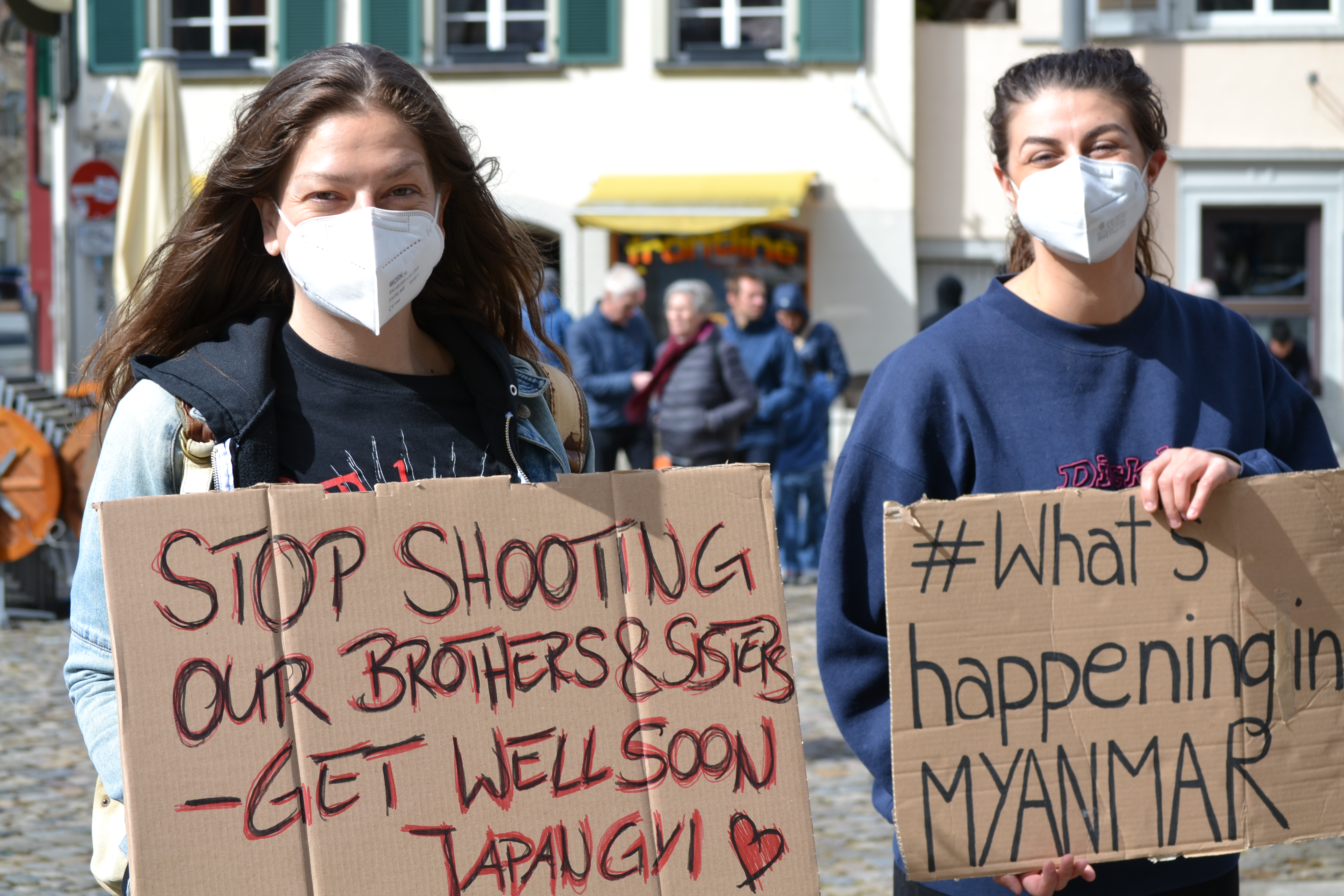
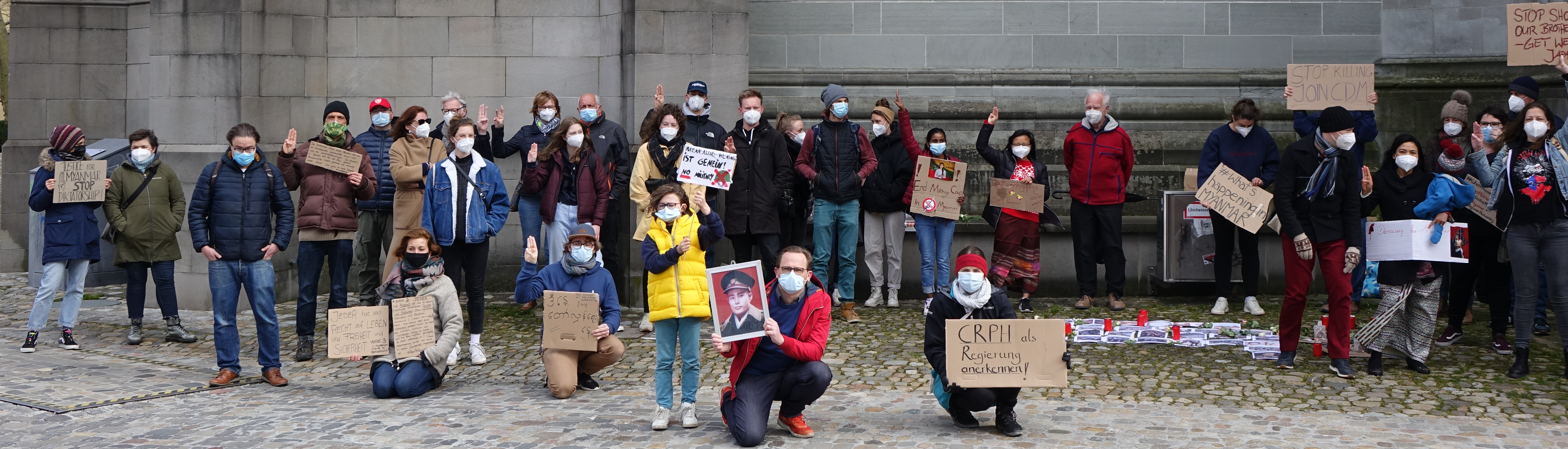
Am Samstag den 27.03.2021 um 14:00 Uhr haben wir im Zuge von bundesweit geplanten Mahnwachen auch in Konstanz unsere Solidarität mit den Menschen in Myanmar ausgedrückt. Wir sind eine diverse Gruppe von Menschen, die beruflich oder privat eine enge Verbindung zu Myanmar haben und den unrechtmäßigen Coup des burmesischen Militärs ablehnen.

Am 1. Februar putschte sich das burmesische Militär, nach fünf Jahren ziviler Regierung, zurück an die Macht. Trotz über 2000 willkürlichen Verhaftungen und mindestens 247 Todesopfern (FAZ 21.03.2021) ist der Widerstand der Bevölkerung nicht zu brechen; es kommt weiterhin täglich zu Massenprotesten. Inzwischen wurde Kriegsrecht in einigen Regionen ausgerufen, was die Situation weiter zuspitzt. Der Ausgang ist offen und der Mut und die Hoffnung der burmesischen Bevölkerung bewundernswert. Mit den bundesweit stattfindenden Mahnwachen soll sowohl den Opfern der Militärjunta gedacht als auch Solidarität mit den Protestierenden und ihren Forderungen nach Demokratie bekundet werden.

Ansprechpartnerin ist Sarah Riebel, MA, Doktorandin in meiner Arbeitsgruppe an der Universität Konstanz. Sie kann bei Fragen kontaktiert werden unter sarah_riebel[at]web.de

Ankündigung im Konstanzer Seemoz am 27.03.2021.

Erwähnt auch in der TAZ unter “Internationale Solidarität

Mahnwache Myanmar in Konstanz. 27 März 2021. Copyright: Judith Beyer

Radio Interview for rbb/inforadio

This morning I was interviewed for the German radio station rbb/inforadio on the ongoing state of exception in Myanmar. In the feature “Vom Militär verhängter Ausnahmezustand in Myanmar” I was asked to talk about how the crisis affects me personally as a scholar, but I tried to emphasize what I find most striking in the way the population deals with the emergency: I continue to be deeply impressed by their determination to remain on the streets and to fight the military regime despite the increase in violence. I have clearly stated that all military operations are most likely mounting to crimes against humanity and go against international humanitarian law.

The reporter asked about the possibility for mediation and I stated very clearly that the population of Myanmar would consider this a betrayal to their cause as none of them is willing to enter into negotiations with the military regime. Instead, it is of utmost importance for Germany, for the EU and the UN to not legitimize the military-imposed “State Administration Council” (SAC). Instead, I emphasized that Germany should grant political asylum to individuals who are in danger of persecution, that communication should be established with the Committee Representing the Pyidaungsu Hluttaw (CRPH), that the Civil Disobedience Movement (CDM) should be supported as well as local journalists who are currently risking their lives in reporting the atrocities.

You can read a short summary and listen to the interview on “Vom Militär verhängter Ausnahmezustand in Myanmar“on the radio’s website.

Myanmar — das Ende der Demokratie? Interview für ARD alpha-Demokratie

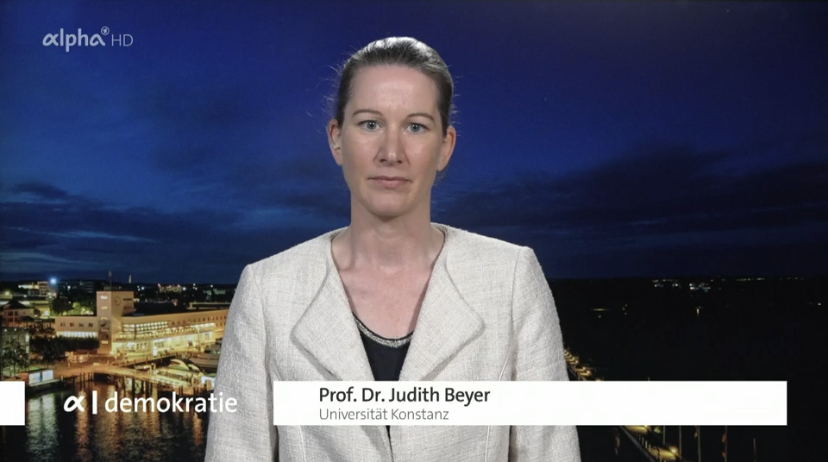
Am 02. März 2021 war Myanmar das Thema der Sendung ARD alpha-Demokratie. Ich war als Expertin zugeschaltet und habe Fragen zur aktuellen zivilen Widerstandsbewegung (CDM) beantwortet, aber auch zu ökonomischen, sozialen und (geo-)politischen Hintergründen, sowie zur Rolle der Staatsrätin Aung San Suu Kyi.

Die Sendung “Myanmar — das Ende der Demokratie?” ist online.

On atrocities committed by the Myanmar military on Feb 28. For Al Jazeera English.

I spoke to Al Jazeera again after what turned out to be the deadliest day in Myanmar since the coup d’êtat on Feb 1st, 2021. They wanted to know how activists in Myanmar coordinate with others in the region and I explained what the “Milk Tea Alliance” is.

I was also very clear about the need for action beyond statements of “grave concern” from the international community and that people in the streets in Myanmar expect more from the outside world.

For more updates on the situation in Myanmar, please follow my twitter threads.

Article for OpenDemocracy: On intergenerational solidarity and intergenerational trauma in Myanmar

In this post I highlight a special dynamic linking the different generations within the ongoing protest movement in Myanmar: The current protests combine the experiences the older generation has had under decades of military rule with the digital know-how of the younger generation that grew up during a decade of partial democratic freedom.

copyright: Kuecool.

For many years, resistance to the military regime centred around the iconic figure of General Aung San and his daughter, Aung San Suu Kyi, who is currently under arrest. This is now changing. The form of resistance is no longer just a “family affair”, I argue. The organization of protests is decentralized, without clear leaders. It involves all generations and brings together very different groups. The rallying cry now resounding on Myanmar’s streets is ‘You messed with the wrong generation.’

Interview with Al Jazeera on statelessness, human rights, Myanmar, Kyrgyzstan

Why are human rights defenders being targeted?” asked Al Jazeera Rajat Khosala from Amnesty International, a specialist for advocacy and policy, Tobi Cadman an International Human Rights Lawyer and myself. Al Jazeera’s “Inside Story” draws a bleak picture of the human rights situation worldwide with repression in authoritarian states increasing. Human rights defenders are particularly being targeted. I reported about the current situation of human rights activism in Kyrgyzstan and Myanmar where we have just witnessed a military coup. I also spoke about the situation of the 10-15 million de-facto stateless people worldwide who cannot even claim human rights as they lack a nationality.

“Why are human rights defenders being targeted?” Al Jazeera, February 5, 2021.

I explained the difference between de jure and de facto statelessness and emphasized that the roles of the state system and that of the United Nations need to be rethought when it comes to statelessness in particular and how we can all ensure the adherence to human rights in general. We also touched upon the importance of staying connected digitally as activism is increasingly being carried out online.

In the name of stability. On the coup in Myanmar

Myanmar’s immediate neighbours have reacted very reluctantly in regard to the military coup that began on February 1 2021. Whereas ASEAN member-states have largely declared the coup an “internal affair” into which they would rather not get involved, China said it had “noted” the events and urged the country to uphold “stability”.

Stability, however, is not a neutral or entirely positive concept I argue in this German-language article for the daily newspaper TAZ: it is possible to justify not only repression and coups in Myanmar with it, but even the recent genocide of the ethnic Rohingya.

Stability has been a key metaphor during previous military dictatorships as well: Until 2010, for example, the second out of four so-called “national causes” that the military government under General Than Swe promoted under the title “The People’s Desires” read “Oppose those trying to jeopardize the stability of the state and the progress of the nation.”

It had also been Aung San Suu Kyi herself who, in December 2019 in her role as a member of her country’s delegation at the International Court of Justice (ICJ) left the more legalistic arguments to the specialists for international law, and challenged the legitimacy of the case on the basis of harmony ideology.

In the name of stability,she argued that the principal judicial organ of the United Nations should refrain from interfering in Myanmar’s domestic affairs.

In my recent article, I thus hold that invoking ‘stability’ is more in line with what the military government is advocating than it it is supportive of the civil resistance that is currently beginning to form.

Read the full post in TAZ.

“Sprechstunde” – neues Interview

Die Interviewreihe “Sprechstunde” der Universität Konstanz stellt ProfessorInnen aller Fachbereiche persönlich vor – als WissenschaftlerIn und als Lehrperson. Hier gebe ich Auskunft über meine Professur, meine Forschungen in Zentral- und Südostasien, mein neues Forschungsprojekt zu Staatenlosigkeit in Europa, sowie über unseren interdisziplinären Masterstudiengang “Ethnologie und Soziologie”, der einzigartig in Deutschland ist.

Aung San Suu Kyi goes to court

On December 8 2019, Open Democracy’s Transformation-series published an op-ed written by Felix Girke and me on the upcoming court hearing between The Republic of The Gambia and Myanmar in The Hague at the International Court of Justice (ICJ) from December 10-12 2019.

Flickr/Jason. CC BY-NC 2.0.

No other than Aung San Suu Kyi, the “State Counsellor” of Myanmar will be travelling to the Netherlands to personally respond to an international case that has been put forward by The Gambia on behalf of the Organization of Islamic Cooperation (OIC). The case concerns atrocities committed against Rohingya Muslims since 2016 by the Myanmar army.

Felix Girke and I argue  — contrary to much current reporting in Western news — that it is not surprising but in line with how Aung San Suu Kyi has been doing politics ever since she returned from the UK in 1988, that she personally wants to attend and respond to this case.

What counts as political in Myanmar is deeply personal: “the focus of her personal engagement is not the world, but her own country. She shoulders the burden … but at the same time avoids the hard task of changing Myanmar’s trajectory” we argue.

Read the full article over at Open Democracy.

Research Granted: How to become an activist in Myanmar and South Africa

The German Research Foundation (DFG) has granted 4 PhD positions at the University of Konstanz for a joint comparative research project on “Activist becomings in South Africa and Myanmar.“ I will supervise 2 PhD projects on Myanmar while my colleague, Thomas Kirsch, will supervise two projects on South Africa. We hope that the outcomes will provide new knowledge concerning practices of democratic participation in the midst of urban and postcolonial crisis.

The project is definitely a precious contribute to the infrastructural turn and could serve as a model of research in very different parts of the world and in different social and political circumstances (anonymous reviewer)

With a focus on material and non-material infrastructure, our project seeks to provide new theoretical and methodological tools to study political formations, thereby contributing to an anthropology of activism, infrastructural studies, political anthropology, anthropology of democracy and African and Asian studies. The research project explicitly seeks to disseminate knowledge and build bridges between scholarly research and activism – something I am really excited about!