Category Archives: activism

New Article Out: Exiled Activists from Myanmar

Our collaborative article “Exiled Activists from Myanmar: Predicaments and Possibilities of Human Rights Activism from Abroad“, published in the Journal of Human Rights Practice (Oxford University Press), is finally out! 🎉

I am very proud of the work that my colleague Samia Akhter-Khan, my two Ph.D. students Sarah Riebel and Nickey Diamond, another author from Myanmar (who has to use a pseudonym for reasons of safety), as well as myself have managed to achieve under very difficult circumstances.

This article was born out of necessity to engage with the topic of exile. None of us had ever wanted to study yet alone experience this existential state of being. The empirical material we draw on in this article stems from autoethnographic accounts (Nickey Diamond and Demo Lulin), semi-structured interviews and conversations with around forty exiled activists currently residing in Thailand, the US, the UK, Austria, and Switzerland (Samia Akhter-Khan and myself) as well as extensive ethnographic work with exiled activists in Thailand (Sarah Riebel).

In this article, we put forward the concept of the ‘exiled activist’ to highlight the predicaments and the possibilities that practicing human rights activism from abroad bring with it. From our analysis, we have developed three so-called ‘practitioner points’ that might guide INGOs, NGOs, states and other bodies to properly relate to exiled activists from Myanmar. These are:

1. Develop trauma-informed support systems for exiled activists by integrating psychosocial care and peer-based mental health resources into human rights programming and diaspora organizing.

2. Adapt partnership models to accommodate the shifting positionality of exiled activists, recognizing their need for secure digital platforms, flexible funding, and shared decision-making across borders.

3. Acknowledge and navigate political divisions within diverse groups of exiled activists – such as differing views on the National League for Democracy, the military, or the Rohingya – by avoiding assumptions of unity and instead fostering inclusive collaboration that respects diverse activist trajectories and lived experiences.

We have made our article openaccess so that everyone is able to download it. Currently, we are working on a shorter version in Burmese/Myanma, to also allow those who do not speak English to read about this important topic.

Thank you to all exiled activists who have participated in this study, trusted us and shared their stories – and to the German Academic Exchange Service (DAAD) for the support of scholars at risk over the last years!
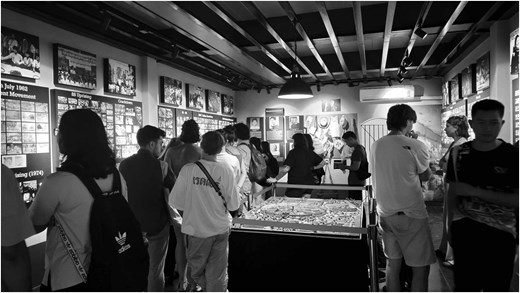
Assistance Association for Political Prisoners Burma Museum, Mae Sot, Thailand. Photograph: Sarah Riebel.

Intro to Anthro for Myanmar Students (and others)

On the occasion of what would have been Aung San’s 111th birthday, I release a video lecture which I have given in late 2021 to anthropology students from Myanmar after the Myanmar military attempted a coup on 1 February 2021.

Some of my own students and tens of thousands more had to go into hiding once the military began occupying their universities and took over their cities. With their professors resigning from their positions out of protest, their education came to a sudden, abrupt halt. Having to leave their dormitories and sitting in their parents’ homes again, or having to flee Yangon, Mandalay and other bigger cities in which they had until then studied, they still longed to continue their studies.

This lecture was an effort to support them in this endeavour, albeit without being able to substitute for what they had lost. Moreover, it became evident over the course of the online sessions, that many could not concentrate due to the ongoing violence and the many new tasks they had to adhere to in order to secure their own living or contribute to the livelihood of their families. It is hard to study while having to cope with trauma.

In the lecture, I discuss the concept of ‘guerilla anthropology’ as a way to educate each other while in hiding or from abroad; education as a subversive act of resistance and as refusal to give in. In the main part of the lecture, I cover both the history of anthropology and the role of history in anthropology.

By 2026, several so-called “virtual universities” have taken over from what had been a first effort of mine and fellow anthropologists back then. They have now build a systematic online education path for thousands of Myanmar students. Moreover, some of my own former students from the Unviersity of Yangon have become educators themselves and now teach schoolchildren in the Myanmar-Thai border region. Others have left the country to pursue their own education – all hope to be able to return to Myanmar one day…

May their dream come true!

Help Myanmar!

The people of Myanmar are the most resilient people I have ever met.
But now, after this devastating earthquake, and with ongoing relentless attacks from the military since the attempted coup of 1 February 2021, they are exhausted and really need our support.

This is easier said than done. When a military dictator, notorious for shooting civilians in broad daylight, for bombing innocent children in their schools out of airplanes, for planting mines across the entire country which will cause suffering for decades to come, suddenly begs the “international community” for any humanitarian aid possible, we need to be very careful.

While international aid and financial support is of utmost importance at this moment, it can not go to the “state” of Myanmar, a structural position currently occupied by the military. As there is no legitimate government inside the country, there will be no way to ensure that the money reaches those who need it.

Instead, we can be sure that humanitarian aid will be diverted by the generals. So, how can you support those suffering?

Here are three initiatives, the first two are known for having done great work since at least the attempted coup, the third one is a personal recommendation:

1. Better Burma (https://lnkd.in/erq79zv6)

2. Advance Myanmar (https://lnkd.in/eQiC_8ut)

3. My PhD student from Mandalay, Nickey Diamond (Ye Myint Win), is collecting funds (https://lnkd.in/eNgZdGjD)

Please repost this and – if you can afford it – please help the people of Myanmar – they deserve it!

Thank you. ကျေးဇူးပါ။

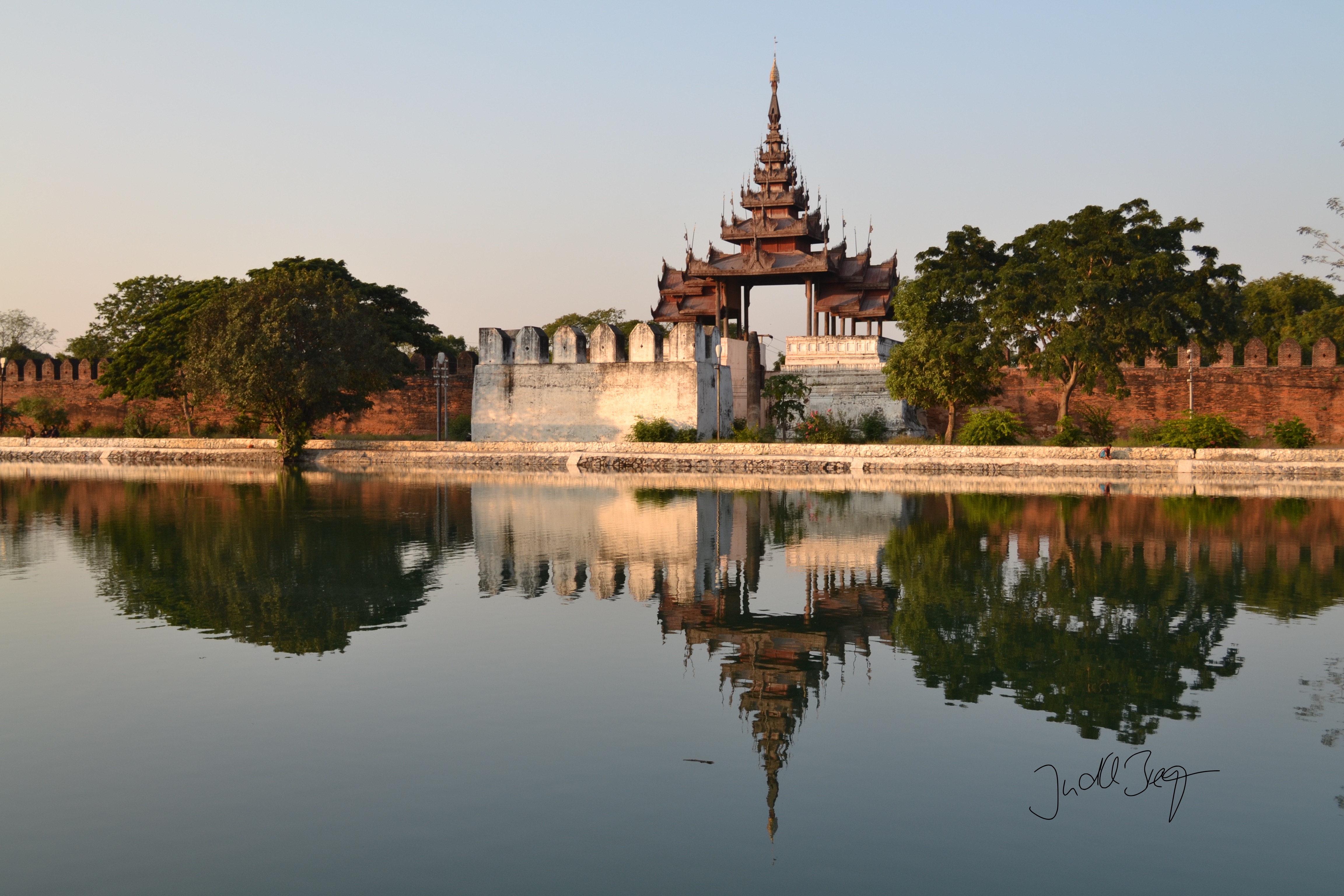
(photo: Judith Beyer. December 2013, Mandalay Palace)


We-formation. Reflections on methodology, the military coup attempt and how to engage with Myanmar today. Lecture in Paris, 16 May 2023

In this invited lecture, I will discuss my concept of “we-formation” in regard to three different topics: First, as anthropological theory and methodology; Second, as a way to make sense of the resistance against the attempted military coup and third in regard to the possibility of a public anthropology of cooperation in these trying times.

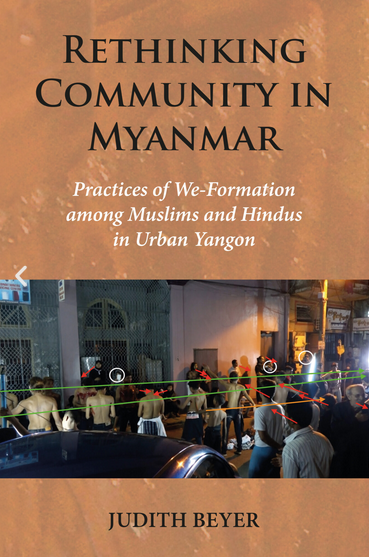
First, I will explore the concept in regard to its theoretical and methodological innovativeness, taking an example from my Yangon ethnography as illustration. We-formation, I argue in my book Rethinking community in Myanmar. Practices of we-formation among Muslims and Hindus in urban Yangon, “springs from an individual’s pre-reflexive self-consciousness whereby the self is not (yet) taken as an intentional object” (8). The concept encompasses individual and intersubjective routines that can easily be overlooked” (20), as welll as more spectacular forms of intercorporeal co-existence and tacit cooperation.

By focusing on individuals and their bodily practices and experiences, as well as on discourses that do not explicitly invoke community but still centre around a we, we-formation sensitizes us to how a sense of we can emerge (Beyer 2023: 20).

Second, I will put my theoretical and methodological analysis of we-formation to work and offer an interpretation of why exactly the attempted military coup of 1 February 2021 is likely to fail (given that the so-called ‘international community’ does not continue making the situation worse). In the conclusion of my book I argue that the “generals’ illegal power grab has not only ended two decades of quasi-democratic rule, it has also united the population in novel ways. As an unintended consequence, it has opened up possibilities of we-formation and enabled new debates about the meaning of community beyond ethno-religious identity” (250).

Third, I will discuss how (not) to cooperate with Myanmar today. Focusing on what is already happening within the country and amongst Burmese activists in exile, but also what researchers of Myanmar from the Global North can do within their own countries of origin to make sure the resistance does not lose momentum. In this third aspect, I take we-formation out of its intercorporeal and pre-reflexive context in which I came to develop the concept during my fieldwork in Yangon and employ it to stress a type of informed anthropological action that, however, does not rely on having a common enemy or on gathering in a new form of ‘community’ that has become reflexive of itself. Rather, it aims at encouraging everyone to think of one’s own indidivual strengths, capabilities and possibilities and put them to work to support those fighting for a free Myanmar.

You can purchase my book on the publisher’s website: NIAS Press.

Here’s the full programme of the Groupe Recherche Birmanie for the spring term 2023:

New blog post: Statelessness, expert activists and the ‘practitioner-scholar dilemma’ for the Critical Statelessness Studies (CSS) Blog Series

I published a new blog post for the Critical Statelessness Studies (CSS) Blog Series of the University of Melbourne.

I describe and analyse a central characteristic of many ‘expert activists’ working in the field of statelessness: they struggle with what I call a ‘practitioner-scholar dilemma’. Despite the fact that they often do cross disciplinary boundaries and fields of practice in combining scholarly and activist work, they position themselves on one side of an imagined divide. Drawing on Gramsci, I argue that the ‘practitioner-scholar dilemma’ originates in the way the state system structures the very possibilities of engagement with the issue of statelessness. I credit one newly emerging group of expert activists with the possibility to overcome this dilemma…

The article is accessible online on the CSS Blog serie’s website.

New publication: The common sense of expert activists

I published a new research article in Dialectical Anthropology as part of a (still forthcoming) special issue on Antonio Gramsci’s concept of “common sense”, co-edited by Jelena Tošić and Andreas Streinzer. The special issue will also feature an afterword by anthropologist Prof. Kate Crehan, an established Gramsci scholar and an important guiding voice during the virtual workshop that Jelena and Andreas organized and afterwards when we circulated our draft papers.

In the article, I follow a group of professionals in their efforts to address the problem of statelessness in Europe. My interlocutors divide the members of their group into “practitioners,” on the one hand, and “scholars” on the other. Relating this emic dichotomization to Antonio Gramsci’s dialectical take on common sense, I argue against a theoretical reductionism that regards expertise and activism as two essentially different and mostly separate endeavors, and put forward the concept of the “expert activist.” Unpacking what I call the “practitioner–scholar dilemma,” I show that in their effort to end statelessness, “practitioners” take a reformist route that aims at realizing citizenship for the stateless, while “scholars” are open to a more revolutionary path that contemplates the denaturalization and even the eradication of the state. By drawing on Gramsci, I suggest that the impasse the group encounters in their work might relate more to the structural constraints imposed by the state within or against which they operate than to the problem of statelessness they are trying to solve.

My article contributes to a body of emergent work in anthropology that explores the intersection of scholarly expertise and activism. It is also the first article that I am writing on the topic of statelessness, drawing on my new fieldwork data that includes written observations, photographs, the recording and subsequent transcription of free-flowing conversations, oral presentations and speeches, journal entries, and textual documents, all obtained from participating in workshops, conferences, and policy briefings in various European settings such as universities in the UK, museums, and event spaces in The Hague and at the European Youth Centre and the Council of Europe in Strasbourg.

My ethnographic research is ongoing and involves in-person and online attendance at thematic webinars on the topic of statelessness, in annual stakeholder meetings, and the launching of new reports and other publications.

I am particularly interested in receiving feedback from the people I have been working with as I continue researching the topic of expert activism and statelessness in Europe.

The article is currently accessible through open access on the journal’s website.

Staatsterror in Myanmar. Neuer Artikel für “Blätter”

Zusammen mit Felix Girke habe ich einen neuen Artikel zum Thema “Staatsterror in Myanmar” für Blätter für deutsche und internationale Politik verfasst.

Darin diskutieren wir wer die zivile Widerstandsbewegung Civil Disobedience Movement (CDM) trägt, was deren Ziele sind und warum sie auch angesichts des zunehmenen Terrors seitens des Militärs nicht aufgibt.

Wir setzen die aktuelle soziale Bewegung in Bezug zu früheren Protest- und Widerstandsbewegungen und gehen bis in die Kolonialzeit des Landes zurück. Neben der zentralen Bedeutung von Aung San für die Unabhängigkeitsbewegung der 1920ger und 1930ger Jahre machen wir deutlich, dass in allen Jahrzehnten die Bewegungen vor allem von Studierenden getragen wurden.

Der Verfassung von 2008 widmen wir besondere Aufmerksamkeit, denn nur über sie konnte das Militär auch in den vergangenen Jahren in einer zunehmend demokratischen und offenen Gesellschaft weiterhin die Macht auf sich zentrieren und letztendlich durch ein Uminterpretieren einer Ausnahmeklausel, wieder an sich reissen.

Wir sehen die gesetzten Ziele der CDM als Herkulesaufgabe an, die vor allem von den Menschen im Land zu stemmen sein wird, da die internationalen Organe wie die Vereinten Nationen zunehmend lethargisch reagieren, vor allem mit China und Russland als Vetomächten. Angesichts des zunehmenden Terrors, der sich nicht nur gegen Demonstrierende, sondern auch Unbeteiligte wie Frauen und Kinder richtet, werden die Rufe der Bevölkerung nach Intervention aus dem Ausland immer lauter.

Radiointerview für Saarländischer Rundfunk. SR2 Kulturradio

Rund acht Wochen nach dem Militärputsch findet der zivile Widerstand auf den Straßen von Myanmar vor allem in der Nacht statt – und auch in den sozialen Medien. Ich habe mit SR-Politikredakteurin und Moderatorin Katrin Aue über die Lage vor Ort gesprochen. Das Interview findet sich unter dem Titel “Die Menschen wollen nicht in einer Militärdiktatur leben“.

Radio Interview for rbb/inforadio

This morning I was interviewed for the German radio station rbb/inforadio on the ongoing state of exception in Myanmar. In the feature “Vom Militär verhängter Ausnahmezustand in Myanmar” I was asked to talk about how the crisis affects me personally as a scholar, but I tried to emphasize what I find most striking in the way the population deals with the emergency: I continue to be deeply impressed by their determination to remain on the streets and to fight the military regime despite the increase in violence. I have clearly stated that all military operations are most likely mounting to crimes against humanity and go against international humanitarian law.

The reporter asked about the possibility for mediation and I stated very clearly that the population of Myanmar would consider this a betrayal to their cause as none of them is willing to enter into negotiations with the military regime. Instead, it is of utmost importance for Germany, for the EU and the UN to not legitimize the military-imposed “State Administration Council” (SAC). Instead, I emphasized that Germany should grant political asylum to individuals who are in danger of persecution, that communication should be established with the Committee Representing the Pyidaungsu Hluttaw (CRPH), that the Civil Disobedience Movement (CDM) should be supported as well as local journalists who are currently risking their lives in reporting the atrocities.

You can read a short summary and listen to the interview on “Vom Militär verhängter Ausnahmezustand in Myanmar“on the radio’s website.