Tag Archives: UK

Open Acess: “Asylum Interviews in the UK”. Published in Social Anthropology

My new article “Asylum Interviews in the UK. The problem of evidence and the possibility of applied anthropology” has just been published with Social Anthropology / Anthropologie Sociale (33/3: 51-65).

In this article, I interrogate the process how evidence is established in asylum procedure by engaging with anthropological and socio-legal literature on evidence and credibility assessments. Drawing on ethnomethodology, I analyse asylum interviews and show in what ways evidence can be understood as the result of an asymmetrical co-construction. As a result of this procedure, the individual applicant disappears and a ‘case’ is established.

Anthropologists who write country of origin reports based on such ‘case material’ for tribunals and courts can highlight the asymmetries in evidence-making and question the very categorisations through which the state operates. The article contributes to ongoing debates on the role of anthropologists and their knowledge as experts in court.

It is open access and can be downloaded here.

Boat is a man

2024 has been the deadliest year for migrants trying to cross the Channel in small boats to reach the UK, with 69 deaths reported (Refugee Council 2025). British politicians have been referring to the circumstances under which people migrate to the UK as “the small boat crisis“ and subsequently made a “small boat deal“ with countries such as Ruanda, to which they wanted to ship people to.

Before the Labour party came to power, they accused the Tories of “having lost control of small boat migration“. Now, that they are in power, they claim that there is “no nice or easy way of doing it“. Getting rid of people who came by boat…

But what if boat were a man?

I recently bought a small booklet filled with Walter Benjamin’s short stories. Tales out of loneliness is its subtitle. In it, there is a 1-page story entitled How the Boat was Invented and Why It Is Called ‘Boat‘. It follows a similar pattern as Benjamin’s short story on Why the elephant is called ‘elephant‘ that immediately precedes the story about the boat.

The storyteller. Tales out of loneliness. Walter Benjamin. Verso Books 2023.

Here’s how Boat’s story goes:

Before all the other people, there lived one person and he was called Boat. He was the first person, as before him there was only an angel who transformed himself into a person, but that is another story.

So the man called Boat wanted to go on the water — you should know that back then there was a lot more water than today. He tied himself to some planks with ropes, a long plank along the belly, that was the keel. And he took a pointed cap of planks, which was, when he lay in the water, at the front — that was the prow. And he stretched out a leg behind him and navigated with it.

In this manner he lay on the water and navigated and rowed with his arms and moved very easily through the water with his plank cap, because it was pointed. Yes, that is how it was: the man Boat, the first man, made himself into a boat, with which one could travel on water.

And therefore — of course that is quite obvious — because he himself was called Boat, he named what he had made ‘boat‘. And that is why the boat is called ‘boat‘.

(Walter Benjamin, 26 September 1933; published posthumously)

The “small boats crisis” is Boat’s crisis, the crisis of man. This is the elephant in the room that nobody wants to talk about. Because they do not know why the elephant is called ‘elephant‘ either.

Philosophy saves lives.

Paper boat made out of a book page (photo by: Maddy Freddie, pexels.com).

Thematic Thread for Allegra Lab on Statelessness, Displacement and Disappearance

For Allegra Lab, I curated a thematic thread on the topic of Statelessness, Displacement and Disappearance. Together with Catherine Allerton, Alice Wilson and Siri Lamoureaux we explore these categories in a total of four blog posts with a focus on who can claim justice on whose behalf and in regard to the various ways in which uncertainty and accountability are being processed.

This thematic thread evolved out of a workshop on Claiming justice after conflict. The stateless, the displaced and the disappeared at the margins of the state, co-organized by Yazid Ben-Hounet (Paris) and myself. The presenters consisted of anthropologists and sociologists and convened for a full day on March 15, 2019, at the École des Hautes Études en Sciences Sociales (EHESS) in Paris.

In my introduction to this week-long thematic thread, I show in what ways statelessness, displacement and disappearance have become familiar and inescapable features of contemporary politics worldwide. The question of who can claim justice on whose behalf is first of all a question of representation, but also touches on scale, resources and access.

In the first post, Catherine Allerton engages with statelessness and the problem of the invisibility of migrant children and their families in Sabah, Malaysia. Their stories are about vulnerability as much as they are about resilience. Employing the concept of “documentary pragmatism,” Allerton explains that for her interlocutors, the goal is “being safe” rather than being documented.
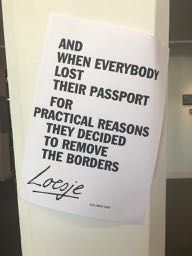
statelessness

In  my own post I explore the relation between accountability and statelessness. First, by investigating the case of expert activists in Europe who have declared a fight against statelessness by trying to hold nation states accountable. Second, I look at asylum cases in the UK where stateless individuals have to give accounts of themselves. I argue that while expert activists demand accountability from nation states, it is nation states who demand accountability from stateless people.


If people cannot make claims vis-à-vis the state at all, we pondered the question of what they might be doing instead. One option that Alice Wilson explores in her post is a shift in the very discussions people are having about disappearance: in her case in the context of Oman’s southern Dhufar region. She argues that the possibilities for claims-making, and its potential success, vary within different political environments.

Finally, Siri Lamoureaux explores in her post on displaced Nuba women in Sudan women’s options such as public shaming and the accusation of perpetrators by the so-called “Nubian Queens.” In light of the recent events her post bears particular urgency. Drawing on long-term fieldwork, she then asks “Where are the Nuba queens”, namely those women who “due to (pre/post)colonial histories of divide and rule, and unequal centre-periphery socioeconomic relations, have never donned a white towb?” that has become so emblamatic of the ongoing protests.  “Without denying the sacrifice and suffering of elite women in the protests, displaced women have suffered immeasurably from the Sudanese government’s policies”, she argues.

You can find all posts of this thematic thread here.