Tag Archives: politics

Crimes against commonality

Before all other forms of membership, we are “all members of the human family”, as the preamble of the Universal Declaration of Human Rights has specified. Thus, the international legal concept of crimes against humanity is crucial because all war crimes are predicated on the fact that those committing these atrocities are enabled once they succeed in establishing difference that makes us forget our human commonality.

We cannot but make do with what the French psychoanalyst Jacques Lacan has called the imaginary order – the way in which we try to relate to others by looking for similarities and differences, mainly in order to acknowledge ourselves. We need the ‘other‘ to sustain ourselves as the I(ndividual) we imagine ourselves to be.

The imaginary order is the order of world-making in the sense of Hannah Arendt (1959) for whom the world is not ‘out there‘, but rather that which arises between people in discourse, as I will develop in an upcoming presentation. We have to keep engaging with others, irrespective of the fact that we will never really understand each other entirely. But we are obliged to keep trying. There is no other way.

“For the world is not humane just because it is made by human beings, and it does not become humane just because the human voice sounds in it, but only when it has become the object of discourse … We humanize what is going on in the world and in ourselves only by speaking of it, and in the course of speaking of it, we learn to be human” (Hannah Arendt, 1959, 24-25)

Human commonality is already there from the beginning, transcending all dichotomies, whereas difference is something we can only ever bring about consciously. What we have in common and what makes us human is that we are split by language, as Lacan argued. If we acknowledge this, we might be able to include the other not as an opposite ‘they’ but as part of our own unconscious: we are always other to ourselves first.

UN Photo In 1950, on the second anniversary of the adoption of the Universal Declaration of Human Rights, students at the UN International Nursery School in New York viewed a poster of the historic document.

Boat is a man

2024 has been the deadliest year for migrants trying to cross the Channel in small boats to reach the UK, with 69 deaths reported (Refugee Council 2025). British politicians have been referring to the circumstances under which people migrate to the UK as “the small boat crisis“ and subsequently made a “small boat deal“ with countries such as Ruanda, to which they wanted to ship people to.

Before the Labour party came to power, they accused the Tories of “having lost control of small boat migration“. Now, that they are in power, they claim that there is “no nice or easy way of doing it“. Getting rid of people who came by boat…

But what if boat were a man?

I recently bought a small booklet filled with Walter Benjamin’s short stories. Tales out of loneliness is its subtitle. In it, there is a 1-page story entitled How the Boat was Invented and Why It Is Called ‘Boat‘. It follows a similar pattern as Benjamin’s short story on Why the elephant is called ‘elephant‘ that immediately precedes the story about the boat.

The storyteller. Tales out of loneliness. Walter Benjamin. Verso Books 2023.

Here’s how Boat’s story goes:

Before all the other people, there lived one person and he was called Boat. He was the first person, as before him there was only an angel who transformed himself into a person, but that is another story.

So the man called Boat wanted to go on the water — you should know that back then there was a lot more water than today. He tied himself to some planks with ropes, a long plank along the belly, that was the keel. And he took a pointed cap of planks, which was, when he lay in the water, at the front — that was the prow. And he stretched out a leg behind him and navigated with it.

In this manner he lay on the water and navigated and rowed with his arms and moved very easily through the water with his plank cap, because it was pointed. Yes, that is how it was: the man Boat, the first man, made himself into a boat, with which one could travel on water.

And therefore — of course that is quite obvious — because he himself was called Boat, he named what he had made ‘boat‘. And that is why the boat is called ‘boat‘.

(Walter Benjamin, 26 September 1933; published posthumously)

The “small boats crisis” is Boat’s crisis, the crisis of man. This is the elephant in the room that nobody wants to talk about. Because they do not know why the elephant is called ‘elephant‘ either.

Philosophy saves lives.

Paper boat made out of a book page (photo by: Maddy Freddie, pexels.com).

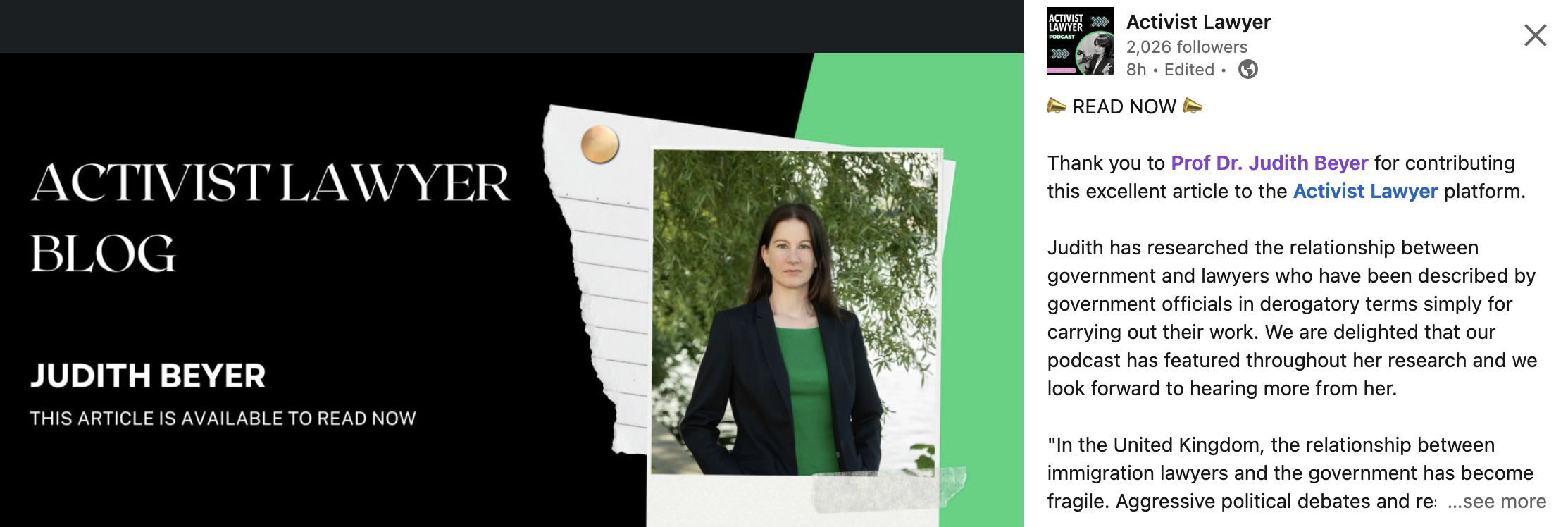
New post for the “Activist Lawyer”-platform

In contemporary Britain, it is no longer only migrants who are being targeted by the government, but those who fend for them just as well.

In “‘Illegal’ migration and the Othering of activist lawyers in the UK“, I argue that human rights solicitors, who pride themselves in fending for their marginalized clients, have become targets of state officials who began to call them “activist lawyers” in 2020.
The current populist atmosphere in British politics regarding the topic of “illegal migration” not only others those who seek asylum, but also their immigration lawyers and NGO workers who are committed to supporting their clients in their asylum claims. Those lawyers who began to publicly reclaim the term “activist lawyers”, a term initially hurled at them as a slur, effectively managed to strip the state’s vocabulary of its negative attributes. What makes the term “activist lawyers” and the way it is being handled by im/migration and human rights lawyers particularly interesting is that it is no longer exclusionary words about others that lawyers are dealing with here, but words about themselves.

Through this reversal, lawyers brought the former slur in line with their profession’s ethical stance as well as their own personal biographies. The podcast and platform “Activist Lawyer”, hosted by the human rights solicitor Sarah Henry, has been covering this development since 2020 and features many interesting audio formats as well as texts. Make sure you visit “Activist Lawyer – and read my full text here.