In December 2025, Leila Dedial and myself spoke to anthropologist and podcaster Ian M. Cook and to scholar-at-risk Ibrar Mirzai about the Hilde Domin Training Programme (HDTP) we host at the University of Konstanz, funded by the German Academic Exchange Service (DAAD).
The Hilde Domin Programme, of which the Training Programme is one part, is a scholar-at-risk programme composed of fellows from across the world, who all had to flee their countries of origin. They now study for their MA degree or write their PhD thesis in Germany, while remaining involved in and committed to their home countries. Many came with their families, others had to leave their loved ones behind …
The Hilde Domin Training Programme is a one-year programme for all fellowship holders, to be studied alongside their degrees. It is composed of two semesters of online webinars and three face-to-face workshops which take place at the University of Konstanz. The goal of the programme is to transmit knowledge that will help our fellows better understand Germany and the EU, to acquire new academic and personal skills, take part in professional coaching events and support them in making informed decisions about their future career.
With Ian and Ibrar, Leila and I also discussed the predicaments that come with being a scholar-at-risk in Germany in regard to issues of integration, mental health, ‘imposter syndrome’ and potential risks deriving from changes in the political landscape in Europe.
You can find this first episode of Ian’s new series “Displacing Universities” on the anthropology platform Allegra Lab and also directly on Soundcloud.
On the occasion of what would have been Aung San’s 111th birthday, I release a video lecture which I have given in late 2021 to anthropology students from Myanmar after the Myanmar military attempted a coup on 1 February 2021.
Some of my own students and tens of thousands more had to go into hiding once the military began occupying their universities and took over their cities. With their professors resigning from their positions out of protest, their education came to a sudden, abrupt halt. Having to leave their dormitories and sitting in their parents’ homes again, or having to flee Yangon, Mandalay and other bigger cities in which they had until then studied, they still longed to continue their studies.
This lecture was an effort to support them in this endeavour, albeit without being able to substitute for what they had lost. Moreover, it became evident over the course of the online sessions, that many could not concentrate due to the ongoing violence and the many new tasks they had to adhere to in order to secure their own living or contribute to the livelihood of their families. It is hard to study while having to cope with trauma.
In the lecture, I discuss the concept of ‘guerilla anthropology’ as a way to educate each other while in hiding or from abroad; education as a subversive act of resistance and as refusal to give in. In the main part of the lecture, I cover both the history of anthropology and the role of history in anthropology.
By 2026, several so-called “virtual universities” have taken over from what had been a first effort of mine and fellow anthropologists back then. They have now build a systematic online education path for thousands of Myanmar students. Moreover, some of my own former students from the Unviersity of Yangon have become educators themselves and now teach schoolchildren in the Myanmar-Thai border region. Others have left the country to pursue their own education – all hope to be able to return to Myanmar one day…
Since I am human, I have an intrinsic motivation to understand. Since I am an anthropologist, I have an intrinsic motivation to understand other humans. Since many humans seem more and more motivated to hand their intrinsic motivation to a machine, I am now intrinsically motivated to not only understand how AI operates and what its effects are, but who the humans behind the technology are and to what they might put AI to use.
Since I am also a university professor, I am faced with the topic of AI almost every day. I have noted three common ways of how academia relates to the issue so far:
a) AI is the future and everything will be great
b) we are doomed and we can’t win against AI
c) who cares about AI ?
So I have started to gather texts on AI, particularly those written by scholars or by journalists engaging with academic literature. The result (so far): AI is stupid and as such maybe not so different from humans after all. But: it feeds off our knowledge and it learns from our mistakes. It also gets better in duping us, luring us in and making us believe that there is indeed ‘someone’ on the other side. There is not.
Instead of a picture: a screenshot of how wordpress suggests to generate an image with AI. No, thank you.
Here is my list of collected texts (tbc.) which I enjoyed reading and which I recommend to everyone, whether you are a) b) or c).
2024 has been the deadliest year for migrants trying to cross the Channel in small boats to reach the UK, with 69 deaths reported (Refugee Council 2025). British politicians have been referring to the circumstances under which people migrate to the UK as “the small boat crisis“ and subsequently made a “small boat deal“ with countries such as Ruanda, to which they wanted to ship people to.
I recently bought a small booklet filled with Walter Benjamin’s short stories. Tales out of loneliness is its subtitle. In it, there is a 1-page story entitled How the Boat was Invented and Why It Is Called ‘Boat‘. It follows a similar pattern as Benjamin’s short story on Why the elephant is called ‘elephant‘ that immediately precedes the story about the boat.
The storyteller. Tales out of loneliness. Walter Benjamin. Verso Books 2023.
Here’s how Boat’s story goes:
Before all the other people, there lived one person and he was called Boat. He was the first person, as before him there was only an angel who transformed himself into a person, but that is another story.
So the man called Boat wanted to go on the water — you should know that back then there was a lot more water than today. He tied himself to some planks with ropes, a long plank along the belly, that was the keel. And he took a pointed cap of planks, which was, when he lay in the water, at the front — that was the prow. And he stretched out a leg behind him and navigated with it.
In this manner he lay on the water and navigated and rowed with his arms and moved very easily through the water with his plank cap, because it was pointed. Yes, that is how it was: the man Boat, the first man, made himself into a boat, with which one could travel on water.
And therefore — of course that is quite obvious — because he himself was called Boat, he named what he had made ‘boat‘. And that is why the boat is called ‘boat‘.
(Walter Benjamin, 26 September 1933; published posthumously)
The “small boats crisis” is Boat’s crisis, the crisis of man. This is the elephant in the room that nobody wants to talk about. Because they do not know why the elephant is called ‘elephant‘ either.
Philosophy saves lives.
Paper boat made out of a book page (photo by: Maddy Freddie, pexels.com).
We are way into the winter term in all public universities in France. I am currently on a research sabbatical at the University Paris-Nanterre where I also teach a course on the Introduction to Legal Anthropology.
Half an hour before my lecture is about to start, one student already sits prepared with their laptop in the hallway. I open the door to the lecture room to allow them to sit more comfortably. But it is as freezing in the room as it is in the hallway. There is no heating in the building. I wonder how many of my students might come today given the heavy rainfall …
Ten minutes before my lecture, I check my emails. I see that several students have written to me already. Only one calls in sick, all others are stuck in the outbound RER A train from central Paris to Nanterre. There has been an incident, the students explained: “We are all stuck”. Another one shares a screenshot of the offical traffic announcement and an additional photograph: an official attestation that there has been a disruption. The document carries the title “Attestation de pertubation”
The date and time is neatly printed and I contemplate how fast and effective not being fast and effective can be. I suggest to the student later to use this textual artefact as an entry point to an essay my students are supposed to write at the end of the term on the everyday life of the law.
It is 10.30h and I decide to see who might have shown up despite the rain falling and the train being late. The room is half full already and within the next 20 minutes the rest trickle in. We are almost at full capacity and I am seriously impressed.
It is on the same day that I learn that in France there is no longer an obligation to attend classes in presence if your personal circumstances do not allow you to do so. Students may study long distance at all universities in France for health-related reasons or because they have to work. At the end of my course I will have to grade essays of students whom I will have never seen in person and who will not have attended a single lecture of mine on campus.
I wonder: what kind of anthropologists are we releasing into the world if the only encounter many students have with the discipline is via self-study ? No dialogue with teachers, no spending time with classmates, no campus experience. Not only that the state keeps on moving the universities beyond the bande péripherique into suburbia, by allowing students to study long-distance, it reduces the campus to mere sites of administration. In the name of “flexibility”, students work towards their grades, but are being deprived of what Bell Hooks has called “the most radical space of possibility in the academy”: the classroom.
Universities are easier to manage if fewer people are around. One might be tempted to reframe long-distance studies as “needs-centred”. Paris already suffered from high living costs before the Covid-19 lockdowns struck. After 2021, many never moved back to the city, but remained in their home towns far away. At times, the campus feels deserted – a striking difference to 2018 and 2019 when I last spent some time in Paris on fellowships.
The students who do attend my seminar, always listen attentively and eagerly write down what I am presenting on my slides. I have split the seminar into two parts: the first is a lecture, the second was intended as an interactive space for discussing the weekly reading and give them the possibility to ask questions – in French or English. However, only very few attend the second part of the seminar. I now understand that this is the case because very few have read the text. I was warned by other lecturers that this is indeed the case: “Students do not read texts.” When I inquired why, the answer was always because they are overworked – from having to take too many courses and from having to work in order to finance their studies …
But anthropology is not a subject that can be taught only. It needs to be ingested until it has become part of oneself. Students need to anthropologize themselves throughout their studies in order to be able to later claim “I am an anthropologist” and mean themselves instead of a mere profession. Anthropology needs to become an integral part of one’s own humaneness, ideally, before one can collaborate with others and analyse what one has learned from them in an ethical manner. But the discipline is increasingly expected to be taught in ways that ensure it remains outside of our students’ individual experience.
Our most important task is therefore to get students back into the classroom while at the same time opening that very classroom up to the world. Rather than transmitting a particular kind of ‘knowledge’, we should be transmitting that anthropology provides a multitude of ways of seeing and conceptualizing humanity as such. While taking our students and their current experiences seriously, our task is also to de-self-center their existing worldview and help them get unstuck. We do not need more ‘attestations des pertubations‘, we need ‘pertubations des attestions‘!”
Flâneuse [flanne-euhze], nom, du français. Forme féminine de flâneur [flanne-euhr], un oisif, un observateur flânant, que l’on trouve généralement dans les villes.
An incremental part of anthropology has always been photography for me. It can be used as an aide mémoire to simply remember where one has been or whom one has encountered on a particular day, thus substituting for fieldnotes. It can also be used as a methodological tool in order to detect the ‘minor modes’ in everyday life or in co-existence. A photograph can be scrutinized for its details, revealing more and more of them, every time one looks closer. But photography can also help express oneself when words fail. Rather than serving the eye, it serves the mouth that does not find the right words or ceases to speak alltogether. When used in this way, photography is neither only a method nor a product. It becomes a mode of existence in itself.
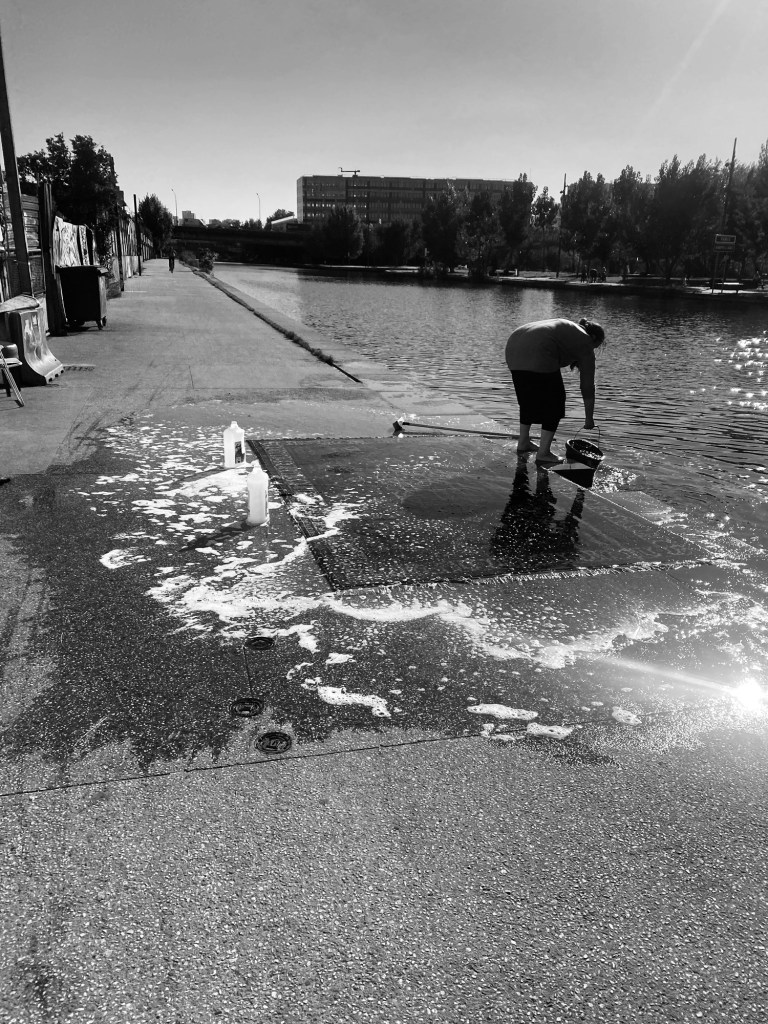
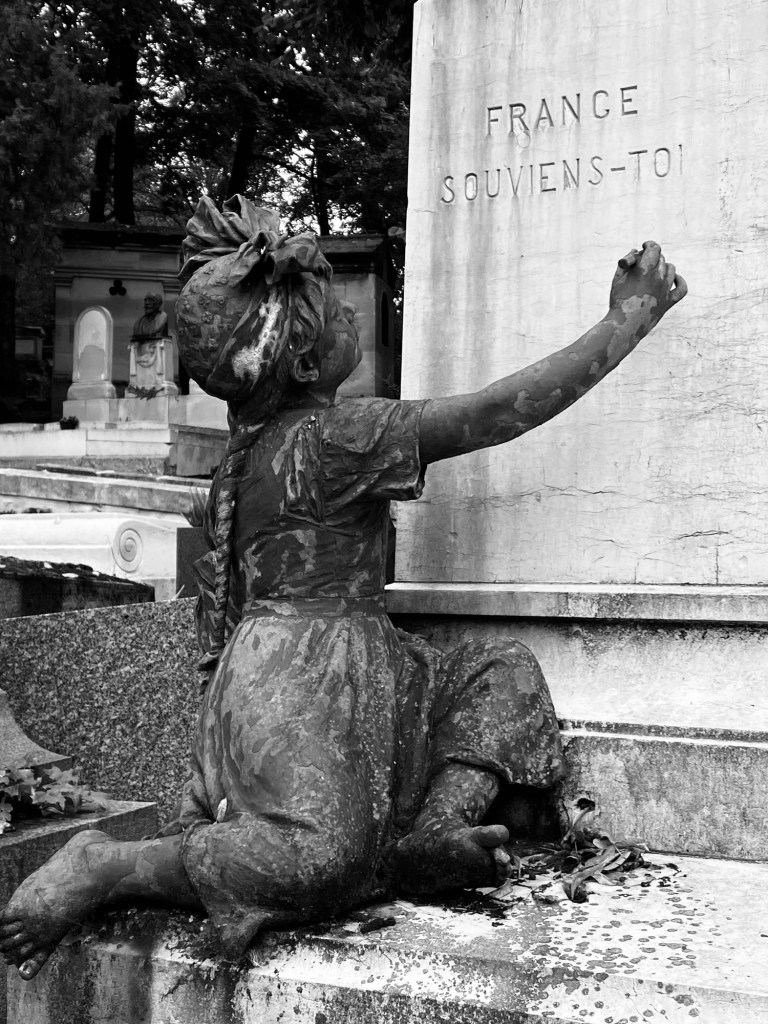
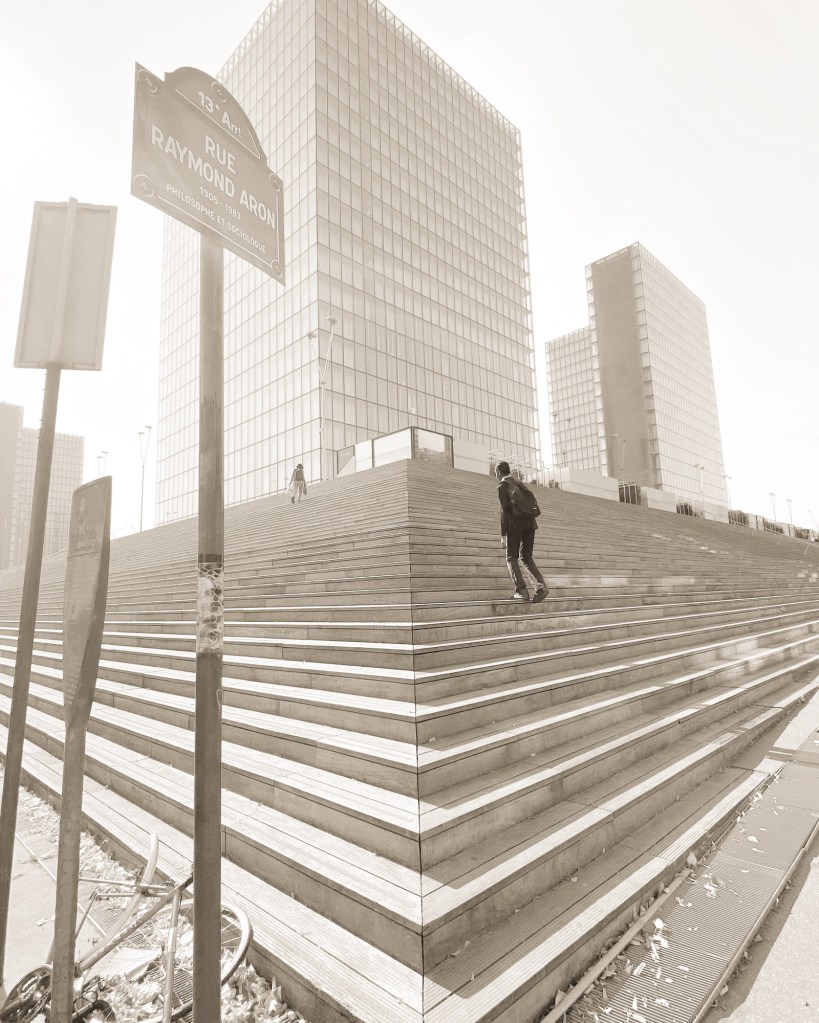
Woman emptying out the Canal. / Femme vidant le canalLittle girl with no memory of the war urges the French to remember it / Une petite fille qui n’a aucun souvenir de la guerre exhorte les Français à s’en souvenir14 million books locked in four towers while researchers work underground / 14 millions de livres enfermés dans quatre tours pendant que les chercheurs travaillent sous terrePart of a wall painting of the anthropology faculty at University Paris-Nanterre, painted by a determined artist / Partie d’une peinture murale de la faculté d’anthropologie de l’Université Paris-Nanterre, réalisée par un artiste déterminé.The Genius of Liberty on top of a tree — optical illusions at the Place de la Bastille / Le Génie de la Liberté au sommet d’un arbre — illusions d’optique à la Place de la Bastille
This winter term, I will be spending some time with my anthropology colleagues at Paris-Nanterre as part of the Laboratoire d’Ethnologie et de Sociologie comparative (LESC), part of the Centre National de la Recherche Scientifique (CNRS).
One part of my research stay is devoted to working on my current project: “Towards an anthropology of statelessness”. I will be speaking at the Department’s Colloquium in December (see plan below). I will also be teaching a course in legal anthropology … more about this one later.
The colloquium is free and open to the public, everyone is welcome.
They must have boarded at Finsterwalde – the East German equivalent to the Black Forest – at least as far as the name is concerned. The shiny new Berlin airport was along the regional train’s route to Wismar on the Baltic Sea. The train was overcrowded and I had to leave my legs dangling outside of our joint compartment as the floor was blocked by their suitcases onto which each of them had rested one protective hand. A hand bag occupied its own seat, equally guarded by the elderly women’s hand; a small wedding band in silver caught my eye.
After we had exchanged a friendly ”Hello” and talked a bit about how packed the train was, but that for me it was just a short ride to the city center, the woman’s grey-haired, orderly combed husband, who was wearing a rain jacket, suddenly pointed at a dilapidated building that appeared on our left side. We turned our heads: “It’s the Gymnasium!”he exclaimed. Not his Gymnasium – “a” Gymnasium. He also recalled its name – the name of the street. The train continued its way through what used to be the countryside, but what is now – thanks to the airport – part of Berlin, home to 6.3 million people.
“We are getting a free city tour with our ride” she said amused and both looked outside their common window – she to the left, he to the right. I had planned to continue reading, but soon realised that listening closely to their conversation and especially following their pointing index fingers with my eyes would be more worthwhile.
It took me a while to understand what I found interesting: they were only looking at “old” things: the dilapidated Gymnasium, „Jannowitzbrücke“ – he named the bridge over the river Spree, when we entered Ostkreuz train station, they both said „Wasserturm!“, pointing their index fingers at the art nouveau landmark tower that is permanently closed. But for the elderly couple it seemed to have remained open. I tried to imagine seeing Berlin the way they were seeing it, actively unseeing everything “new”: the renovated train stations? No comment. Not there. The massive glas office buildings? No pointing. Not there. A building aptly called “Futurium”? No remark. Not there.
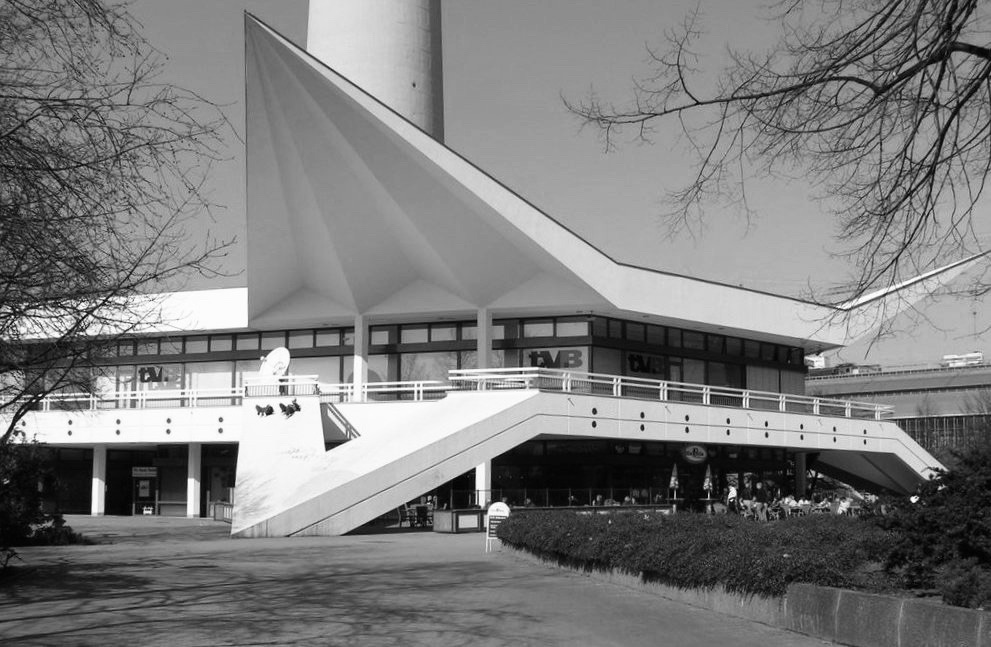
Suddenly both erupted in laughter when they saw the (formerly) white pavilion in front of the Alex: “Just like in the old days!” The train passed over the bridge that separates the “Museum Island” from the main land. “Repair work” she said. Oh! I noticed a break in the pattern. But then he told her: “It’s because they are repairing the war damage!“ “But the Bode Museum is still as it was?” she asks. “Yes, because they can only repair one building after the other.”
I was travelling with a couple who not only travelled through Berlin for the first time in decades, I was travelling with a couple who travelled through Eastern Berlin as if the war had just ended and through Western Berlin as if the wall had just come down.
But before I could tell them how much I liked them for this, another hand pointed its index finger onto the hand bag which had travelled comfortably on its own seat with us. A young Asian-looking man with grey glasses and headphones looked at me. I smiled and pointed towards the elderly lady. His index finger left the bag and now carefully tipped onto the woman’s shoulder. She had not noticed him, her body was turned towards the window where the past continued to pass by.
Both looked at the young man and the elderly man shouted a loud “No!” into his face that made me and him jump a little. I looked at the two without saying a word, the woman then took her bag and placed it onto the small table in front of her and the man assumed the handbag’s seat. “… oder ok” murmured the husband and both turned their heads again … I felt a stitch. Had this been a racist reaction? I looked at the young man, making sure he was ok. He wasn’t.
As soon as we had reached Hauptbahnhof where most people got out, the handbag reclaimed its seat as the young man quickly found himself another place to sit. Then a Black man arrived. He pointed at the handbag which was from a German brand and which depicted many people with different skin tones, wearing colourful clothes and sporting hairstyles! This time, the woman immediately reacted and nobody spoke a word. They were sitting quietly until I had to get out. I wished them safe travels and they wished me a “good night”, assuming that because I had been up since 5am, I was about to go to sleep. I did not correct them.
Walking through Berlin I contemplated: what if all the “different looking” and “different speaking” people were as “new” to this elderly couple as the shiny glass dome on top of the “Reichstag” was for them? What if they equally erased everyone as they had erased everything they did not remember from the past? What if “their past” was not gone?
We cannot assume that we are inhabiting the same world.
We also cannot assume that we are seeing the same things even when we are looking outside the same window.
We even cannot assume a “we” that is united by more than jointly passing by.
In contemporary Britain, it is no longer only migrants who are being targeted by the government, but those who fend for them just as well.
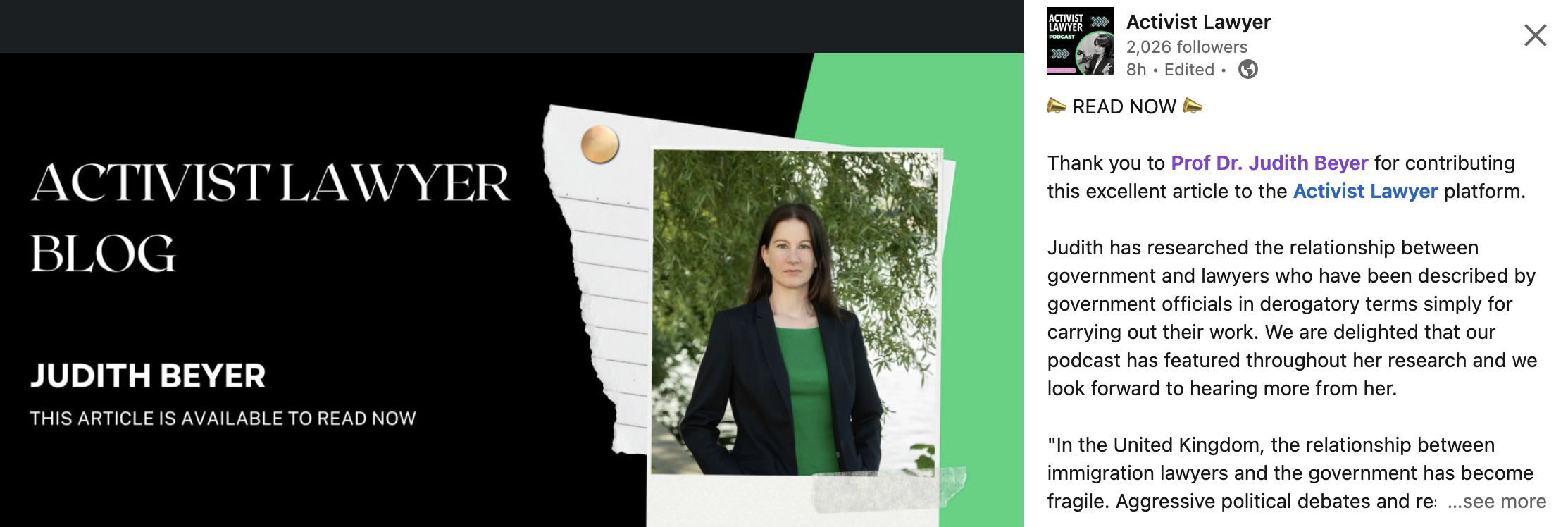
In “‘Illegal’ migration and the Othering of activist lawyers in the UK“, I argue that human rights solicitors, who pride themselves in fending for their marginalized clients, have become targets of state officials who began to call them “activist lawyers” in 2020. The current populist atmosphere in British politics regarding the topic of “illegal migration” not only others those who seek asylum, but also their immigration lawyers and NGO workers who are committed to supporting their clients in their asylum claims. Those lawyers who began to publicly reclaim the term “activist lawyers”, a term initially hurled at them as a slur, effectively managed to strip the state’s vocabulary of its negative attributes. What makes the term “activist lawyers” and the way it is being handled by im/migration and human rights lawyers particularly interesting is that it is no longer exclusionary words about others that lawyers are dealing with here, but words about themselves.
Through this reversal, lawyers brought the former slur in line with their profession’s ethical stance as well as their own personal biographies. The podcast and platform “Activist Lawyer”, hosted by the human rights solicitor Sarah Henry, has been covering this development since 2020 and features many interesting audio formats as well as texts. Make sure you visit “Activist Lawyer – and read my full text here.
Two new publications came out this month — one on my last research with ethno-religious minorities in urban Yangon in Myanmar, the other based on long-term fieldwork in Central Asia, in rural Kyrgyzstan.
In “Legal Pluralism in Central Asia“, published for an edited volume on the Central Asian World by Routledge, I put forward the argument of a rhetorical emergence of legal pluralism, combining literature from legal and linguistic anthropology. I argue that “we should understand legal pluralism not as the precondition that allows for cases to be dealt with and adjudicated in a plural legal manner; rather, it should be considered a possible outcome whose rhetorical emergence empirically varies from case to case. Depending on the situation, legal pluralism does not define the set-up of a case from the beginning, but rather becomes created intersubjectively in situ by the disputing parties involved in the case” (410). I conclude with a caution: “As anthropologists, we should refrain from advocating legal pluralism in such contexts [where claims about ‘custom’ are competitive rather than descriptive] as a more “culture- friendly” or encompassing way to deal with questions of order, sanctioning or indeed harmony, since “Plurality may actually reinforce structures of inequality as the plurality of forums available decreases the binding power of any law” (418, von Benda- Beckmann et al., 2009, p. 12).
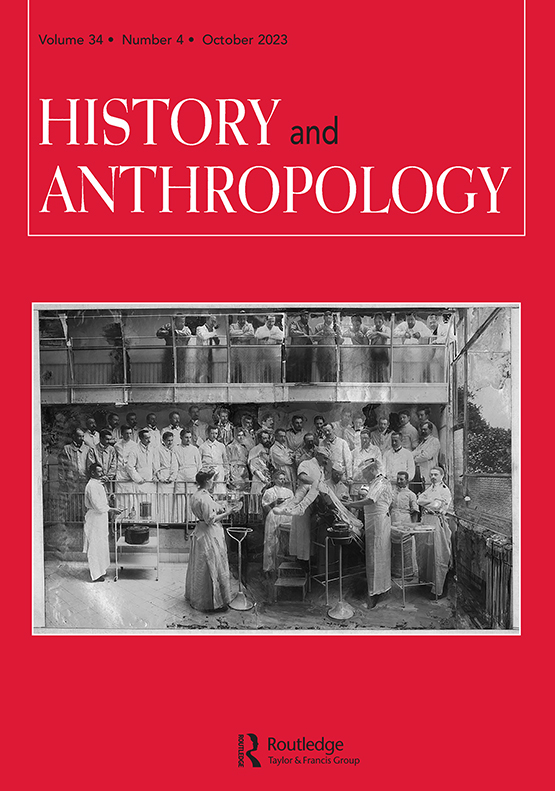
In “Community as a category of empire“, published for History and Anthropology, I argue that ‘community’ is a category that is inextricably bound up with the historical development of the British empire. It was in this context that modern social theory took root, including, eventually, publications on community in anthropology and sociology that profoundly influenced nineteenth- and twentieth-century thought and that continue to shape everyday understandings of the category within and beyond academia. I first elaborate what type of work the category ‘community’ was intended to do in the British empire. I then introduce two key figures who were responsible for designing, distributing and implementing two contrasting imperial theories of community. Subsequently, I sketch the migratory history of the category following the ancestors of today’s so-called ‘Burmese Indians’ across the Bay of Bengal from India to Burma. The final part of the article presents the repercussions ‘community’ has in contemporary Myanmar, drawing on recent legislation around ‘race and religion’ as well as my own ethnographic data from religious processions of ethno-religious minorities who find themselves in a subaltern position vis-à-vis the Buddhist majority population and an ethnonationalist state.







 judith beyer
