On the occasion of what would have been Aung San’s 111th birthday, I release a video lecture which I have given in late 2021 to anthropology students from Myanmar after the Myanmar military attempted a coup on 1 February 2021.
Some of my own students and tens of thousands more had to go into hiding once the military began occupying their universities and took over their cities. With their professors resigning from their positions out of protest, their education came to a sudden, abrupt halt. Having to leave their dormitories and sitting in their parents’ homes again, or having to flee Yangon, Mandalay and other bigger cities in which they had until then studied, they still longed to continue their studies.
This lecture was an effort to support them in this endeavour, albeit without being able to substitute for what they had lost. Moreover, it became evident over the course of the online sessions, that many could not concentrate due to the ongoing violence and the many new tasks they had to adhere to in order to secure their own living or contribute to the livelihood of their families. It is hard to study while having to cope with trauma.
In the lecture, I discuss the concept of ‘guerilla anthropology’ as a way to educate each other while in hiding or from abroad; education as a subversive act of resistance and as refusal to give in. In the main part of the lecture, I cover both the history of anthropology and the role of history in anthropology.
By 2026, several so-called “virtual universities” have taken over from what had been a first effort of mine and fellow anthropologists back then. They have now build a systematic online education path for thousands of Myanmar students. Moreover, some of my own former students from the Unviersity of Yangon have become educators themselves and now teach schoolchildren in the Myanmar-Thai border region. Others have left the country to pursue their own education – all hope to be able to return to Myanmar one day…
Since I am human, I have an intrinsic motivation to understand. Since I am an anthropologist, I have an intrinsic motivation to understand other humans. Since many humans seem more and more motivated to hand their intrinsic motivation to a machine, I am now intrinsically motivated to not only understand how AI operates and what its effects are, but who the humans behind the technology are and to what they might put AI to use.
Since I am also a university professor, I am faced with the topic of AI almost every day. I have noted three common ways of how academia relates to the issue so far:
a) AI is the future and everything will be great
b) we are doomed and we can’t win against AI
c) who cares about AI ?
So I have started to gather texts on AI, particularly those written by scholars or by journalists engaging with academic literature. The result (so far): AI is stupid and as such maybe not so different from humans after all. But: it feeds off our knowledge and it learns from our mistakes. It also gets better in duping us, luring us in and making us believe that there is indeed ‘someone’ on the other side. There is not.
Instead of a picture: a screenshot of how wordpress suggests to generate an image with AI. No, thank you.
Here is my list of collected texts (tbc.) which I enjoyed reading and which I recommend to everyone, whether you are a) b) or c).
In this article, I interrogate the process how evidence is established in asylum procedure by engaging with anthropological and socio-legal literature on evidence and credibility assessments. Drawing on ethnomethodology, I analyse asylum interviews and show in what ways evidence can be understood as the result of an asymmetrical co-construction. As a result of this procedure, the individual applicant disappears and a ‘case’ is established.
Anthropologists who write country of origin reports based on such ‘case material’ for tribunals and courts can highlight the asymmetries in evidence-making and question the very categorisations through which the state operates. The article contributes to ongoing debates on the role of anthropologists and their knowledge as experts in court.
Before all other forms of membership, we are “all members of the human family”, as the preamble of the Universal Declaration of Human Rights has specified. Thus, the international legal concept of crimes against humanity is crucial because all war crimes are predicated on the fact that those committing these atrocities are enabled once they succeed in establishing difference that makes us forget our human commonality.
We cannot but make do with what the French psychoanalyst Jacques Lacan has called the imaginary order – the way in which we try to relate to others by looking for similarities and differences, mainly in order to acknowledge ourselves. We need the ‘other‘ to sustain ourselves as the I(ndividual) we imagine ourselves to be.
The imaginary order is the order of world-making in the sense of Hannah Arendt (1959) for whom the world is not ‘out there‘, but rather that which arises between people in discourse, as I will develop in an upcoming presentation. We have to keep engaging with others, irrespective of the fact that we will never really understand each other entirely. But we are obliged to keep trying. There is no other way.
“For the world is not humane just because it is made by human beings, and it does not become humane just because the human voice sounds in it, but only when it has become the object of discourse … We humanize what is going on in the world and in ourselves only by speaking of it, and in the course of speaking of it, we learn to be human” (Hannah Arendt, 1959, 24-25)
Human commonality is already there from the beginning, transcending all dichotomies, whereas difference is something we can only ever bring about consciously. What we have in common and what makes us human is that we are split by language, as Lacan argued. If we acknowledge this, we might be able to include the other not as an opposite ‘they’ but as part of our own unconscious: we are always other to ourselves first.
UN Photo In 1950, on the second anniversary of the adoption of the Universal Declaration of Human Rights, students at the UN International Nursery School in New York viewed a poster of the historic document.
2024 has been the deadliest year for migrants trying to cross the Channel in small boats to reach the UK, with 69 deaths reported (Refugee Council 2025). British politicians have been referring to the circumstances under which people migrate to the UK as “the small boat crisis“ and subsequently made a “small boat deal“ with countries such as Ruanda, to which they wanted to ship people to.
I recently bought a small booklet filled with Walter Benjamin’s short stories. Tales out of loneliness is its subtitle. In it, there is a 1-page story entitled How the Boat was Invented and Why It Is Called ‘Boat‘. It follows a similar pattern as Benjamin’s short story on Why the elephant is called ‘elephant‘ that immediately precedes the story about the boat.
The storyteller. Tales out of loneliness. Walter Benjamin. Verso Books 2023.
Here’s how Boat’s story goes:
Before all the other people, there lived one person and he was called Boat. He was the first person, as before him there was only an angel who transformed himself into a person, but that is another story.
So the man called Boat wanted to go on the water — you should know that back then there was a lot more water than today. He tied himself to some planks with ropes, a long plank along the belly, that was the keel. And he took a pointed cap of planks, which was, when he lay in the water, at the front — that was the prow. And he stretched out a leg behind him and navigated with it.
In this manner he lay on the water and navigated and rowed with his arms and moved very easily through the water with his plank cap, because it was pointed. Yes, that is how it was: the man Boat, the first man, made himself into a boat, with which one could travel on water.
And therefore — of course that is quite obvious — because he himself was called Boat, he named what he had made ‘boat‘. And that is why the boat is called ‘boat‘.
(Walter Benjamin, 26 September 1933; published posthumously)
The “small boats crisis” is Boat’s crisis, the crisis of man. This is the elephant in the room that nobody wants to talk about. Because they do not know why the elephant is called ‘elephant‘ either.
Philosophy saves lives.
Paper boat made out of a book page (photo by: Maddy Freddie, pexels.com).
We are way into the winter term in all public universities in France. I am currently on a research sabbatical at the University Paris-Nanterre where I also teach a course on the Introduction to Legal Anthropology.
Half an hour before my lecture is about to start, one student already sits prepared with their laptop in the hallway. I open the door to the lecture room to allow them to sit more comfortably. But it is as freezing in the room as it is in the hallway. There is no heating in the building. I wonder how many of my students might come today given the heavy rainfall …
Ten minutes before my lecture, I check my emails. I see that several students have written to me already. Only one calls in sick, all others are stuck in the outbound RER A train from central Paris to Nanterre. There has been an incident, the students explained: “We are all stuck”. Another one shares a screenshot of the offical traffic announcement and an additional photograph: an official attestation that there has been a disruption. The document carries the title “Attestation de pertubation”
The date and time is neatly printed and I contemplate how fast and effective not being fast and effective can be. I suggest to the student later to use this textual artefact as an entry point to an essay my students are supposed to write at the end of the term on the everyday life of the law.
It is 10.30h and I decide to see who might have shown up despite the rain falling and the train being late. The room is half full already and within the next 20 minutes the rest trickle in. We are almost at full capacity and I am seriously impressed.
It is on the same day that I learn that in France there is no longer an obligation to attend classes in presence if your personal circumstances do not allow you to do so. Students may study long distance at all universities in France for health-related reasons or because they have to work. At the end of my course I will have to grade essays of students whom I will have never seen in person and who will not have attended a single lecture of mine on campus.
I wonder: what kind of anthropologists are we releasing into the world if the only encounter many students have with the discipline is via self-study ? No dialogue with teachers, no spending time with classmates, no campus experience. Not only that the state keeps on moving the universities beyond the bande péripherique into suburbia, by allowing students to study long-distance, it reduces the campus to mere sites of administration. In the name of “flexibility”, students work towards their grades, but are being deprived of what Bell Hooks has called “the most radical space of possibility in the academy”: the classroom.
Universities are easier to manage if fewer people are around. One might be tempted to reframe long-distance studies as “needs-centred”. Paris already suffered from high living costs before the Covid-19 lockdowns struck. After 2021, many never moved back to the city, but remained in their home towns far away. At times, the campus feels deserted – a striking difference to 2018 and 2019 when I last spent some time in Paris on fellowships.
The students who do attend my seminar, always listen attentively and eagerly write down what I am presenting on my slides. I have split the seminar into two parts: the first is a lecture, the second was intended as an interactive space for discussing the weekly reading and give them the possibility to ask questions – in French or English. However, only very few attend the second part of the seminar. I now understand that this is the case because very few have read the text. I was warned by other lecturers that this is indeed the case: “Students do not read texts.” When I inquired why, the answer was always because they are overworked – from having to take too many courses and from having to work in order to finance their studies …
But anthropology is not a subject that can be taught only. It needs to be ingested until it has become part of oneself. Students need to anthropologize themselves throughout their studies in order to be able to later claim “I am an anthropologist” and mean themselves instead of a mere profession. Anthropology needs to become an integral part of one’s own humaneness, ideally, before one can collaborate with others and analyse what one has learned from them in an ethical manner. But the discipline is increasingly expected to be taught in ways that ensure it remains outside of our students’ individual experience.
Our most important task is therefore to get students back into the classroom while at the same time opening that very classroom up to the world. Rather than transmitting a particular kind of ‘knowledge’, we should be transmitting that anthropology provides a multitude of ways of seeing and conceptualizing humanity as such. While taking our students and their current experiences seriously, our task is also to de-self-center their existing worldview and help them get unstuck. We do not need more ‘attestations des pertubations‘, we need ‘pertubations des attestions‘!”
This winter term, I will be spending some time with my anthropology colleagues at Paris-Nanterre as part of the Laboratoire d’Ethnologie et de Sociologie comparative (LESC), part of the Centre National de la Recherche Scientifique (CNRS).
One part of my research stay is devoted to working on my current project: “Towards an anthropology of statelessness”. I will be speaking at the Department’s Colloquium in December (see plan below). I will also be teaching a course in legal anthropology … more about this one later.
The colloquium is free and open to the public, everyone is welcome.
In seiner hommage an Jacques Lacan anlässlich der Erstveröffentlichung von Seminar XV, L’Acte psychanalytique, sagte Jacques-Alain Miller folgendes:
‘Moi, la vérité, je parle’ … In dieser Eigenschaft lehrt Lacan. Sich verständlich zu machen ist nicht lehren, sondern das Gegenteil. Man versteht nur das, was man bereits zu wissen glaubt. Genauer gesagt, man versteht immer nur einen Sinn, dessen Befriedigung man bereits erfahren hat. Das bedeutet, dass man immer nur seine Phantasien versteht. Und man wird nie belehrt, außer durch das, was man nicht versteht.[1] (Jacques-Alain Miller 2024, min. 1:19:12)
Der Satz Moi, la vérité, je parle! („Ich, die Wahrheit, spreche“) ist aus einem Vortrag Lacans entnommen, den dieser im November 1955 in Wien an der Neuropsychiatrischen Universitätsklinik gehalten hatte.[2] Und es ist dieser Vortrag, auf den sich Lacan am Ende des 9. Kapitels des Seminars X bezieht:
Es ist Diana, die ich als die Flucht (fuite) oder die Fortsetzung (suite) dieses Dings (Chose) zeigend bezeichne. Das Freud’sche Ding ist das, was Freud hat fallen lassen – aber es macht weiter nach seinem Tod, und es reißt noch die ganze Jagd mit sich, in der Gestalt von uns allen. Diese Verfolgung, wir werden sie das nächste Mal weiterführen“ (Lacan 2010: 164).
Dieses Seminarende, so gesprochen am 23. Januar 1963, ähnelt dem Sitzungsende am 19. Dezember 1962. Da sagt Lacan:
… es gibt die Jagd Dianas, über die ich Ihnen zu dem von mir gewählten Zeitpunkt, dem Zeitpunkt der Hundertjahrfeier von Freud, gesagt habe, dass sie das Ding (Chose) der Freud’schen Suche war. (Lacan 2010: 108)
Was ist „das Ding der Freud’schen Suche“, auf das sich Lacan in Seminar X bezieht? [3] Und was hat es mit der „Jagd Dianas“ auf sich?
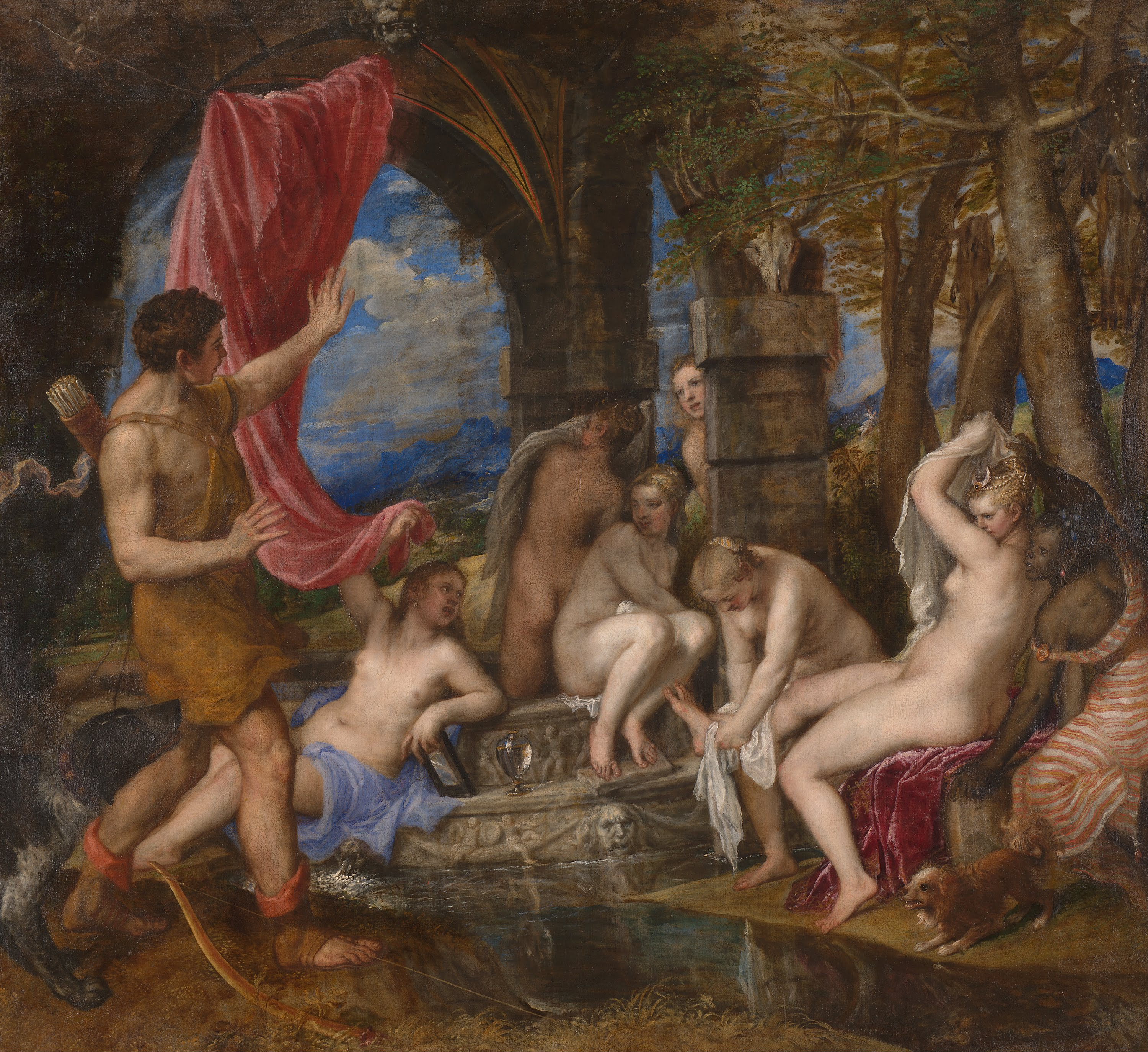
Diana und Actaeon
Diana („die Leuchtende“) ist die römische Göttin der Jagd, der Natur, und die Schutzherrin der Frauen und Kinder. In der mythischen Erzählung von Ovid wird sie als „hochgegürtet“ und „jungfräulich“ beschrieben. Sie badet mit ihren Nymphen in einer Quelle in einer Grotte inmitten des Waldes, ihre Waffen und Kleider abgelegt, als Actaeon, der Enkel des Kadmos, Gründer und König von Theben, in ihren Wald eintritt. Er trifft in der Grotte auf die Göttin und sieht sie ohne Kleider. Die erboste Göttin bespritzt ihn mit Quellwasser und verkündet „Nun darfst du gern erzählen, du habest mich ohne Kleid gesehen, wenn du es noch wirst erzählen können!“ Sie lässt Actaeon ein Hirschgeweih wachsen, spitzt seine Ohren zu, gibt ihm Hufe und „auch noch die Angst“ (lat. pavor). Actaeon ergreift in dem Moment die Flucht, in dem er sein Spiegelbild sieht. Ovid schreibt allwissend: „[s]obald er aber Gesicht und Geweih im Wasser gesehen hatte, wollte er „Ich Elender!“ sagen – aber keine Stimme folgte! … nur sein früheres Bewusstsein blieb erhalten.“ Actaeon wird sodann im Wald von seinen eigenen Hunden gewittert, die ihn nicht mehr erkennen, ihn verfolgen und letztendlich reißen. Erst dann war der Zorn der Göttin Diana gesättigt, so Ovid.
Die Hundertjahrfeier, die Lacan im Zusammenhang mit der „Jagd Dianas“ anführt, war jene zu Ehren von Sigmund Freuds 100. Geburtstag in Wien. Im daraus entstandenen Vortragstext, findet sich eine Stelle, in der Lacan seine Zuhörer als „Spürhunde“ bezeichnet (Lacan 2019a: 484), sowie einen sehr langen Absatz, in dem er zunächst Freud als Actaeon darstellt, der sich „fortwährend durch von Anbeginn auf die falsche Spur gesetzte Hunde losgelassen, bis zur Verbissenheit darum bemüht, dass sie seine Verfolgung wieder aufnehmen, ohne den Lauf zu [sic!] verlangsamen zu können, worin allein seine Leidenschaft für die Göttin ihn führt. Ihn so weit führt, dass er erst in den Grotten anzuhalten vermag…“ (485). Lacan bezieht sich meines Erachtens hier auf all das, was vor Actaeons Verwandlung in einen Hirsch geschehen ist – das, was ihn überhaupt vor die Göttin hat treten lassen. Nach Ovid ist Actaeon in dem ihm „unbekannten“ Wald „herumgeirrt“, seine Schritte seien „unsicher“ gewesen und es sei „das Schicksal“ gewesen, dass ihn in die Grotte geführt habe. So wie ich Lacan lese, schreibt er Actaeons Eintritt in die Grotte dessen Begehren zu. Das Begehren ist nichts, was man verstehen könnte, nichts, zu dem ein Subjekt unmittelbaren Zugang hätte.[4] Es ist vielmehr etwas, das einen sich unsicher fühlen und herumirren lässt. Aber es ist auch das, was in Richtung Wahrheit zieht. Und so führt Lacan in seinem Wiener Vortrag weiter aus, die Grotte Dianas sei „für seine [Freuds] Schüler noch weit davon entfernt erreicht zu werden, sofern sie sich nicht gar weigern, ihm dorthin zu folgen, und damit ist der Aktäon, der hier in Stücke gerissen wird, nicht Freud, sondern sehr wohl im Maße der Leidenschaft, die ihn entflammte … jeder Analytiker“ (Lacan 2019a: 485). Der Vortrag Lacans in Wien ist somit auch eine Abrechnung mit der Wiener Psychoanalyse nach Freud, weil Lacan der Ansicht war, dass man von dieser Jagd abgelassen habe.[5]
Wahrheit, Begehren und die Angst
Wenn Lacan sagt Moi, la vérité, je parle, dann ist nicht er der Wahrheitsverkünder, genauso wenig wie Freud es war, sondern es geht ihm darum, die anderen „Hunde, zu denen Sie werden, wenn Sie mich vernehmen…“ (484) auf ihren Weg in die Grotte anzuleiten, näher heran an den Ort an dem die Wahrheit „von/für sich“ spricht“ (481).[6] Lacan möchte, dass man wie Actaeon seinem Begehren nicht nachgibt, dass man wie jemand ist, der nicht weiß, was ihn antreibt, der aber Freud und Lacan hörend und lesend, sich auf den eigenen Weg macht.
Doch was passiert in dem Moment, wo Actaeon auf die Göttin trifft? Er bekommt von Diana als Strafe die Sprache weggenommen und sie gibt ihm die Angst. Im Deutschen sagt man „es verschlägt einem vor Angst die Sprache“ und so ist es bei Actaeon tatsächlich. „Auf welche Distanz muss ich die Angst halten, um zu Ihnen darüber zu sprechen …?“ fragt Lacan daher in Seminar X. Dies sei „seit Beginn“ seine Frage gewesen. Angst ist ein Affekt (Lacan 2010: 24, 30) und als solcher nicht verbalisiert. Aber Angst ist auch das, was nicht täuscht (101).[7] Deshalb ist der in einen Hirsch verwandelte Actaeon der Einzige, der noch weiß, wer er ist – im Gegensatz zu seinen Hunden und seinen Dienern. Indem Diana Actaeon Angst gegeben hat, hat sie sein Begehren bestraft.[8] Aber was genau war das Objekt seines Begehrens? Warum führen Lacan und auch Freud diesen Mythos überhaupt an? Eine mögliche Interpretation ist, dass gar nicht die Göttin in der Gestalt der schönen Jungfrau begehrt wurde, sondern die Wahrheit (lat. veritas), die sie verkörpert.[9] Lacan sagt: „Denn die Wahrheit erweist sich darin als vom Wesen her komplex, demütig in ihren Diensten und fremd der Realität, aufsässig gegen die Wahl des Geschlechts, verwandt mit dem Tod und, wenn man alles zusammennimmt, eher unmenschlich, Diana vielleicht…“ (513). Lacan setzt hier Diana mit der Wahrheit gleich. Und er folgt Freud, wenn er sagt „die Wahrheit [packt] im Munde Freuds besagtes Tier bei den Hörnern: ‚Ich bin also für Sie das Rätsel derjenigen, die sich, sobald sie erschienen ist, entzieht …“ (481).
Im letzten Teil dieses Textes von 1956, den Lacan „Die Ausbildung künftiger Analytiker“ nennt (512), zitiert er die bekannte Aussage Freuds, dass es sich bei Erziehen, Regieren und Psychoanalysieren um „unmögliche Unternehmungen“ handle bei denen das Subjekt solange verfehlt werde, wie es sich „in dem Spielraum, den Freud der Wahrheit vorbehält, aus dem Staub macht“ (513). Auf dem Weg der Wahrheit geht es also darum, sich nicht aus dem Staub zu machen. Aber dies bedeute im Umkehrschluss gerade nicht, dass man sich als Analytiker mit seinen Analysanden auf den staubigen Weg durch den Kamin begeben soll – in Anlehnung an die von „Anna O“ geprägte Metapher des chimney sweepings auf die Lacan am Ende der Sitzung vom 23. Januar 1963 in Seminar X anspielt.
Freud selbst, so Lacan, habe „das Ding“ (laChose) fallenlassen, indem er wollte, dass Breuers Patientin diesem „alles sagt.“ Wenn es um die Wahrheit gehe, dann sage er sie zwar immer, so wird Lacan es einige Jahre später in Télevision (1974) formulieren, aber er sage sie nie ganz – denn dies sei unmöglich.[10]
In Seminar X verwendet Lacan verschiedene Jagdmetaphern: Netze, Schlingen, Knoten, Spuren und das Ausstreichen von Fährten. Doch auf dem Weg zur Wahrheit kann es keine Spuren geben, denen man folgen könnte: die Wahrheit ist das Einzige, was noch nicht geschrieben ist. Das Einzige, was stets noch erfunden werden muss. Dass, was in der Zukunft liegt – so formuliert es Jacques-Alain Miller in seiner hommage an Lacan vom Februar 2024.[11] Und deshalb beschäftigt sich Lacan so ausführlich mit der „unmöglichen Unternehmung,“ andere einem folgen zu lassen, um „die Stunde der Wahrheit zu finden“:
Treten Sie auf meinen Ruf hin in die Arena und heulen Sie mit meiner Stimme. Schon sind Sie, siehe da, verloren, ich widerspreche mir, ich fordere Sie heraus, ich stehle mich fort: Sie sagen, dass ich mich wehre (Lacan 2019a: 484).[12]
In einem Vortrag aus dem Jahr 1988 in den USA vor amerikanischen Psychoanalytikern bezeichnete Jacques-Alain Miller sich als underdog (Miller 1991: 84) und verwendet damit Lacans Hundemetapher. Miller war eingeladen, etwas von der Psychoanalyse zu erzählen, aber er wusste nicht recht was, denn zu groß schien ihm der Glaube seiner amerikanischen Zuhörer daran, bereits alles über die Psychoanalyse zu wissen. Wissen und Verstehen hilft auf dem Weg zur Wahrheit aber nicht: Die Natur der Wahrheit ist es, verschleiert zu sein und man kommt ihr nur näher, indem man den Schleier hebt, so Miller.[13]
Schluss
Es ist das Begehren, welches Actaeon in die Grotte und in sein Verderben führte. Da er keine Angst hatte, als er auf die Göttin traf, musste sie ihm von ihr erst gegeben werden. Bei uns Menschen steht die Angst jedoch bereits zwischen Begehren und Wahrheit. An diesem Ort verhindert sie, dass wir ungeschützt hinter den Vorhang blicken. Es macht nämlich einen Unterschied, ob der Akt des Vorhang-hebens allein vollzogen wird, wie bei Actaeon, der in Tizianos Gemälde in dem Moment eine Abwehrbewegung macht, in dem er wortwörtlich die nackte Wahrheit sieht, oder ob eine Annäherung an die Wahrheit im Rahmen einer ‚analytischen Aktion‘ (acte analytique) erfolgt. Das Begehren, die ganze Wahrheit erfahren zu wollen, ist dabei jedoch immer verfehlt.[14]
„Gerade durch dieses Unmögliche“, so Lacan in Télévision, „hängt die Wahrheit am Realen“ (Lacan 1974, 9). Die Angst, die sich zwischen das Begehren und die Wahrheit stellt, schützt uns also vor der ultimativen Konfrontation mit dem Realen. Wir verlieren durch sie zwar kurzzeitig unsere Sprache, aber immerhin nicht unsere menschliche Gestalt.
Freud, Sigmund. 1911. Varia. “Gross ist die Diana der Epheser” Zentralblatt für Psychoanalyse 2 (3): 158-159.
Harris, Oliver. 2017. Lacan’s return to antiquity. Between nature and the gods. London and New York: Routledge.
Katz, Maya Balakirsky. 2021. Great is the parable of Diana of the Ephesians! American Imago 78 (2): 389-418.
Klossowski, Pierre. 1980 (1956). Le bain de Diane. Paris. Gallimard.
Lacan, Jacques. 2010. Die Angst. Das Seminar, Buch X. 1962-1963. Übersetzt von Hans-Dieter Gondek. Wien und Berlin: Turia + Kant.
Lacan, Jacques. 2017 [1960/1961]. XXV. The relationship between anxiety and desire. In: Transference. The seminar of Jacques Lacan. Book VIII, übersetzt von Bruce Fink, 360-371.
Lacan, Jacques. 2019a [1955/1956]. Die Freud’sche Sache oder Sinn der Rückkehr zu Freud in der Psychoanalyse. In Jacques Lacan. Schriften I. Übersetzt von Hans-Dieter Gondek. Wien und Berlin: Turia + Kant, S. 472-513.
Lacan, Jacques. 2019b [1958-1959]. Desire and its interpretation. Seminar VI. Übersetzt von Bruce Fink. Medford, MA: Polity.
Lacan, Jacques. 2015 [1959]. Zum Gedenken an Ernest Jones. Über seine Theorien der Symbolik. In Jacques Lacan. Schriften II. Übersetzt von Hans-Dieter Gondek. Wien und Berlin: Turia + Kant, S. 205-238.
Lacan, Jacques. 1974. Télévision. Paris: Editions du Seuil.
Logan, Marie-Rose. 2002. Antique myth and modern mind. Jacques Lacan’s version of Actaeon and the fictions of surrealism. Journal of Modern Literature 25 (3/4): 90-100.
Malem, Sandrine. 2008. Un point de vue excentrique. Che vuoi ? 29 (1): 111-119.
Mathews, Peter. 2021. The symbolism of clothing. The naked truth about Jacques Lacan. CLC Web. Comparative Literature and Culture 23 (4): https://doi.org/10.7771/1481-4374.3740
Miller, Jacques-Alain. 2009 [1980]. Another Lacan. Vortrag gehalten auf “Rencontre Internationale du Champ Freudien”, Caracas, Venezuela. Veröffentlicht in Symptom 10, übersetzt von Ralph Chipman.
Miller, Jacques-Alain. 1991. The analytic experience. Means, ends, and results. Vortrag gehalten 1988 in den USA. In Lacan and the subject of language, herausgegeben von Ellie Ragland. New York und London: Routledge, S. 83-99.
Miller, Jacques-Alain. 2016. La verité fait couple avec le sens. La Cause du Désir 92: 84-93.
[1] „‘Moi, la vérité, je parle‘ … C’est à ce titre que Lacan enseigne. Se faire comprendre, ce n’est pas enseigner, c’est l’inverse. On ne comprend que ce que l’on croit déjà savoir. Plus exactement, on ne comprend jamais qu’un sens dont on a déjà éprouvé la satisfaction. C’est dire qu’on ne comprend jamais que ses fantasmes. Et on n’est jamais enseigné sinon par ce que l’on ne comprend pas.” Wenn nicht anders angegeben, stammen alle Übersetzungen von mir.
[2] „La chose freudienne“ im Original oder „Die Freud’sche Sache oder Sinn der Rückkehr zu Freud in der Psychoanalyse“ (2019a [1956]) in der deutschen Übersetzung.
[3] In den früheren Seminaren V und VIII finden sich ebenfalls Diana-Referenzen.
[4] Lacan, Sem. X, S. 36: „Deshalb gibt es für mich nicht nur keinen Zugang zu meinem Begehren…“, siehe auch Lacan 2017: 361.
[5] In dieser Hinsicht ähnelt Lacans Botschaft der von Freud (1911), der selbst einen Diana-Text verfasste, welcher, so Katz (2021), bisher als eine unzureichende religionswissenschaftliche Abhandlung interpretiert wurde. Katz liest Freuds Text jedoch als eine versteckte Kritik an der damaligen Wiener Psychoanalyse.
[6] In der Sitzung vom 21. November 1962 unterscheidet Lacan „analytische Theorie“ von „analytischer Erfahrung“ und es ist die letztere, die er als die „Quelle“ (source) bezeichnet, zu der er seine Seminarzuhörer führen möchte.
[7] Der deutsche Kladdentext zu Sem X ist daher missverständlich. Er fasst den Inhalt des Buches wie folgt zusammen: „Es geht um die vielfältigen Erscheinungsformen der Angst in ihrem Täuschungs- und in ihrem Wahrheitscharakter.“ Nach Lacan hat die Angst keinen Täuschungscharakter – und ihr Bezug zur Wahrheit ist zentral, aber nicht als ein Aspekt der Angst, sondern vielmehr als das, was jenseits der Angst liegt.
[8] Siehe auch Lacan, Sem VIII: “In order that anxiety should be constituted, there has to be a relationship at the level of desire” (Lacan, 2017, 363; und: “… anxiety [angoisse], inasmuch as we consider it to be key to the determination of symptoms, arises only insofar as some activity that enters into the play of symptoms becomes eroticized – or, to put it better, is taken up in the mechanism of desire.” Lacan 2019b [1958-59], S. 12).
[9] Für andere Interpretationen siehe Klossowksi (1980 [1956]), Logan (2002) oder vergleichend Harris (2017).
[10] “Je dis toujours la vérité: pas toute, parce que toute la dire, on n’y arrive pas. La dire toute, c’est impossible, matériellement: les mots y manquent…“ (Lacan 1974, 9).
[11] “Non, tout n’est pas écrit. La vérité n’est pas déjà là, elle s’invente ; elle s’invente, elle est au futur…“ (Miller 2024).
[12] Ähnlich auch: „Was ist Lehren (enseigner), wenn es das, was es zu lehren gilt, nicht nur dem zu lehren gilt, der nicht weiß, sondern eben dem, der nicht wissen kann? Und man muss zugestehen, dass bis zu einem gewissen Punkt, geht man aus von dem, worum es sich handelt, wir hier alle im selben Boot sitzen (logés à la même enseigne)“ (Lacan, Sem X, 28).
[13] “… son statut natal est le voilage. La vérité comme telle est cachée et on n’y accède que par une levée du voile.” (Miller 2016, 87).
[14] Siehe auch Beyer 2023; Malem 2008; Mathews 2021.
If you are a recent graduate (MA-/MPhil-degree holder) with an interest in pursuing a PhD in Social and Cultural Anthropology under my supervision, please consider applying for a PhD position at the newly established Graduate School “Post-Euroentric Europe. Narratives of a World-Province in Transformation” at the University of Konstanz.
Together with 10 other professors we have worked hard in the last years to realize an ambitious and highly relevant programme that is aimed at decentring and questioning narratives about Europe.
“Where is Europe?” we might be tempted to ask. “And is it even one place?” (Attali 1994). Is Europe to be found in the minds and hearts of the refugees detained in camps on its southern border, for whom it is place of longing, even as it denies them entry or sets up hurdles in their way? How and to what extent do “soft” cultural factors in the form of collective narratives and imaginations solidify into “hard” institutional realities, which in turn have a reflexive effect on the availability of narrative resources?
While it has long been customary to regard “Europe” and “modernity” as more or less synonymous, only recently has there been a systematic examination of the fact that the European continent was and is permeated by political-cultural demarcations and asyn-chronicities, even within its own borders. Increased attention to non-European traditions or those marginalized in Europe’s dominant self-narrative not only guides a redefinition of Europe’s position in world affairs; it also requires us to diversify notions of Europe from within.
The work of our graduate program aims to contribute to the historical and contemporary demonopolization of the concept of Europe in local contexts, which has been tightly restricted to dominant traditions in the West-Central European area.
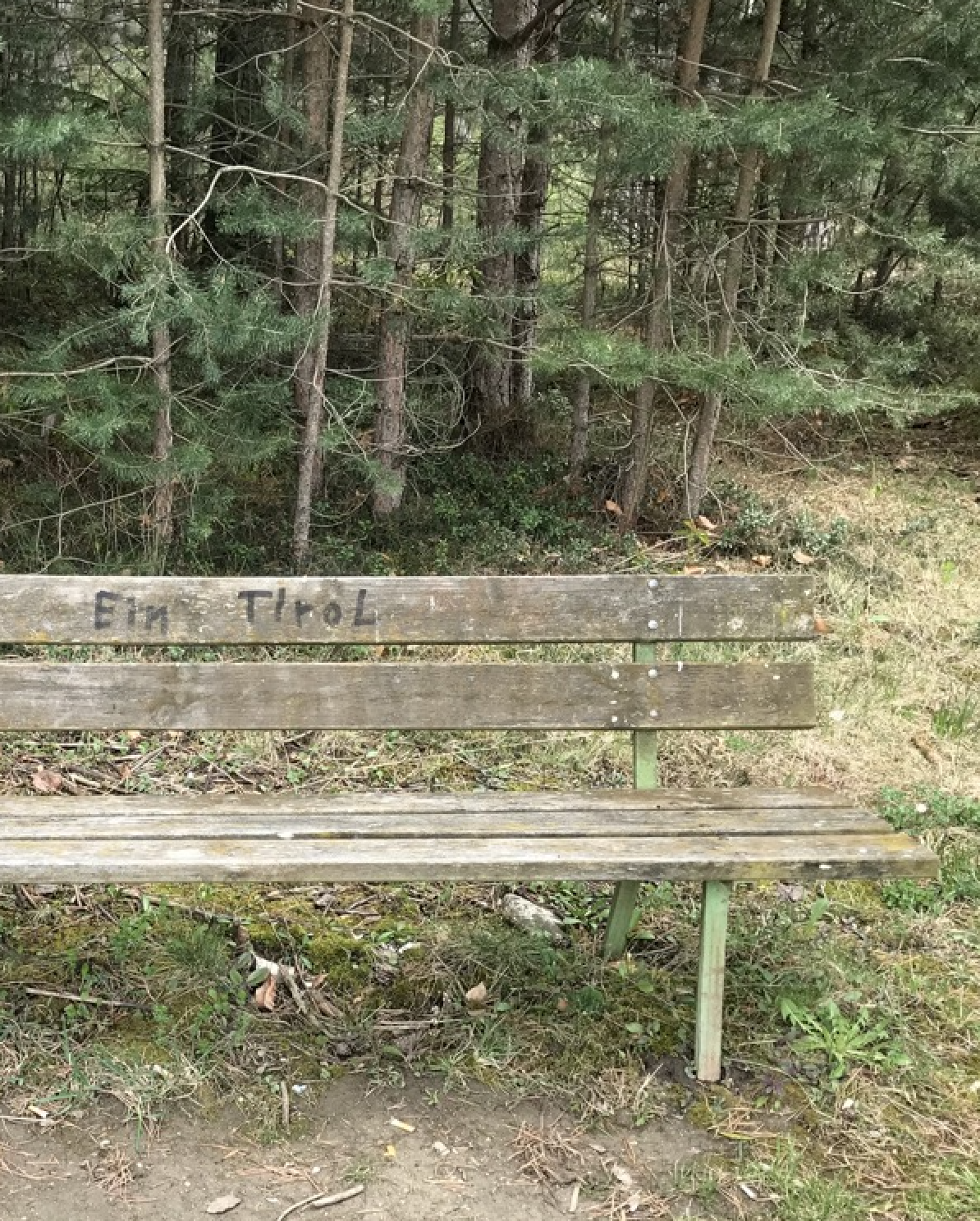
Within this interdisciplinary Graduate School, I am particularly interested in supervising anthropological PhD projects with a focus on statelessnessin Europe or its border regions or on one of the various European independence movements (e.g. in Catalonia, Bretagne, Basque Country, Scotland, Celtic Nationalism, One Tirol, … ). Other topics are possible, too, as long as they fit the programme and are based on ethnographic field research and lie within the field of political and legal anthropology.
Make sure you read the entire research programme carefully before preparing your application! If you have questions, contact me under my uni-konstanz email-address.The deadline is already 30 June 2024!
In contemporary Britain, it is no longer only migrants who are being targeted by the government, but those who fend for them just as well.
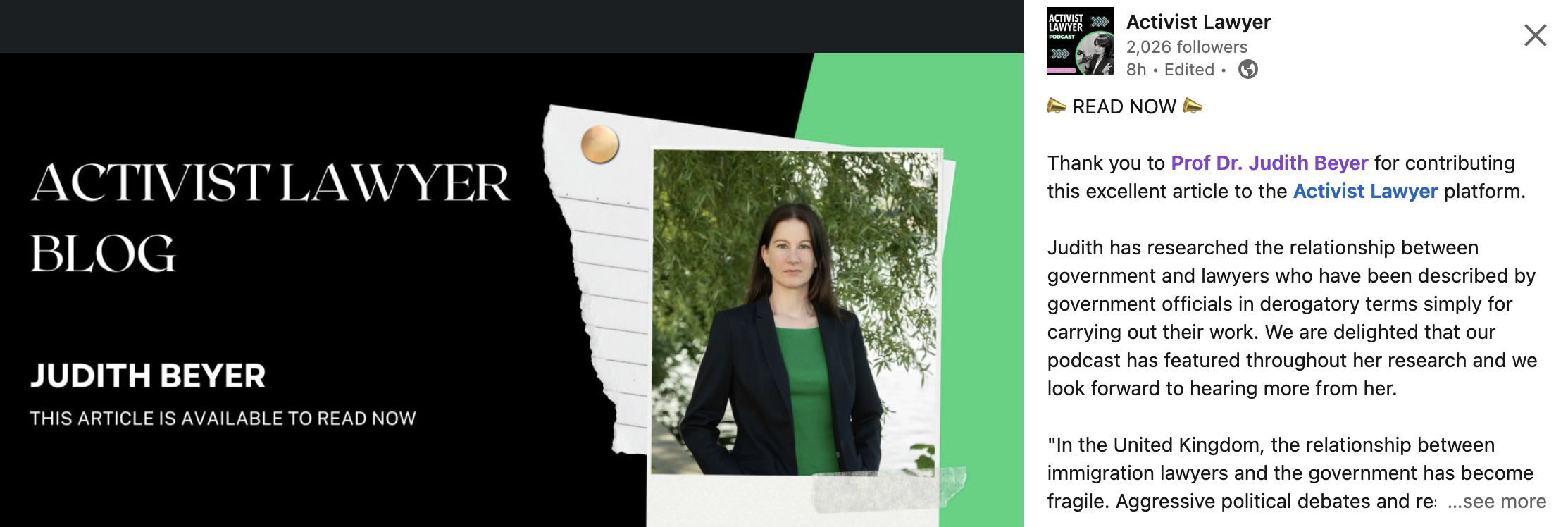
In “‘Illegal’ migration and the Othering of activist lawyers in the UK“, I argue that human rights solicitors, who pride themselves in fending for their marginalized clients, have become targets of state officials who began to call them “activist lawyers” in 2020. The current populist atmosphere in British politics regarding the topic of “illegal migration” not only others those who seek asylum, but also their immigration lawyers and NGO workers who are committed to supporting their clients in their asylum claims. Those lawyers who began to publicly reclaim the term “activist lawyers”, a term initially hurled at them as a slur, effectively managed to strip the state’s vocabulary of its negative attributes. What makes the term “activist lawyers” and the way it is being handled by im/migration and human rights lawyers particularly interesting is that it is no longer exclusionary words about others that lawyers are dealing with here, but words about themselves.
Through this reversal, lawyers brought the former slur in line with their profession’s ethical stance as well as their own personal biographies. The podcast and platform “Activist Lawyer”, hosted by the human rights solicitor Sarah Henry, has been covering this development since 2020 and features many interesting audio formats as well as texts. Make sure you visit “Activist Lawyer – and read my full text here.




 judith beyer
