Category Archives: politics

#Contra AI 🤖 – Arguments against AI

Since I am human, I have an intrinsic motivation to understand. Since I am an anthropologist, I have an intrinsic motivation to understand other humans. Since many humans seem more and more motivated to hand their intrinsic motivation to a machine, I am now intrinsically motivated to not only understand how AI operates and what its effects are, but who the humans behind the technology are and to what they might put AI to use.

Since I am also a university professor, I am faced with the topic of AI almost every day. I have noted three common ways of how academia relates to the issue so far:

a) AI is the future and everything will be great

b) we are doomed and we can’t win against AI

c) who cares about AI ?

So I have started to gather texts on AI, particularly those written by scholars or by journalists engaging with academic literature. The result (so far): AI is stupid and as such maybe not so different from humans after all. But: it feeds off our knowledge and it learns from our mistakes. It also gets better in duping us, luring us in and making us believe that there is indeed ‘someone’ on the other side. There is not.

Instead of a picture: a screenshot of how wordpress suggests to generate an image with AI. No, thank you.

Here is my list of collected texts (tbc.) which I enjoyed reading and which I recommend to everyone, whether you are a) b) or c).

Order on fair use

Shutdown resistance in reasoning models

Expressing stigma and inappropriate responses prevents LLMs from safely replacing mental health providers.

Your Brain on ChatGPT: Accumulation of Cognitive Debt when Using an AI Assistant for Essay Writing Task

What Happens After A.I. Destroys College Writing?

Why we fear AI: On the Interpretation of Nightmares

Writing is thinking

Surface Fairness, Deep Bias: A Comparative Study of Bias in Language Models

Geoffrey Hinton’s speech at the Nobel Prize banquet, 10 December 2024

Echte Emotionen. Generative KI und rechte Weltbilder

Assuring an accurate research record

Lawyer caught using AI-generated false citations in court case penalised in Australian first

Why Even Try if You Have A.I.?

Statelessness Studies In An Age Of Artificial Intelligence: Challenges, Opportunities & Setting A Future Agenda

Help Sheet: Resisting AI Mania in Schools

Against the Uncritical Adoption of ‘AI’ Technologies in Academia

Putting ChatGPT on the Couch

Large Language Muddle

When Knowledge Is Free, What Are Professors For?

Largest study of its kind shows AI assistants misrepresent news content 45% of the time – regardless of language or territory

What Machines Don’t Know

Kritik der Digitalisierung. Technik, Rationalität und Kunst

Nature: Major AI conference flooded with peer reviews written fully by AI

to be continued …

Open Acess: “Asylum Interviews in the UK”. Published in Social Anthropology

My new article “Asylum Interviews in the UK. The problem of evidence and the possibility of applied anthropology” has just been published with Social Anthropology / Anthropologie Sociale (33/3: 51-65).

In this article, I interrogate the process how evidence is established in asylum procedure by engaging with anthropological and socio-legal literature on evidence and credibility assessments. Drawing on ethnomethodology, I analyse asylum interviews and show in what ways evidence can be understood as the result of an asymmetrical co-construction. As a result of this procedure, the individual applicant disappears and a ‘case’ is established.

Anthropologists who write country of origin reports based on such ‘case material’ for tribunals and courts can highlight the asymmetries in evidence-making and question the very categorisations through which the state operates. The article contributes to ongoing debates on the role of anthropologists and their knowledge as experts in court.

It is open access and can be downloaded here.

Crimes against commonality

Before all other forms of membership, we are “all members of the human family”, as the preamble of the Universal Declaration of Human Rights has specified. Thus, the international legal concept of crimes against humanity is crucial because all war crimes are predicated on the fact that those committing these atrocities are enabled once they succeed in establishing difference that makes us forget our human commonality.

We cannot but make do with what the French psychoanalyst Jacques Lacan has called the imaginary order – the way in which we try to relate to others by looking for similarities and differences, mainly in order to acknowledge ourselves. We need the ‘other‘ to sustain ourselves as the I(ndividual) we imagine ourselves to be.

The imaginary order is the order of world-making in the sense of Hannah Arendt (1959) for whom the world is not ‘out there‘, but rather that which arises between people in discourse, as I will develop in an upcoming presentation. We have to keep engaging with others, irrespective of the fact that we will never really understand each other entirely. But we are obliged to keep trying. There is no other way.

“For the world is not humane just because it is made by human beings, and it does not become humane just because the human voice sounds in it, but only when it has become the object of discourse … We humanize what is going on in the world and in ourselves only by speaking of it, and in the course of speaking of it, we learn to be human” (Hannah Arendt, 1959, 24-25)

Human commonality is already there from the beginning, transcending all dichotomies, whereas difference is something we can only ever bring about consciously. What we have in common and what makes us human is that we are split by language, as Lacan argued. If we acknowledge this, we might be able to include the other not as an opposite ‘they’ but as part of our own unconscious: we are always other to ourselves first.

UN Photo In 1950, on the second anniversary of the adoption of the Universal Declaration of Human Rights, students at the UN International Nursery School in New York viewed a poster of the historic document.

Boat is a man

2024 has been the deadliest year for migrants trying to cross the Channel in small boats to reach the UK, with 69 deaths reported (Refugee Council 2025). British politicians have been referring to the circumstances under which people migrate to the UK as “the small boat crisis“ and subsequently made a “small boat deal“ with countries such as Ruanda, to which they wanted to ship people to.

Before the Labour party came to power, they accused the Tories of “having lost control of small boat migration“. Now, that they are in power, they claim that there is “no nice or easy way of doing it“. Getting rid of people who came by boat…

But what if boat were a man?

I recently bought a small booklet filled with Walter Benjamin’s short stories. Tales out of loneliness is its subtitle. In it, there is a 1-page story entitled How the Boat was Invented and Why It Is Called ‘Boat‘. It follows a similar pattern as Benjamin’s short story on Why the elephant is called ‘elephant‘ that immediately precedes the story about the boat.

The storyteller. Tales out of loneliness. Walter Benjamin. Verso Books 2023.

Here’s how Boat’s story goes:

Before all the other people, there lived one person and he was called Boat. He was the first person, as before him there was only an angel who transformed himself into a person, but that is another story.

So the man called Boat wanted to go on the water — you should know that back then there was a lot more water than today. He tied himself to some planks with ropes, a long plank along the belly, that was the keel. And he took a pointed cap of planks, which was, when he lay in the water, at the front — that was the prow. And he stretched out a leg behind him and navigated with it.

In this manner he lay on the water and navigated and rowed with his arms and moved very easily through the water with his plank cap, because it was pointed. Yes, that is how it was: the man Boat, the first man, made himself into a boat, with which one could travel on water.

And therefore — of course that is quite obvious — because he himself was called Boat, he named what he had made ‘boat‘. And that is why the boat is called ‘boat‘.

(Walter Benjamin, 26 September 1933; published posthumously)

The “small boats crisis” is Boat’s crisis, the crisis of man. This is the elephant in the room that nobody wants to talk about. Because they do not know why the elephant is called ‘elephant‘ either.

Philosophy saves lives.

Paper boat made out of a book page (photo by: Maddy Freddie, pexels.com).

Help Myanmar!

The people of Myanmar are the most resilient people I have ever met.
But now, after this devastating earthquake, and with ongoing relentless attacks from the military since the attempted coup of 1 February 2021, they are exhausted and really need our support.

This is easier said than done. When a military dictator, notorious for shooting civilians in broad daylight, for bombing innocent children in their schools out of airplanes, for planting mines across the entire country which will cause suffering for decades to come, suddenly begs the “international community” for any humanitarian aid possible, we need to be very careful.

While international aid and financial support is of utmost importance at this moment, it can not go to the “state” of Myanmar, a structural position currently occupied by the military. As there is no legitimate government inside the country, there will be no way to ensure that the money reaches those who need it.

Instead, we can be sure that humanitarian aid will be diverted by the generals. So, how can you support those suffering?

Here are three initiatives, the first two are known for having done great work since at least the attempted coup, the third one is a personal recommendation:

1. Better Burma (https://lnkd.in/erq79zv6)

2. Advance Myanmar (https://lnkd.in/eQiC_8ut)

3. My PhD student from Mandalay, Nickey Diamond (Ye Myint Win), is collecting funds (https://lnkd.in/eNgZdGjD)

Please repost this and – if you can afford it – please help the people of Myanmar – they deserve it!

Thank you. ကျေးဇူးပါ။

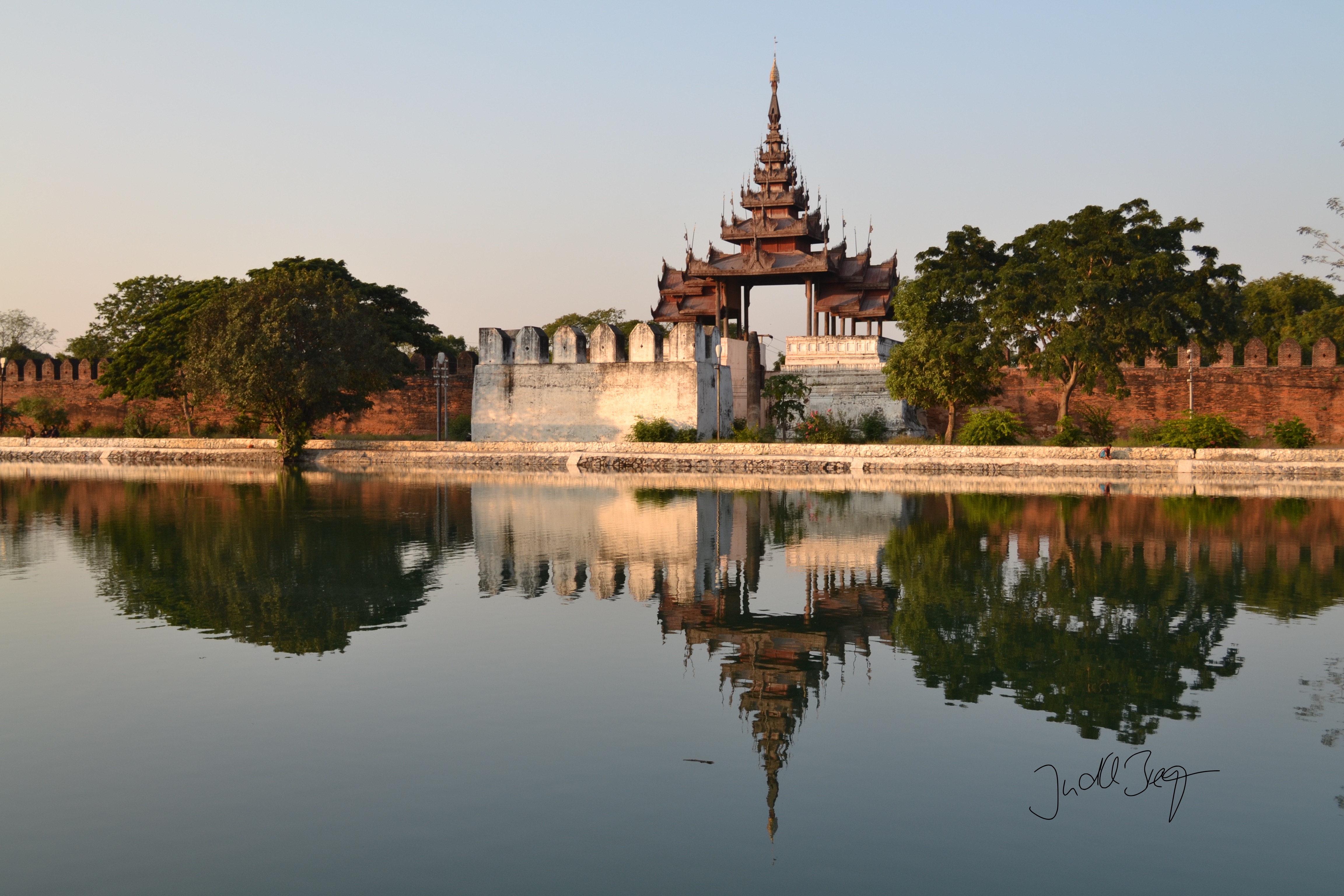
(photo: Judith Beyer. December 2013, Mandalay Palace)


Research Colloquium at Université Paris-Nanterre

This winter term, I will be spending some time with my anthropology colleagues at Paris-Nanterre as part of the Laboratoire d’Ethnologie et de Sociologie comparative (LESC), part of the Centre National de la Recherche Scientifique (CNRS).

One part of my research stay is devoted to working on my current project: “Towards an anthropology of statelessness”. I will be speaking at the Department’s Colloquium in December (see plan below). I will also be teaching a course in legal anthropology … more about this one later.

The colloquium is free and open to the public, everyone is welcome.

In honour of Akbar Hussain (1944 – 2024)

On July 28, 2024  at 4.30pm, my  dear Akbar Hussain passed away.

We have known each other for over a decade and as is the case with many central interlocutors in anthropology, there is never a way to thank them enough for what they are enabling us to achieve. Akbar Hussain was born as Mohammad Akbar Hussain Khan. He descended from a well-known Turkic Qizilbash family of high-ranking warriors, originating from Lankaran in what is now Azerbaijan. His ancestors had fought in the British Army and their heroic services were rewarded with name titles – such as “Captain” – and with land titles – such as a grant given to Akbar Hussain’s great-grandfather in 1886 that allowed him to relocate from the Northern part of British India to Burma. While the family raised their children in Myanmar, they continued to go back and forth to countries in the East such as Pakistan (since 1947) and the West (Akbar Hussain himself lived in the USA for many years). Theirs was a polyglott Muslim family as most Muslim families are in Myanmar. In contrast to his ancestors, however, Akbar Hussain did not serve any army; he served his mosque in downtown Yangon. He knew its history better than most, and due to the location of his appartment, he also knew its present: who would go in and out, at what time and for what purpose. He was curious enough to engage with my curiosity, multi-lingual so that we could easily communicate about the most complicated matters, very knowledgable and yet modest and able to admit when he did not know something – suggesting that I probe literature instead of his brain.
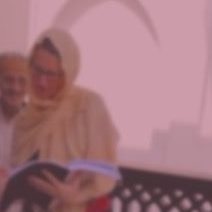
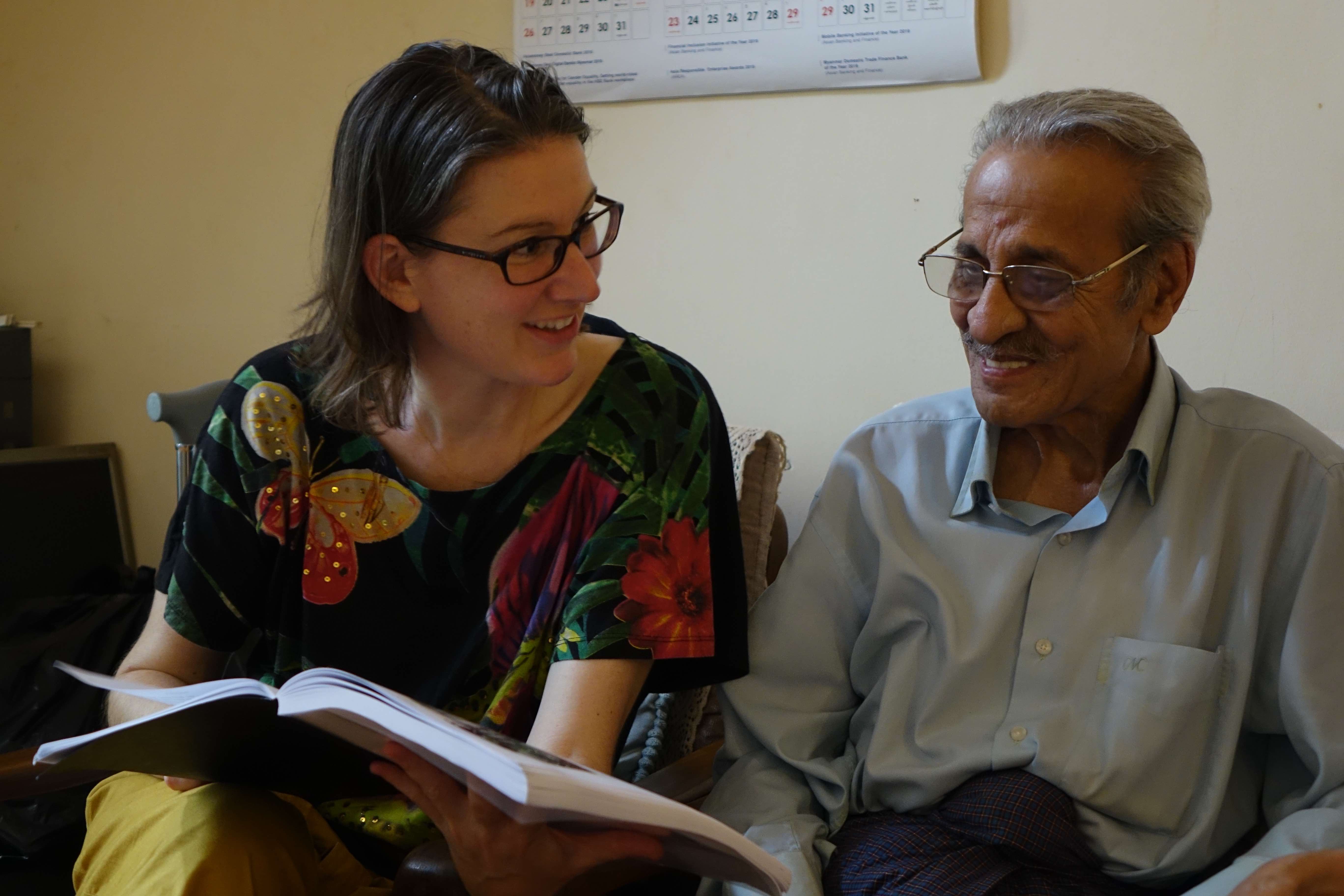
This is a very blurry picture of the two of us, but somehow, it says so much about our relation. Akbar Hussain was always there when I needed him and even, when I did not know that I needed him. He always kept to the background or to the sidelines, observing everything, commenting quietly afterwards or hinting at things, pointing at people, alerting me what to pay attention to, and whom to listen to more closely. Translating from Urdu to English for me at times, and always making sure that I get home safely at night after a procession or another long day spent at his house with him and his lovely wife.

He passed away and I could not say goodbye properly, neither in person, nor at the graveyard. He had asked me many times to come see him during the last few years. We communicated via a third person who would scan his handwritten letters to me in an internet café … as if it were the 1990s, as if there was a military dicatorship in place … wait … oh. And I would write self-censored emails back, because I knew that I was sending them to an address and a person whom I did not know and that I relied on that person to print them out and give them to him when he came to pick up his ‘mail’. So he knew all about my private life in safe Europe, but little of my fears and worries for him, his wife and everyone in Myanmar, really, as there was no way to ask how he was really doing in the current situation. He never spoke of politics, he sticked to writing about his health, his religion, the weather and of course reported meticuously about all upcoming festivities at the mosque.

We met at the mosque over 10 years ago and soon I realized that he frequently stayed at the managing trustee’s house at the time. He was his right hand, but also a careful observer as the person was very old and also not uncomplicated, feared by some even. Akbar Hussain knew how to handle complicated people, he even knew how to deal with a female German anthropologist who intruded into the daily life of the mosque, too, but – in contrast to  tourists or journalists who dropped in and out, sometimes coming only for one day in the year – Ashura – to witness, record and distribute gruesome images of men flagellating themselves or walking over burning coal – to then disappear again, thinking they had understood something, he dealt with me as someone who would always come back and stay because I somehow never understood enough. And he kept explaining. Eventually, when he thought, I had acquired enough knowledge, he asked me: “Hey, when will you become Shia?” In my book, I recall this sentence and have interpreted it in the following way:

‘Hey, when will you become Shia?’ he often asked, which indicated to me that it would have been easier for him to conceive of me as a converted ‘member’ than as someone who was simply very interested (and increasingly knowledgeable) in what it means to be a Shia in Yangon. My interest and knowledge in the Shia religion were fine, but they were not what mattered in the end: membership in the community did (Beyer 2024 ,8)
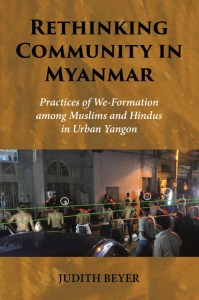
He is on the cover photograph of my Myanmar book, as usual at the sidelines, with his back even turned away from where supposedly the ‘action’ is, yet later able to deconstruct and interpret the event with me in all its details. Since we often sticked together, everyone initiatially wondered who I was. The following conversation is from a transcript I made between Akbar Hussain, me and another person from the mosque who explained to me how Akbar Hussain would answer this question in my absence.

Third person (to me): they all ask ‘where is she from, where is she from?’ Akbar Hussain then always says ‘my relation’ #00:08:44-6#

AH Because my relation are all foreigners  #00:08:49-8#

J That is true #00:08:51-8#

AH So they thought that you are my relative #00:08:57-3#

J That’s good – we can keep it this way (laughs) #00:09:02-9#

AH They ask me ‘from America?’ ‘No, I say, from Germany.’ They are very inquisitive (laughs) #00:09:18-7#

J That’s fine, I am also inquisitive #00:09:23-9#

(all laughing) #00:09:26-6#

All his relatives are foreigners, he said, because Akbar Hussain had chosen to never give up his Pakistani citizenship. He loved Myanmar and Yangon, the downtown area, his street and the mosque, but his home was in Pakistan where he spent his youth and went to university. He was fiercely political, one of the harshest critics of the mullahs in Pakistan and in Afghanistan, of those who perverted his beloved religion and his culture. He was proud and knowledgable and sometimes so outspoken that when he picked up the microphone at the mosque to condemn the killing of innocents, the endemic corruption or anything else going on in Pakistan, Saudi Arabia, Iran or Northern Africa, one could mistake him for being radical himself. He was radical in the sense that he did not only believe, but stood up for what he believed. But this concerned politics and religion abroad. He was careful to not position himself publicly when it came to Myanmar – knowing that he was a foreigner by choice. Someone who had to frequent the downtown visa section of the Ministry of Foreign affairs every few months to renew his residence status. While he had tried to incorporate me into his ‘community’ and even his family, he himself had remained Other all the time … we both occupied the same positionality, I later understood.

I read about Akbar Hussain’s death on the Facebook page of a friend of mine from Yangon. She is the wife of the late managing trustee and knew Akbar Hussain very well. He saw her getting married at a young age, he saw her two children growing up, he went in and out of her house in downtown for many years and he supported her late husband in many ways. She is thankful for him, her story being one of the numerous stories that need to be told because they are paradigmatic for Myanmar’s Muslims: for the way religious divides are being bridged, for the way religious tolerance is being practiced at a low level, for the way in which the people of Myanmar are capable of transcending the categories that have been imposed upon them throughout colonial history. These are the stories we do not get to hear about too much, but they exist and they matter. Just like the people that tell them.

One last conversation in person. Spring 2020 (photo: Felix Girke)

Akbar Hussain, may you rest in peace and … thank you.

မိသားစုနဲ့ထပ်တူအလွန်တရာမှဝမ်းနည်းကြေကွဲမိပါတယ်စိတ်မကောင်းလိုက်တာသူသိတ်ချစ်မြတ်နိုးလှတဲ့လလေး Muharram လမှာဆုံးသွားရှာရတာစိတ်ထိခိုက်ဝမ်းနည်းမိပါတယ်

Inna lillahi wa inna ilayhi raji’un إِنَّا لِلَّٰهِ وَإِنَّا إِلَيْهِ رَاجِعُونَ.


Come work with me! PhD positions on Europe

If you are a recent graduate (MA-/MPhil-degree holder) with an interest in pursuing a PhD in Social and Cultural Anthropology under my supervision, please consider applying for a PhD position at the newly established Graduate School “Post-Euroentric Europe. Narratives of a World-Province in Transformation” at the University of Konstanz.

Together with 10 other professors we have worked hard in the last years to realize an ambitious and highly relevant programme that is aimed at decentring and questioning narratives about Europe.

“Where is Europe?” we might be tempted to ask. “And is it even one place?” (Attali 1994). Is Europe to be found in the minds and hearts of the refugees detained in camps on its southern border, for whom it is place of longing, even as it denies them entry or sets up hurdles in their way? How and to what extent do “soft” cultural factors in the form of collective narratives and imaginations solidify into “hard” institutional realities, which in turn have a reflexive effect on the availability of narrative resources?

While it has long been customary to regard “Europe” and “modernity” as more or less synonymous, only recently has there been a systematic examination of the fact that the European continent was and is permeated by political-cultural demarcations and asyn-chronicities, even within its own borders. Increased attention to non-European traditions or those marginalized in Europe’s dominant self-narrative not only guides a redefinition of Europe’s position in world affairs; it also requires us to diversify notions of Europe from within.

The work of our graduate program aims to contribute to the historical and contemporary demonopolization of the concept of Europe in local contexts, which has been tightly restricted to dominant traditions in the West-Central European area.

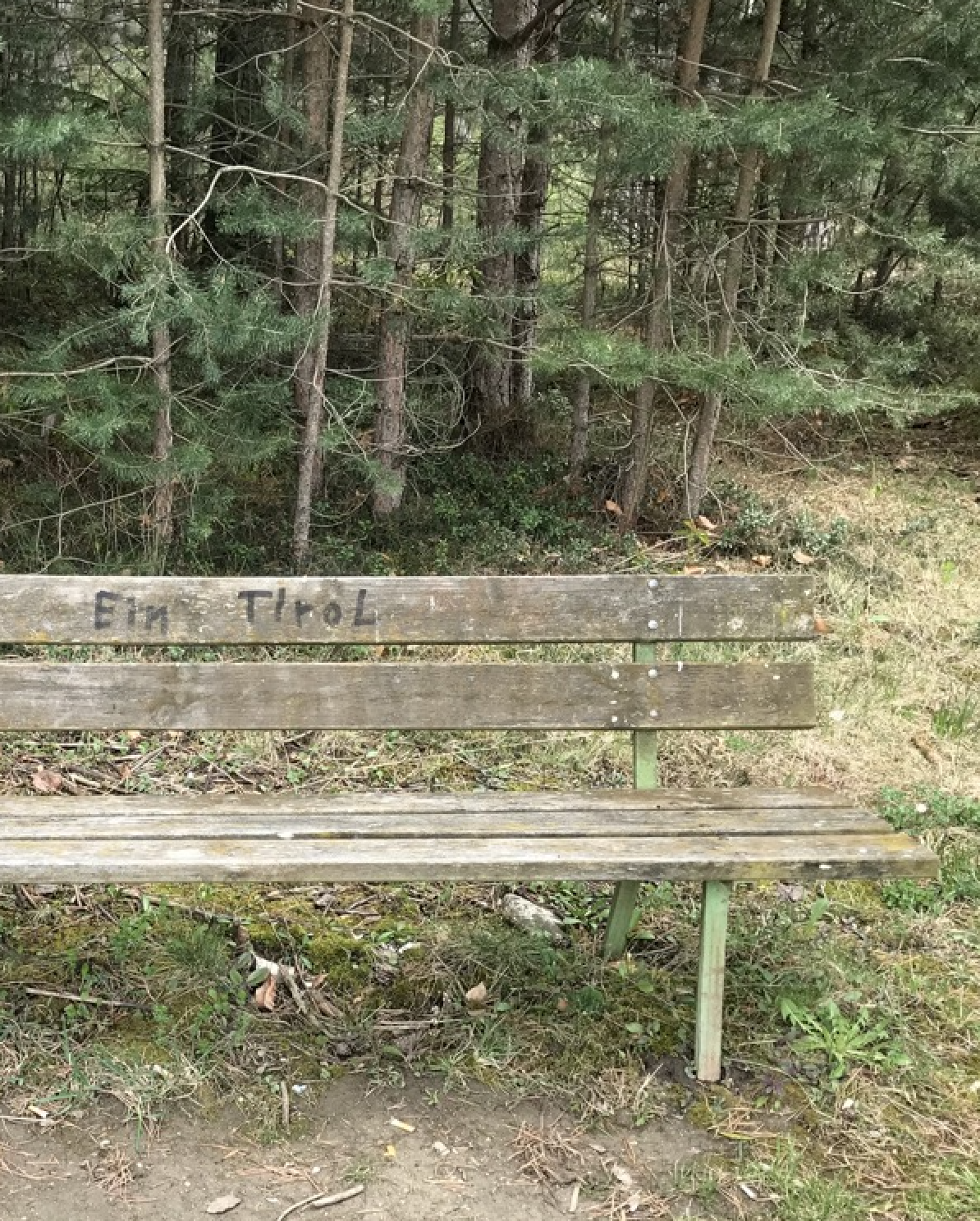
Within this interdisciplinary Graduate School, I am particularly interested in supervising anthropological PhD projects with a focus on statelessness in Europe or its border regions or on one of the various European independence movements (e.g. in Catalonia, Bretagne, Basque Country, Scotland, Celtic Nationalism, One Tirol, … ). Other topics are possible, too, as long as they fit the programme and are based on ethnographic field research and lie within the field of political and legal anthropology.

Make sure you read the entire research programme carefully before preparing your application! If you have questions, contact me under my uni-konstanz email-address.The deadline is already 30 June 2024!

New post for the “Activist Lawyer”-platform

In contemporary Britain, it is no longer only migrants who are being targeted by the government, but those who fend for them just as well.

In “‘Illegal’ migration and the Othering of activist lawyers in the UK“, I argue that human rights solicitors, who pride themselves in fending for their marginalized clients, have become targets of state officials who began to call them “activist lawyers” in 2020.
The current populist atmosphere in British politics regarding the topic of “illegal migration” not only others those who seek asylum, but also their immigration lawyers and NGO workers who are committed to supporting their clients in their asylum claims. Those lawyers who began to publicly reclaim the term “activist lawyers”, a term initially hurled at them as a slur, effectively managed to strip the state’s vocabulary of its negative attributes. What makes the term “activist lawyers” and the way it is being handled by im/migration and human rights lawyers particularly interesting is that it is no longer exclusionary words about others that lawyers are dealing with here, but words about themselves.

Through this reversal, lawyers brought the former slur in line with their profession’s ethical stance as well as their own personal biographies. The podcast and platform “Activist Lawyer”, hosted by the human rights solicitor Sarah Henry, has been covering this development since 2020 and features many interesting audio formats as well as texts. Make sure you visit “Activist Lawyer – and read my full text here.

New publications on legal pluralism and community

Two new publications came out this month — one on my last research with ethno-religious minorities in urban Yangon in Myanmar, the other based on long-term fieldwork in Central Asia, in rural Kyrgyzstan.

In “Legal Pluralism in Central Asia“, published for an edited volume on the Central Asian World by Routledge, I put forward the argument of a rhetorical emergence of legal pluralism, combining literature from legal and linguistic anthropology.
I argue that
“we should understand legal pluralism not as the precondition that allows for cases to be dealt with and adjudicated in a plural legal manner; rather, it should be considered a possible outcome whose rhetorical emergence empirically varies from case to case. Depending on the situation, legal pluralism does not define the set-up of a case from the beginning, but rather becomes created intersubjectively in situ by the disputing parties involved in the case” (410).
I conclude with a caution:
“As anthropologists, we should refrain from advocating legal pluralism in such contexts [where claims about ‘custom’ are competitive rather than descriptive] as a more “culture- friendly” or encompassing way to deal with questions of order, sanctioning or indeed harmony, since “Plurality may actually reinforce structures of inequality as the plurality of forums available decreases the binding power of any law” (418, von Benda- Beckmann et al., 2009, p. 12).

In “Community as a category of empire“, published for History and Anthropology, I argue that ‘community’ is a category that is inextricably bound up with the historical development of the British empire. It was in this context that modern social theory took root, including, eventually, publications on community in anthropology and sociology that profoundly influenced nineteenth- and twentieth-century thought and that continue to shape everyday understandings of the category within and beyond academia. I first elaborate what type of work the category ‘community’ was intended to do in the British empire. I then introduce two key figures who were responsible for designing, distributing and implementing two contrasting imperial theories of community. Subsequently, I sketch the migratory history of the category following the ancestors of today’s so-called ‘Burmese Indians’ across the Bay of Bengal from India to Burma. The final part of the article presents the repercussions ‘community’ has in contemporary Myanmar, drawing on recent legislation around ‘race and religion’ as well as my own ethnographic data from religious processions of ethno-religious minorities who find themselves in a subaltern position vis-à-vis the Buddhist majority population and an ethnonationalist state.