Category Archives: outreach

Interview with Al Jazeera on statelessness, human rights, Myanmar, Kyrgyzstan

Why are human rights defenders being targeted?” asked Al Jazeera Rajat Khosala from Amnesty International, a specialist for advocacy and policy, Tobi Cadman an International Human Rights Lawyer and myself. Al Jazeera’s “Inside Story” draws a bleak picture of the human rights situation worldwide with repression in authoritarian states increasing. Human rights defenders are particularly being targeted. I reported about the current situation of human rights activism in Kyrgyzstan and Myanmar where we have just witnessed a military coup. I also spoke about the situation of the 10-15 million de-facto stateless people worldwide who cannot even claim human rights as they lack a nationality.

“Why are human rights defenders being targeted?” Al Jazeera, February 5, 2021.

I explained the difference between de jure and de facto statelessness and emphasized that the roles of the state system and that of the United Nations need to be rethought when it comes to statelessness in particular and how we can all ensure the adherence to human rights in general. We also touched upon the importance of staying connected digitally as activism is increasingly being carried out online.

In the name of stability. On the coup in Myanmar

Myanmar’s immediate neighbours have reacted very reluctantly in regard to the military coup that began on February 1 2021. Whereas ASEAN member-states have largely declared the coup an “internal affair” into which they would rather not get involved, China said it had “noted” the events and urged the country to uphold “stability”.

Stability, however, is not a neutral or entirely positive concept I argue in this German-language article for the daily newspaper TAZ: it is possible to justify not only repression and coups in Myanmar with it, but even the recent genocide of the ethnic Rohingya.

Stability has been a key metaphor during previous military dictatorships as well: Until 2010, for example, the second out of four so-called “national causes” that the military government under General Than Swe promoted under the title “The People’s Desires” read “Oppose those trying to jeopardize the stability of the state and the progress of the nation.”

It had also been Aung San Suu Kyi herself who, in December 2019 in her role as a member of her country’s delegation at the International Court of Justice (ICJ) left the more legalistic arguments to the specialists for international law, and challenged the legitimacy of the case on the basis of harmony ideology.

In the name of stability,she argued that the principal judicial organ of the United Nations should refrain from interfering in Myanmar’s domestic affairs.

In my recent article, I thus hold that invoking ‘stability’ is more in line with what the military government is advocating than it it is supportive of the civil resistance that is currently beginning to form.

Read the full post in TAZ.

“Sprechstunde” – neues Interview

Die Interviewreihe “Sprechstunde” der Universität Konstanz stellt ProfessorInnen aller Fachbereiche persönlich vor – als WissenschaftlerIn und als Lehrperson. Hier gebe ich Auskunft über meine Professur, meine Forschungen in Zentral- und Südostasien, mein neues Forschungsprojekt zu Staatenlosigkeit in Europa, sowie über unseren interdisziplinären Masterstudiengang “Ethnologie und Soziologie”, der einzigartig in Deutschland ist.

Towards an anthropology of statelessness

As part of my tenure-track evaluation I held a public lecture at the end of April 2020 at the University of Konstanz on the topic of statelessness. I am currently in the process of drafting a funding application that would enable me to work towards developing how an anthropology of statelessness could look like.

I’d like to mention a couple of thoughts here to help me think through this potential new subdiscipline and to raise awareness of what I think is a structural lack at two different levels:

1) within the very concept of the nation-state and

2) within the anthropology of the state.

While the first concerns the prime object of analysis of the anthropology of the state, the second concerns a structural lack within how we have up to date researched that prime object.

I argue that statelessness has so far been approached as something ‘lacking’ in the constitution of those who do not have a nationality — for whatever reason (and there are many). Thus, activists, practitioners, (I)NGOs and other global actors have focussed their attention on ‘fixing’ the lack of the stateless by trying to make sure they, too, receive nationality (or citizenship; I won’t go into details here as to where these concepts overlap and where they don’t). In doing so, statelessness has remained an ‘anomaly’ — something that needs ‘fixing’. But we have neglected (almost entirely) in our scholarly analyses (these are mostly legal, political and almost none anthropological up to date) that it might not be the stateless who need ‘fixing’, but the nation-state itself. This argument has been made by the political theorist Phil Cole (2017), for example,  but needs to be taken seriously and thought through in legal and political anthropology as well for it might provide novel insights into the anthropology of the state.

Understanding statelessness as a structural lack of nation-states

In my tenure lecture, I have argued that statelessness cannot be researched at the ‘heart of the state’ (Fassin) or at its ‘margins’ (Das and Poole) where anthropology has so far located its objects of inquiry when studying the state in a transversal or tangential (Harvey) manner. It rather points to what I – with Lacan – would define as a structural lack in how nation-states are set up and operate. As such, this type of lack is not meant to be ‘filled’. As much as statelessness is not a mode of being that could be ‘fixed’, the structural lack that statelessness opens up statelessnesswithin the concept of the nation-state is not meant to be ‘filled’. It is there on purpose, I argue. Treating statelessness not as anomaly, but as an intentional product in the way the state operates allows for new insights into the state as much as it will move our engagement with the phenomenon of statelessness beyond appeals of ‘fixing’.
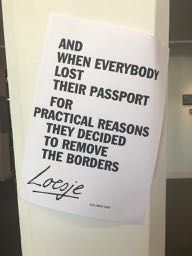
As much as statelessness is not a mode of being that could be ‘fixed’, the structural lack that statelessness opens up within the concept of the nation-state is not meant to be ‘filled’.

Despite the fact that we have international conventions in place since the mid 1950s, and despite the fact that more and more states have ratified these conventions and are closing legal loopholes: statelessness continues to exist and in many parts of the world, including Europe, its numbers are increasing. It remains one of the most overlooked human rights violations and it won’t go away, no matter how much the UN wants it to. The project I am currently drafting would bring legal scholars, anthropologists and practitioners together and study the structural lack of statelessness as an intrinsic component of the nation-state.

From stateless societies to stateless individuals

Anthropologists have historically dealt with stateless societies as part of Europe’s (and America’s) colonial politics of expansion and exploitation. Most ethnographic monographs centred on ‘acephalous’ ethnic groups or tried to grapple with understanding how groups organized and interacted with one another without a clear leadership or someone ‘in power’. After the demise of colonialism, such work has almost completely come to a halt; the state has come to tighten its grip on ethnic groups to such an extent that there is, by now, no place on earth that would not feel its eery presence. This includes hunter-gatherer societies (Sapignoli 2018) and sedentary tribes (Girke 2018) in rural Africa as much as agrarian groups in Southeast Asia (Scott 2010). However, statelessness has remained an immanent phenomenon worth anthropological attention. My argument is, however, that nowadays we need to focus on stateless individuals (in the sense of an anthropo-logy) more than on stateless societies (in the sense of an ethno-logy). While many groups are de facto stateless (e.g. Rohingya), the de jure status of statelessness is granted to individuals only. In line with an existential anthropology (Jackson and Piette 2015), my aim is to research statelessness not as a historical leftover of group encounters with the (colonial) state, but as an existential human condition that allows us to understands a structural lack of the contemporary nation-state.

Stay tuned …



#corona On being prudent

In a recent post for Allegra Lab, I ask what we can do from our homes, to which we are confined these weeks, being overwhelmed, seeing the problematic and political nature of  all these facts and narratives that are presented to us in the Covid-19-crisis.

I have elaborated on three tasks:

First, we can join public debates and be a voice of prudence. This is to help de-escalate discussions where people – sometimes out of sensationalism, sometimes out of hurried obedience and often out of fear – demand that their states take extreme measures of surveillance, deprivation of liberty and sanction. The term “state of exception” has been used to such an extent that we have gotten used to it already – exactly what Giorgio Agamben warned us about.

Second, we can engage with our students and address their sense of insecurity by adapting our upcoming or ongoing courses, seminars and lectures in a way that allows the topic to influence whatever subject we had intended to work on. Since few things are as pervasive as a global pandemic, there is hardly any subject (in anthropology and beyond) which we could not reconceptualize by taking account of COVID-19. As we will have to teach digitally, it is also important to discuss the pitfalls that come with online learning, while making use of newly available resources.

Third, we can practice writing our fieldwork diaries in our homes: Note down how the virus has already impacted our own personal everyday lives, how it has led to a restructuring of our daily schedules, how it has decreased and altered the amount of time we spend with colleagues and friends and how it might have increased the number of hours we spend with members of our household. For those of us who have children, we can observe how they, too, struggle to adapt to a physical world that has suddenly shrunk and to a digital world that has suddenly expanded. We can look outside our windows and correlate how changes in governmental policies become observable in the very way people physically move in the streets. And we can honestly record our own feelings from day to day. We can then come back to these notes at a later stage – just as we do when we come home from the field.

This too, to me, is public anthropology. One directly engages with the media, the second takes up current topics and reworks these with our students for whom we are responsible, and the third collects data diligently in order to be able to draw from this source later on when we have the capacity and the psychological distance required to take a long hard look at what is happening in front of our eyes right now.

Read the full post here. My intro is part of an ongoing series which we have labelled #corona thread.

Keynote on “Little and Grand Narratives in Central Asia”

Keynote speech “Little and Grand Narratives in Central Asia”

Held at the Conference “Central Asian Studies Inside Out. Challenging Grand Narratives”, organized by l’EHESS and ZMO (Berlin). March 28, 2019. Paris.

In this keynote speech, I engaged with the conference topic of “challenging” and even “disturbing” “Grand Narratives” through an investigation of the tradition of orality and the usage of oral history in Central Asia. These are two interlinked endeavours, as oral tradition has been investigated “as history” (Vansina) and oral history understood as “the voice from the past” (Thompson). Anthropologists (of Central Asia) investigate tradition as “a site of necessary engagement that aggregates people, … informs policy, public debates, law, and representation, and is – despite its often enough strategic inception – affectively powerful” (Beyer and Finke forth. in Central Asian Survey). Examples from Central Asia show how “oral tradition”, especially when mediated by state and media apparatus, can take on “grand narrative” qualities. Moreover, in contrast to how oral history has been treated in the past, namely as history “from below”, of “the everyday” and by “the little guys” (Graeber), thus as “little narrative”, as I call it, it is worth exploring in what ways this method of ethnographic and historical inquiry has the capacity to yield “grand” results.


Interview with the ASN

In 2007 I attended one of my first academic conferences, the Association for the Study of Nationalities (ASN)-Conference in New York, which is held yearly at Columbia University. I enjoyed travelling to New York as I had lived in this city for one and a half years in 1997-1998. It gave me a chance to see friends and my former host family.

I thoroughly enjoyed the conference, particularly meeting colleagues I had gotten to know during my field research in Kyrgyzstan (2005-2006) and, for the first time, seeing “big names” in person whose work I had read as a graduate student and when preparing for my PhD-project. I presented a paper on the imagination of state law in Kyrgyz aksakal courts (lit. courts of elders) — the first part of my ethnographic data I decided to work with. I did not expect winning an award for this that early, but I guess part of the reason why I won is that I just followed my intuition to start with the most fascinating part of ethnography that I gathered during my field research.

Here is the interview with ASN – go check out their new website, too! You will find more interviews with other scholars as well as a bunch of new resources.

Judith Beyer Interview

April 2, 2019

In 2007, Judith Beyer wrote an award winning paper on Kyrgyz legal pluralism. Today her academic focus also includes Myanmar and issues of statelessness.

ASN19 Judith Beyer

ASN: In 2007 your paper “Imagining the State. How perceptions of the state influence customary law in two Kyrgyz communities” won one of the Best Doctoral Students Awards. What was the inspiration for this paper?

JB: I had just returned from 15 months of fieldwork in rural Kyrgyzstan and had to decide which part of the data that I had gathered I wanted to work with first. I decided to start with an extended case study I had found particularly intriguing. Part of my research had been devoted to understanding the type of work of the so-called “aksakal courts” (lit. “courts of whitebeards”, i.e. male elders) in the two villages I was working in. This institution can be described as neo-traditional, although the figure of the “whitebeard” and the assumption that (male) elders, in their roles as household or lineage heads, are capable of solving local disputes, goes back centuries in Kyrgyzstan. The paper drew on a particular case I had participated in, centred on questions of divorce, remarriage, separation of property and child support. What intrigued me most, however, was how – in a rural setting where “the state” was experienced as absent, where the end of the Soviet Union had resulted in the demolishing of the social security system, where there was no police and no formal state court – the local court of elders engaged in what I call “performing the state” by replicating what they imagined to be state court procedures. “There is no state here anymore” was a sentence I regularly heard from my informants. Thus, feeling left to their own devices, the aksakalshad to handle their new role as judges by themselves, a role into which they were pushed by new laws on local dispute resolution, enacted after the country had become independent in 1991. In court sessions they tried to create the appearance of a state court and introduced procedures they claimed were derived from state laws. They also invoked the state apparatus as a threat, specifically when people did not want to heed their decisions. While the institution of the aksakalcourt had been explicitly set up in each village of the country to allow adjudication according to “customs and traditions” as a special law on the aksakalcourts stipulated, the elders acted out imagined state law instead.

ASN: What stage in the graduate program were you at the time?

JB: I was a PhD candidate at the Max Planck Institute for Social Anthropology, where I was a member of the working group “Legal Pluralism” headed by the legal anthropologists Franz and Keebet von Benda-Beckmann. I was also enrolled as a PhD student at the Martin Luther University Halle-Wittenberg from which I then graduated in 2010.

ASN: What happened to this paper?

JB: I published a first version as a Working Paper and a later version appeared in an edited volume entitled “Ethnographies of the state in Central Asia” in 2014 with Indiana U Press, which I co-edited with Madeleine Reeves and Johan Rasanayagam. I also use the ethnographic material in a chapter of my monograph “The force of custom. Law and the ordering of everyday life in Kyrgyzstan” which I published in 2016 with the U of Pittsburgh Press.

What is your current position?

In October 2014 I have been appointed Professor of Anthropology (tenure track) at the University of Konstanz in Germany.

What projects are you working on now?

From 2010 onwards, I developed a new regional interest in Asia, starting fieldwork in Myanmar. There, I work in Yangon, the former capital of the country, a metropolis of seven million people – quite a change of scenery compared to the Kyrgyz village I used to live in! My interest lies in understanding the positioning of religious and ethnic minorities in this city, particularly Hindu and Muslim groups, their histories of migration from India in the 19th century as part of the final expansion of the British Empire, and their current political situation in a de facto Buddhist state which has had a long history of repressing minorities, particularly Muslims. I am specifically interested in understanding my informants’ strategies of acting as “communities” in order to secure their religious properties as well as to keep a realm of autonomy and self-determination in an increasingly hostile environment. There are, however, numerous overlaps to my research in Central Asia and I have begun to publish comparatively by drawing on my insights from Kyrgyzstan. Most recently, for example, an article on the concept of “transition” that has been so central in scholarly analyses of the entire post-Soviet world and that has now migrated from Central Asia (where I encountered it first) to Myanmar. The article is called “’Transition’ as a migratory model in Myanmar” and has been co-published with Felix Girke.

I am also working on new projects related to the issue of statelessness, both in Myanmar and in Europe. Since statelessness is a problem in Central Asia as well, there might be future possibilities to again link my different field sites with each other.

Paris 2019. Lectures, Conference, Keynote

Conférences de Judith Beyer (University of Konstanz), Professeure invitée de l’EHESS, Chaire sécable de l’Institut d’études de l’Islam et des sociétés du monde musulman
 

1. The force of custom. Law and the ordering of everyday life in Kyrgyzstan

In this talk, I offer a unique critique of the concept of ‘postsocialism’, a new take on the concept of legal pluralism, and a plea to bring ethnomethodological approaches into correspondence with ethnographic data. Drawing on a decade of anthropological fieldwork and engagement with Central Asia, I will focus on describing how my informants in rural Kyrgyzstan order their everyday lives and rationalize their recent history by invoking the force of custom (Kyrgyz: ‘salt’).
Although ‘salt’ is often blamed for bringing about more disorder and hardship than order and harmony, as I will exemplify with the example of mortuary rituals, it allows my informants to disavow responsibility for their actions by pushing a model of ‘how things get done here’ to the front. Invoking ‘salt’ enables actors even as they claim to be constrained by it, it opens up possibilities to conceptualize, classify, and contextualize large- and mid-scale developments in an intimate idiom. It also is a way to communicate to others that one is an expert in and of one’s own culture. An ethnomethodological perspective, as I pursue it, challenges a conception of social order as hidden within the visible actions and behaviours of members of society. Rather, it examines how members produce and sustain the observable orderliness of their own actions.

  • Le 12 mars 2019 de 16h à 18h – Université Paris-Nanterre, Département d’anthropologie, salle E105, 200, avenue de la République, 92001 Nanterre

2. The arrival of the Indian Other. On classifying minorities in Burma

Migrants from India have arrived in Burma from pre-colonial times onwards up until the Second World War. They crossed the Bay of Bengal out of personal economic endeavours, but having been categorized collectively by the British colonial state already before they embarked on the steamships to Rangoon, their collective identities travelled with them. Next to looking for work, other migrants relocated there to make use of parcels of land that were given to them as a reward for their services in the colonial apparatus or in the Indian army; yet others took up positions in the higher echelons of the administration in Burma. These people entered a Buddhist polity that had been shaped by centuries of hierarchical modes of royal governance – one which included Muslims and other ethno-religious minorities. This talk traces the different types of classifications and reclassifications that were projected onto and subsequently appropriated by ‘Indian migrants’ in order to shed light on the current situation of ethno-religious minorities in contemporary Myanmar, particularly in the city of Yangon.

Dans le cadre du Séminaire “Dialogues entre recherches classiques et actuelles sur l’Asie du Sud-Est

  • Le 14 mars 2019 de 10h à 12h – EHESS, SR 737, 54, boulevard Raspail, 75006 Paris

3. Accountability and justice in asylum claims. Debating the issue of Rohingya statelessness in British courts.

Accountability is a reflexive technique by means of which actors realize and lay claim to their actions. In order to be recognizable, accountability “depends on the mastery of ethno-methods” (Giddens 1979: 57; 83). If, as Garfinkel put it, “[a]ny setting organizes its activities to make its properties as an organized environment of practical activities detectable, countable, recordable, repeatable, tell-a-story-aboutable, analysable – in short, accountable” (1967, 33; italics in original), then so-called ‘screening interviews’ in asylum cases of stateless Rohingya are a challenge to this principle as they are defined by non-knowledge about the other. When UK border agents and Rohingya meet, their ‘membership’, which forms the basis of all co-production of action (and knowledge) in ethnomethodology, needs to be established ad hoc in the interview situation. What we can learn from those ‘first contact’ encounters and the subsequent travelling of a Rohingya asylum seeker’s file through the court system, is, I argue, how accountability is constantly being produced through interaction and how, as an important by-product of this production process, not only a ‘case’ is decided, but also the validity of the state’s own account is rendered plausible.

Dans le cadre de la conférence co-organisée par Yazid Ben Hounet et Judith Beyer “Claiming Justice after Conflict: The Stateless, the Displaced and the Disappeared at the Margins of the State”

  • Le 15 mars 2019 de 10h15 à 11h15 – FMSH, Salle A3-50, 54 Bd Raspail 75006 Paris

4. On little and grand narratives in Central Asia

In this keynote speech, I engage with the conference topic of “challenging” and even “disturbing” “Grand Narratives” through an investigation of the tradition of orality and the usage of oral history in Central Asia. These are two interlinked endeavours, as oral tradition has been investigated “as history” (Vansina) and oral history understood as “the voice from the past” (Thompson). Anthropologists (of Central Asia) investigate tradition as “a site of necessary engagement that aggregates people, … informs policy, public debates, law, and representation, and is – despite its often enough strategic inception – affectively powerful” (Beyer and Finke forth. in Central Asian Survey). Examples from Central Asia show how “oral tradition”, especially when mediated by state and media apparatus, can take on “grand narrative” qualities. Moreover, in contrast to how oral history has been treated in the past, namely as history “from below”, of “the everyday” and by “the little guys” (Graeber), thus as “little narrative”, as I will call it, it is worth exploring in what ways this method of ethnographic and historical inquiry has the capacity to yield “grand” results.

Dans le cadre de la Conférence “CASIO 2.0 : Disturbing Grand Narratives” organisée par l’EHESS et ZMO (Berlin).

  •  Le 28 mars 2019 de 10h à 12h – PSL, Salle du Conseil, 60, Rue Mazarine, 75006 Paris.

Going back to Paris …

In the middle of my ongoing sabbatical, there is some light at the end of the (writing) tunnel:

I will be going back to Paris for a month, almost exactly a year after my last one-month stay.

From March 11 until April 11 I will be staying again at the Maison Suger, writing my book on ethno-religious minorities in Myanmar. My host this time will be the Institut d’études de l’Islam et des sociétés du monde musulman and I will be invited as a Professeure invitée together with other international scholars.

My task is to give a series of four lectures which I will focus thematically on the roles of Muslims in Asia, most generally. One presentation will be directly on my new Myanmar project, the second will be on legal pluralism in Central Asia. The third is a keynote I was invited to give in the frame of a conference on “Grand Narratives in Central Asia” in which I will focus on the role of oral history. The final lecture will be a first attempt to bridge to my newest project which aims at investigating the issue of statelessness in Europe, working with case material concerning Muslim Rohingya from Myanmar who are applying for asylum in the UK.

For the official press release of the University of Konstanz see here.