Two new publications came out this month — one on my last research with ethno-religious minorities in urban Yangon in Myanmar, the other based on long-term fieldwork in Central Asia, in rural Kyrgyzstan.
In “Legal Pluralism in Central Asia“, published for an edited volume on the Central Asian World by Routledge, I put forward the argument of a rhetorical emergence of legal pluralism, combining literature from legal and linguistic anthropology.
I argue that
“we should understand legal pluralism not as the precondition that allows for cases to be dealt with and adjudicated in a plural legal manner; rather, it should be considered a possible outcome whose rhetorical emergence empirically varies from case to case. Depending on the situation, legal pluralism does not define the set-up of a case from the beginning, but rather becomes created intersubjectively in situ by the disputing parties involved in the case” (410).
I conclude with a caution:
“As anthropologists, we should refrain from advocating legal pluralism in such contexts [where claims about ‘custom’ are competitive rather than descriptive] as a more “culture- friendly” or encompassing way to deal with questions of order, sanctioning or indeed harmony, since “Plurality may actually reinforce structures of inequality as the plurality of forums available decreases the binding power of any law” (418, von Benda- Beckmann et al., 2009, p. 12).
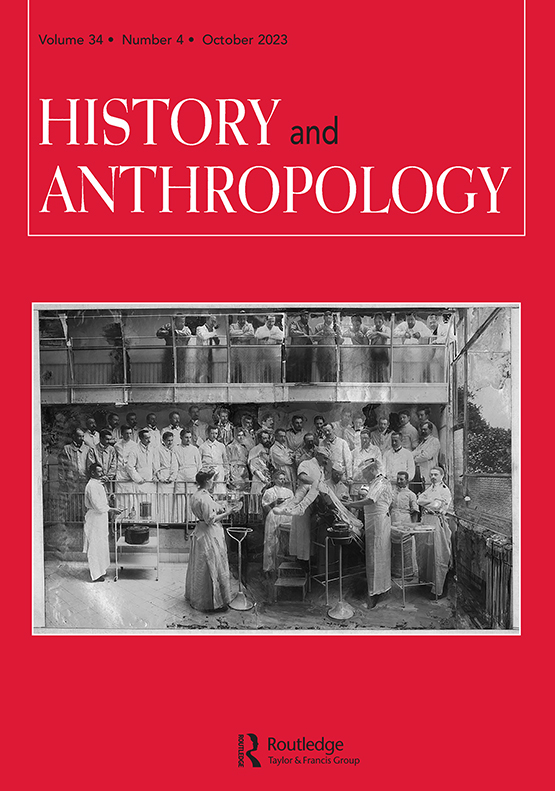
In “Community as a category of empire“, published for History and Anthropology, I argue that ‘community’ is a category that is inextricably bound up with the historical development of the British empire. It was in this context that modern social theory took root, including, eventually, publications on community in anthropology and sociology that profoundly influenced nineteenth- and twentieth-century thought and that continue to shape everyday understandings of the category within and beyond academia. I first elaborate what type of work the category ‘community’ was intended to do in the British empire. I then introduce two key figures who were responsible for designing, distributing and implementing two contrasting imperial theories of community. Subsequently, I sketch the migratory history of the category following the ancestors of today’s so-called ‘Burmese Indians’ across the Bay of Bengal from India to Burma. The final part of the article presents the repercussions ‘community’ has in contemporary Myanmar, drawing on recent legislation around ‘race and religion’ as well as my own ethnographic data from religious processions of ethno-religious minorities who find themselves in a subaltern position vis-à-vis the Buddhist majority population and an ethnonationalist state.




 judith beyer