Tag Archives: philosophy

Crimes against commonality

Before all other forms of membership, we are “all members of the human family”, as the preamble of the Universal Declaration of Human Rights has specified. Thus, the international legal concept of crimes against humanity is crucial because all war crimes are predicated on the fact that those committing these atrocities are enabled once they succeed in establishing difference that makes us forget our human commonality.

We cannot but make do with what the French psychoanalyst Jacques Lacan has called the imaginary order – the way in which we try to relate to others by looking for similarities and differences, mainly in order to acknowledge ourselves. We need the ‘other‘ to sustain ourselves as the I(ndividual) we imagine ourselves to be.

The imaginary order is the order of world-making in the sense of Hannah Arendt (1959) for whom the world is not ‘out there‘, but rather that which arises between people in discourse, as I will develop in an upcoming presentation. We have to keep engaging with others, irrespective of the fact that we will never really understand each other entirely. But we are obliged to keep trying. There is no other way.

“For the world is not humane just because it is made by human beings, and it does not become humane just because the human voice sounds in it, but only when it has become the object of discourse … We humanize what is going on in the world and in ourselves only by speaking of it, and in the course of speaking of it, we learn to be human” (Hannah Arendt, 1959, 24-25)

Human commonality is already there from the beginning, transcending all dichotomies, whereas difference is something we can only ever bring about consciously. What we have in common and what makes us human is that we are split by language, as Lacan argued. If we acknowledge this, we might be able to include the other not as an opposite ‘they’ but as part of our own unconscious: we are always other to ourselves first.

UN Photo In 1950, on the second anniversary of the adoption of the Universal Declaration of Human Rights, students at the UN International Nursery School in New York viewed a poster of the historic document.

Boat is a man

2024 has been the deadliest year for migrants trying to cross the Channel in small boats to reach the UK, with 69 deaths reported (Refugee Council 2025). British politicians have been referring to the circumstances under which people migrate to the UK as “the small boat crisis“ and subsequently made a “small boat deal“ with countries such as Ruanda, to which they wanted to ship people to.

Before the Labour party came to power, they accused the Tories of “having lost control of small boat migration“. Now, that they are in power, they claim that there is “no nice or easy way of doing it“. Getting rid of people who came by boat…

But what if boat were a man?

I recently bought a small booklet filled with Walter Benjamin’s short stories. Tales out of loneliness is its subtitle. In it, there is a 1-page story entitled How the Boat was Invented and Why It Is Called ‘Boat‘. It follows a similar pattern as Benjamin’s short story on Why the elephant is called ‘elephant‘ that immediately precedes the story about the boat.

The storyteller. Tales out of loneliness. Walter Benjamin. Verso Books 2023.

Here’s how Boat’s story goes:

Before all the other people, there lived one person and he was called Boat. He was the first person, as before him there was only an angel who transformed himself into a person, but that is another story.

So the man called Boat wanted to go on the water — you should know that back then there was a lot more water than today. He tied himself to some planks with ropes, a long plank along the belly, that was the keel. And he took a pointed cap of planks, which was, when he lay in the water, at the front — that was the prow. And he stretched out a leg behind him and navigated with it.

In this manner he lay on the water and navigated and rowed with his arms and moved very easily through the water with his plank cap, because it was pointed. Yes, that is how it was: the man Boat, the first man, made himself into a boat, with which one could travel on water.

And therefore — of course that is quite obvious — because he himself was called Boat, he named what he had made ‘boat‘. And that is why the boat is called ‘boat‘.

(Walter Benjamin, 26 September 1933; published posthumously)

The “small boats crisis” is Boat’s crisis, the crisis of man. This is the elephant in the room that nobody wants to talk about. Because they do not know why the elephant is called ‘elephant‘ either.

Philosophy saves lives.

Paper boat made out of a book page (photo by: Maddy Freddie, pexels.com).

Research Colloquium at Université Paris-Nanterre

This winter term, I will be spending some time with my anthropology colleagues at Paris-Nanterre as part of the Laboratoire d’Ethnologie et de Sociologie comparative (LESC), part of the Centre National de la Recherche Scientifique (CNRS).

One part of my research stay is devoted to working on my current project: “Towards an anthropology of statelessness”. I will be speaking at the Department’s Colloquium in December (see plan below). I will also be teaching a course in legal anthropology … more about this one later.

The colloquium is free and open to the public, everyone is welcome.

Anthropology and existentialism. Back to the individual?

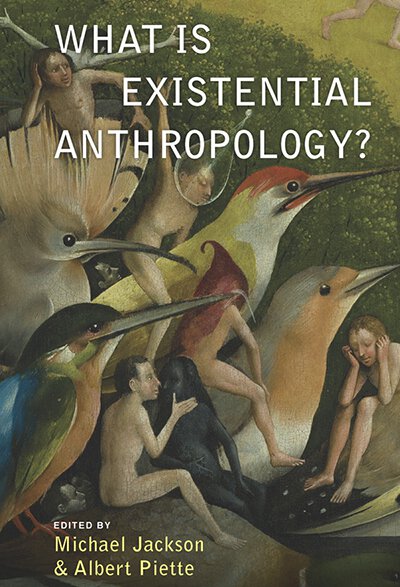
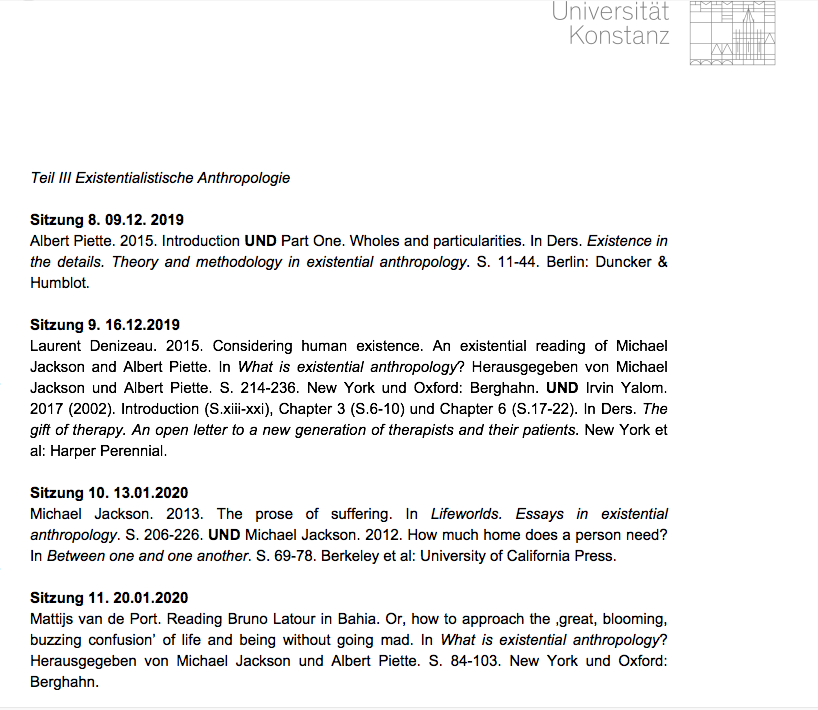
Next to a BA-level course on Indigeneity and Law, I will be teaching in our Master’s Program “Anthropology and Sociology” a thematic course on anthropology and existentialism. After having spent a couple of months in France (Paris, in particular) this year and last year, living in direct vicinity to Sartre’s and De Beauvoir’s former “writing ground” (Café Le Flore, Café Les Deux Magots) in St. Germain, I became more and more interested in combining anthropological reasoning with existential philosophy. Next to Sartre, De Beauvoir and other French intellectuals of the mid-20th century, I encountered the work of Albert Piette (who teaches at Uni Nanterre in Paris) whom I only knew as Michael Jackson’s “sidekick” from “What is existential anthropology?” (Berghahn 2015). I slowly read through his oeuvre, most of it only available in French, but some of it already translated into English by now. His creative way of approaching an anthropo-centric anthropology via what he calls ‘phenomenography’ is as innovative as it is radical. He argues against ethnomethodology, against social interactionism and against every other theory that privileges collectivity rather than individuality.

Since the best way to truly understand theory is to teach it, I am looking forward to my seminar where the question “What role does the individual actually play in anthropology?” will stand at the center of our inquiry. We will see that this question needs to be answered differently depending on what decade and what anthropological tradition we are talking about. We will be reading classical  anthropological literature (Malinowski, Benedict, Geertz, Obeyesekere, Rosaldo, Rapport, Lutz and Abu-Lughod) in order to understand how often the individual rather stood in anthropology’s way on the path towards ‘society’, ‘structure’ or ‘systems of meaning’. We will counter these views not only with recent existential anthropological literature, but also with literature from neighbouring disciplines such as philosophy (the old French classics) and existential psychoanalysis (Chodorow, Yalom).

Last but not least I hope to generate  insights into the nature of the relationships we develop with our key interlocutors during field research: Does a stronger focus on the individual’s existence require a change in the way we approach our ‘field’ and collect our ‘data’? How do we reflect on our own role as individuals in the field?

Here is the syllabus to the seminar: