In this article, I interrogate the process how evidence is established in asylum procedure by engaging with anthropological and socio-legal literature on evidence and credibility assessments. Drawing on ethnomethodology, I analyse asylum interviews and show in what ways evidence can be understood as the result of an asymmetrical co-construction. As a result of this procedure, the individual applicant disappears and a ‘case’ is established.
Anthropologists who write country of origin reports based on such ‘case material’ for tribunals and courts can highlight the asymmetries in evidence-making and question the very categorisations through which the state operates. The article contributes to ongoing debates on the role of anthropologists and their knowledge as experts in court.
2024 has been the deadliest year for migrants trying to cross the Channel in small boats to reach the UK, with 69 deaths reported (Refugee Council 2025). British politicians have been referring to the circumstances under which people migrate to the UK as “the small boat crisis“ and subsequently made a “small boat deal“ with countries such as Ruanda, to which they wanted to ship people to.
I recently bought a small booklet filled with Walter Benjamin’s short stories. Tales out of loneliness is its subtitle. In it, there is a 1-page story entitled How the Boat was Invented and Why It Is Called ‘Boat‘. It follows a similar pattern as Benjamin’s short story on Why the elephant is called ‘elephant‘ that immediately precedes the story about the boat.
The storyteller. Tales out of loneliness. Walter Benjamin. Verso Books 2023.
Here’s how Boat’s story goes:
Before all the other people, there lived one person and he was called Boat. He was the first person, as before him there was only an angel who transformed himself into a person, but that is another story.
So the man called Boat wanted to go on the water — you should know that back then there was a lot more water than today. He tied himself to some planks with ropes, a long plank along the belly, that was the keel. And he took a pointed cap of planks, which was, when he lay in the water, at the front — that was the prow. And he stretched out a leg behind him and navigated with it.
In this manner he lay on the water and navigated and rowed with his arms and moved very easily through the water with his plank cap, because it was pointed. Yes, that is how it was: the man Boat, the first man, made himself into a boat, with which one could travel on water.
And therefore — of course that is quite obvious — because he himself was called Boat, he named what he had made ‘boat‘. And that is why the boat is called ‘boat‘.
(Walter Benjamin, 26 September 1933; published posthumously)
The “small boats crisis” is Boat’s crisis, the crisis of man. This is the elephant in the room that nobody wants to talk about. Because they do not know why the elephant is called ‘elephant‘ either.
Philosophy saves lives.
Paper boat made out of a book page (photo by: Maddy Freddie, pexels.com).
Flâneuse [flanne-euhze], nom, du français. Forme féminine de flâneur [flanne-euhr], un oisif, un observateur flânant, que l’on trouve généralement dans les villes.
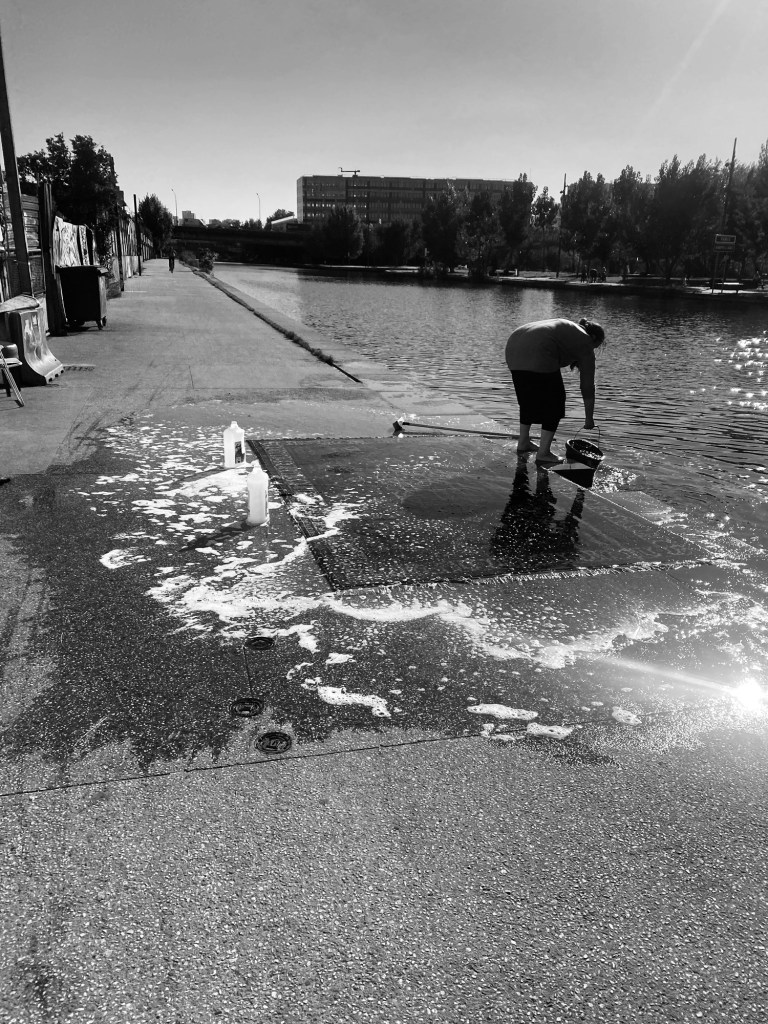
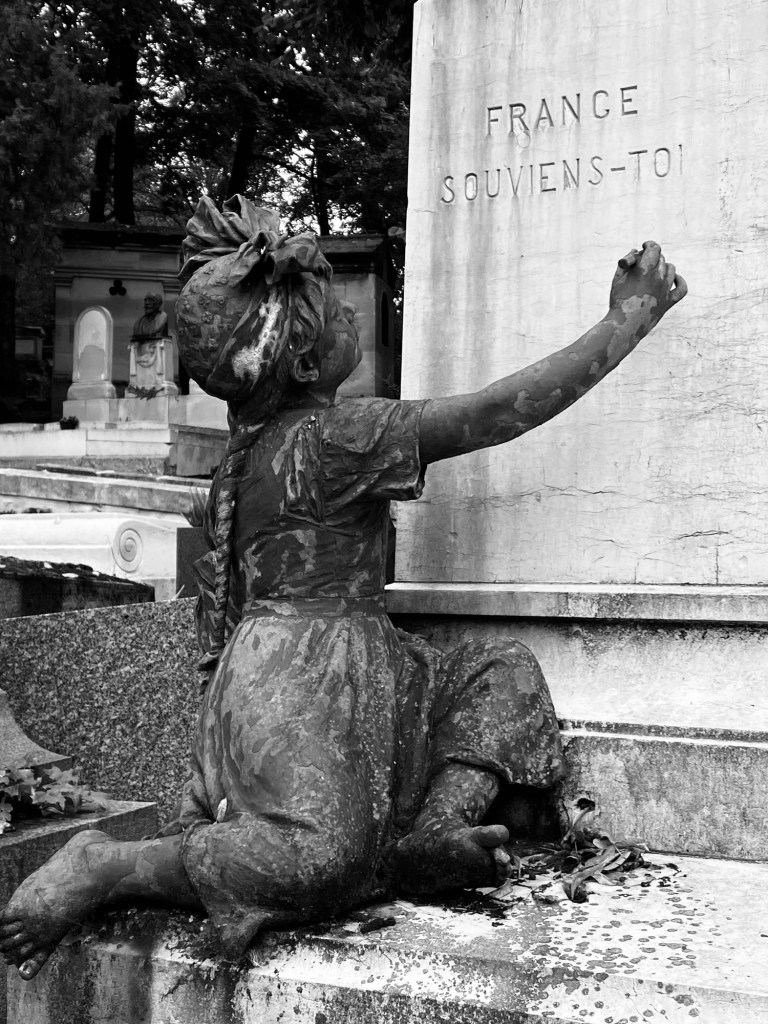
An incremental part of anthropology has always been photography for me. It can be used as an aide mémoire to simply remember where one has been or whom one has encountered on a particular day, thus substituting for fieldnotes. It can also be used as a methodological tool in order to detect the ‘minor modes’ in everyday life or in co-existence. A photograph can be scrutinized for its details, revealing more and more of them, every time one looks closer. But photography can also help express oneself when words fail. Rather than serving the eye, it serves the mouth that does not find the right words or ceases to speak alltogether. When used in this way, photography is neither only a method nor a product. It becomes a mode of existence in itself.
Woman emptying out the Canal. / Femme vidant le canalLittle girl with no memory of the war urges the French to remember it / Une petite fille qui n’a aucun souvenir de la guerre exhorte les Français à s’en souvenir14 million books locked in four towers while researchers work underground / 14 millions de livres enfermés dans quatre tours pendant que les chercheurs travaillent sous terrePart of a wall painting of the anthropology faculty at University Paris-Nanterre, painted by a determined artist / Partie d’une peinture murale de la faculté d’anthropologie de l’Université Paris-Nanterre, réalisée par un artiste déterminé.The Genius of Liberty on top of a tree — optical illusions at the Place de la Bastille / Le Génie de la Liberté au sommet d’un arbre — illusions d’optique à la Place de la Bastille
This winter term, I will be spending some time with my anthropology colleagues at Paris-Nanterre as part of the Laboratoire d’Ethnologie et de Sociologie comparative (LESC), part of the Centre National de la Recherche Scientifique (CNRS).
One part of my research stay is devoted to working on my current project: “Towards an anthropology of statelessness”. I will be speaking at the Department’s Colloquium in December (see plan below). I will also be teaching a course in legal anthropology … more about this one later.
The colloquium is free and open to the public, everyone is welcome.
If you are a recent graduate (MA-/MPhil-degree holder) with an interest in pursuing a PhD in Social and Cultural Anthropology under my supervision, please consider applying for a PhD position at the newly established Graduate School “Post-Euroentric Europe. Narratives of a World-Province in Transformation” at the University of Konstanz.
Together with 10 other professors we have worked hard in the last years to realize an ambitious and highly relevant programme that is aimed at decentring and questioning narratives about Europe.
“Where is Europe?” we might be tempted to ask. “And is it even one place?” (Attali 1994). Is Europe to be found in the minds and hearts of the refugees detained in camps on its southern border, for whom it is place of longing, even as it denies them entry or sets up hurdles in their way? How and to what extent do “soft” cultural factors in the form of collective narratives and imaginations solidify into “hard” institutional realities, which in turn have a reflexive effect on the availability of narrative resources?
While it has long been customary to regard “Europe” and “modernity” as more or less synonymous, only recently has there been a systematic examination of the fact that the European continent was and is permeated by political-cultural demarcations and asyn-chronicities, even within its own borders. Increased attention to non-European traditions or those marginalized in Europe’s dominant self-narrative not only guides a redefinition of Europe’s position in world affairs; it also requires us to diversify notions of Europe from within.
The work of our graduate program aims to contribute to the historical and contemporary demonopolization of the concept of Europe in local contexts, which has been tightly restricted to dominant traditions in the West-Central European area.
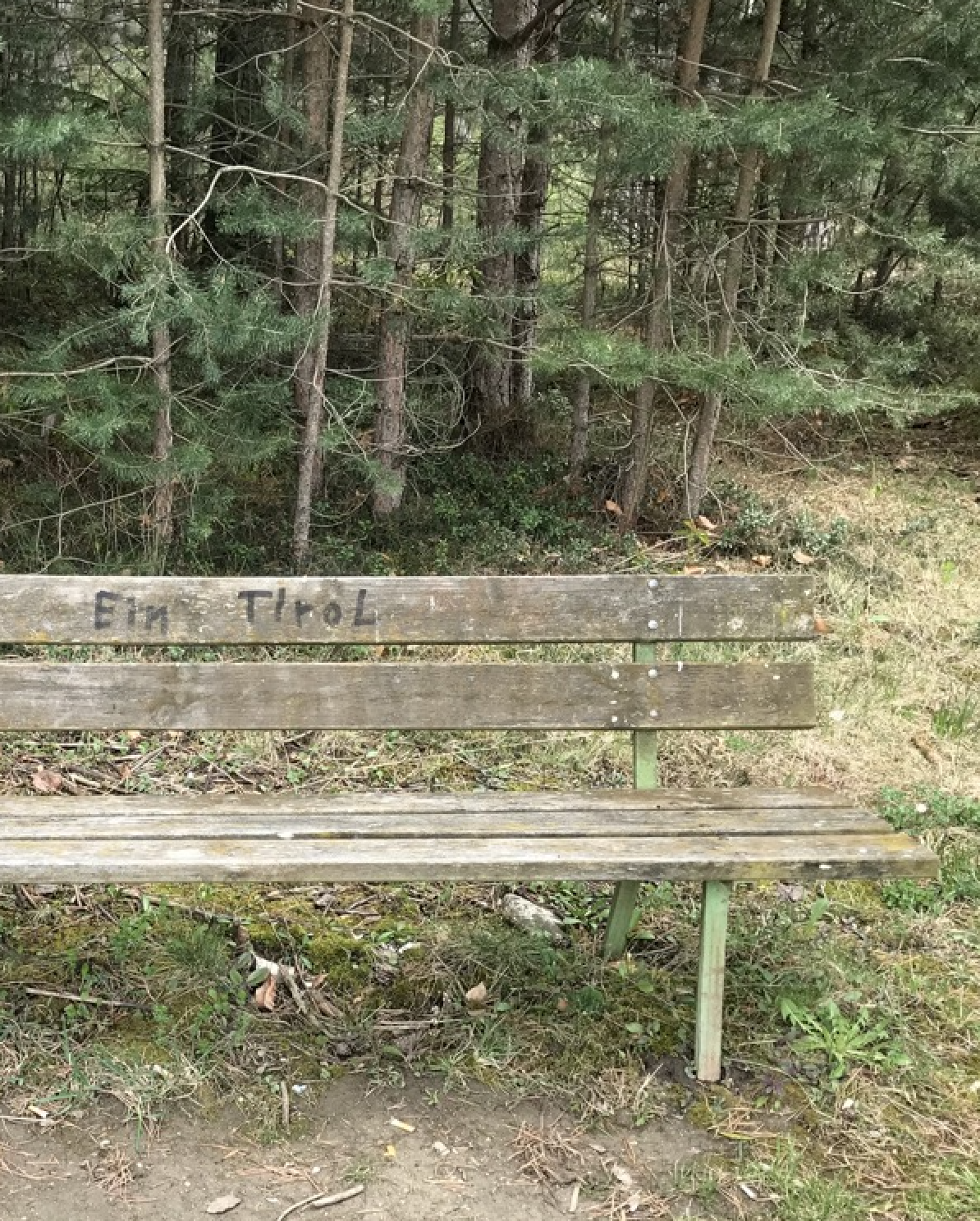
Within this interdisciplinary Graduate School, I am particularly interested in supervising anthropological PhD projects with a focus on statelessnessin Europe or its border regions or on one of the various European independence movements (e.g. in Catalonia, Bretagne, Basque Country, Scotland, Celtic Nationalism, One Tirol, … ). Other topics are possible, too, as long as they fit the programme and are based on ethnographic field research and lie within the field of political and legal anthropology.
Make sure you read the entire research programme carefully before preparing your application! If you have questions, contact me under my uni-konstanz email-address.The deadline is already 30 June 2024!
In contemporary Britain, it is no longer only migrants who are being targeted by the government, but those who fend for them just as well.
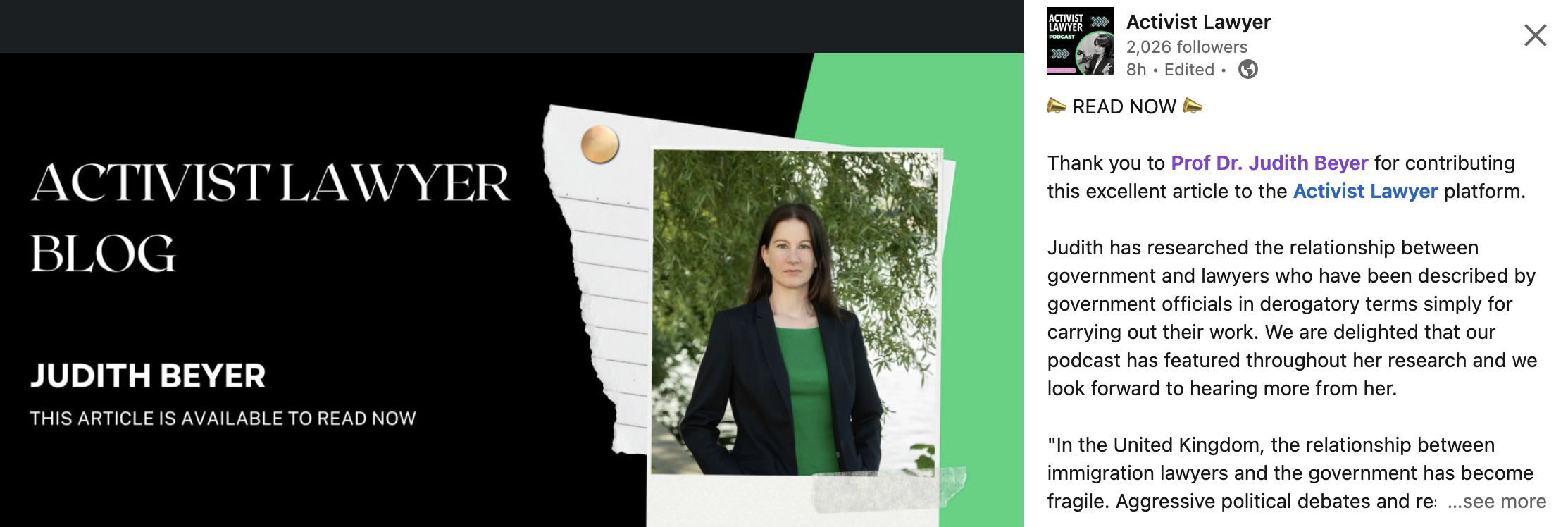
In “‘Illegal’ migration and the Othering of activist lawyers in the UK“, I argue that human rights solicitors, who pride themselves in fending for their marginalized clients, have become targets of state officials who began to call them “activist lawyers” in 2020. The current populist atmosphere in British politics regarding the topic of “illegal migration” not only others those who seek asylum, but also their immigration lawyers and NGO workers who are committed to supporting their clients in their asylum claims. Those lawyers who began to publicly reclaim the term “activist lawyers”, a term initially hurled at them as a slur, effectively managed to strip the state’s vocabulary of its negative attributes. What makes the term “activist lawyers” and the way it is being handled by im/migration and human rights lawyers particularly interesting is that it is no longer exclusionary words about others that lawyers are dealing with here, but words about themselves.
Through this reversal, lawyers brought the former slur in line with their profession’s ethical stance as well as their own personal biographies. The podcast and platform “Activist Lawyer”, hosted by the human rights solicitor Sarah Henry, has been covering this development since 2020 and features many interesting audio formats as well as texts. Make sure you visit “Activist Lawyer – and read my full text here.
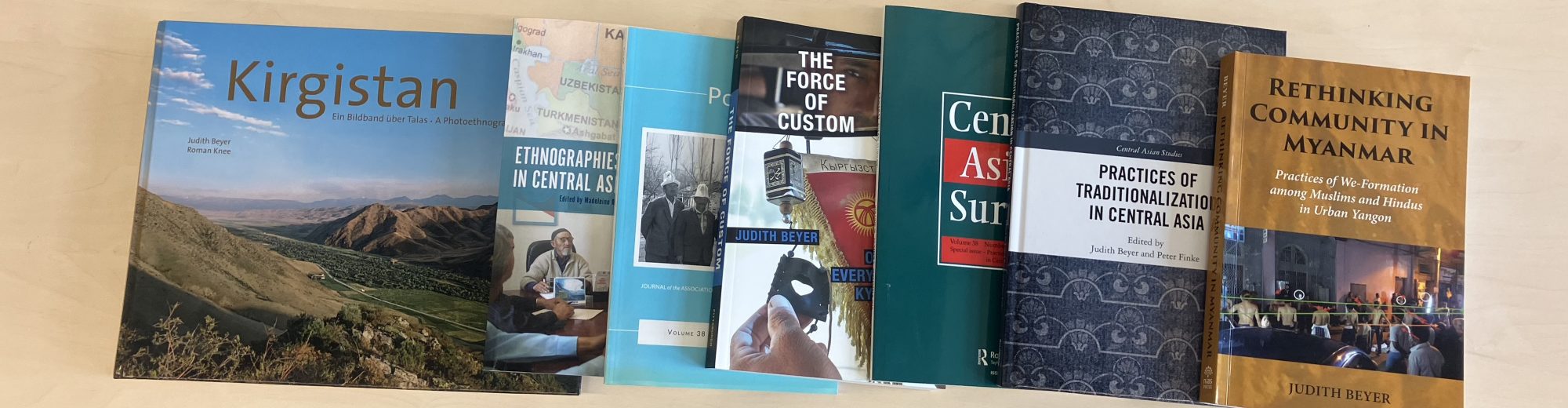
Two new publications came out this month — one on my last research with ethno-religious minorities in urban Yangon in Myanmar, the other based on long-term fieldwork in Central Asia, in rural Kyrgyzstan.
In “Legal Pluralism in Central Asia“, published for an edited volume on the Central Asian World by Routledge, I put forward the argument of a rhetorical emergence of legal pluralism, combining literature from legal and linguistic anthropology. I argue that “we should understand legal pluralism not as the precondition that allows for cases to be dealt with and adjudicated in a plural legal manner; rather, it should be considered a possible outcome whose rhetorical emergence empirically varies from case to case. Depending on the situation, legal pluralism does not define the set-up of a case from the beginning, but rather becomes created intersubjectively in situ by the disputing parties involved in the case” (410). I conclude with a caution: “As anthropologists, we should refrain from advocating legal pluralism in such contexts [where claims about ‘custom’ are competitive rather than descriptive] as a more “culture- friendly” or encompassing way to deal with questions of order, sanctioning or indeed harmony, since “Plurality may actually reinforce structures of inequality as the plurality of forums available decreases the binding power of any law” (418, von Benda- Beckmann et al., 2009, p. 12).
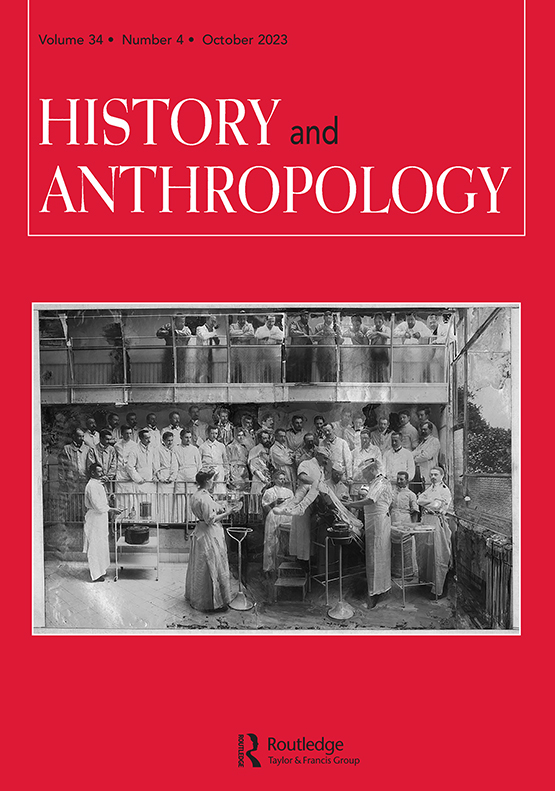
In “Community as a category of empire“, published for History and Anthropology, I argue that ‘community’ is a category that is inextricably bound up with the historical development of the British empire. It was in this context that modern social theory took root, including, eventually, publications on community in anthropology and sociology that profoundly influenced nineteenth- and twentieth-century thought and that continue to shape everyday understandings of the category within and beyond academia. I first elaborate what type of work the category ‘community’ was intended to do in the British empire. I then introduce two key figures who were responsible for designing, distributing and implementing two contrasting imperial theories of community. Subsequently, I sketch the migratory history of the category following the ancestors of today’s so-called ‘Burmese Indians’ across the Bay of Bengal from India to Burma. The final part of the article presents the repercussions ‘community’ has in contemporary Myanmar, drawing on recent legislation around ‘race and religion’ as well as my own ethnographic data from religious processions of ethno-religious minorities who find themselves in a subaltern position vis-à-vis the Buddhist majority population and an ethnonationalist state.
This is a peer-reviewed journal article that developed out of two years of Cartel work within the Lacan Circle of Australia (Melbourne). I presented the topic in 2021 and worked on this publication in which I combine psychoanalytical theory with an anthropological outlook on contemporary politics.
In this article I explore the psychoanalytical underpinnings of the recent purchase of the original manuscript of Marquis de Sade’s 120 Days of Sodom by the French state from the perspective of Jacques Lacan’s concept of perversion. I argue that in declaring de Sade’s book national heritage, the French state has tried to empty the text of its transgressive characteristics and reduced it to a fetish object. By placing the textual artefact inside the National Library of France, where it remains inaccessible, it has installed this object at the centre of the State in an effort to prop itself up while at the same time trying to veil a void. While this case is spectacular, we can abstract from it a distinguishing characteristic of the 21st century: the installation of fetish objects in an increasingly deserted symbolic order as well as the reappearance of the Name-of-the-Father in the imaginary order where the State acts as if it was the progenitor. This article aims to demonstrate the usefulness of Lacan’s teaching on perversion for a critical psychoanalysis that is “in the world”.
Jacques Lacan wrote “On Kant with Sade” in 1963; six years after the French state dropped a ban on Marquis de Sade’s book “120 Days of Sodom” (1904). Since 2021, the book is part of France’s “national heritage”.
I am currently beginning new work in a Cartel on “Brave Waste World” that is devoted to studying Lacan’s teachings in regard to the concepts of waste, the exiled and the world. The topic of my Cartel contribution is “Waste of the world. On statelessness.”
I published a new blog post for the Critical Statelessness Studies (CSS) Blog Series of the University of Melbourne.
I describe and analyse a central characteristic of many ‘expert activists’ working in the field of statelessness: they struggle with what I call a ‘practitioner-scholar dilemma’. Despite the fact that they often do cross disciplinary boundaries and fields of practice in combining scholarly and activist work, they position themselves on one side of an imagined divide. Drawing on Gramsci, I argue that the ‘practitioner-scholar dilemma’ originates in the way the state system structures the very possibilities of engagement with the issue of statelessness. I credit one newly emerging group of expert activists with the possibility to overcome this dilemma…
I published a new research article in Dialectical Anthropology as part of a (still forthcoming) special issue on Antonio Gramsci’s concept of “common sense”, co-edited by Jelena Tošić and Andreas Streinzer. The special issue will also feature an afterword by anthropologist Prof. Kate Crehan, an established Gramsci scholar and an important guiding voice during the virtual workshop that Jelena and Andreas organized and afterwards when we circulated our draft papers.
In the article, I follow a group of professionals in their efforts to address the problem of statelessness in Europe. My interlocutors divide the members of their group into “practitioners,” on the one hand, and “scholars” on the other. Relating this emic dichotomization to Antonio Gramsci’s dialectical take on common sense, I argue against a theoretical reductionism that regards expertise and activism as two essentially different and mostly separate endeavors, and put forward the concept of the “expert activist.” Unpacking what I call the “practitioner–scholar dilemma,” I show that in their effort to end statelessness, “practitioners” take a reformist route that aims at realizing citizenship for the stateless, while “scholars” are open to a more revolutionary path that contemplates the denaturalization and even the eradication of the state. By drawing on Gramsci, I suggest that the impasse the group encounters in their work might relate more to the structural constraints imposed by the state within or against which they operate than to the problem of statelessness they are trying to solve.
My article contributes to a body of emergent work in anthropology that explores the intersection of scholarly expertise and activism. It is also the first article that I am writing on the topic of statelessness, drawing on my new fieldwork data that includes written observations, photographs, the recording and subsequent transcription of free-flowing conversations, oral presentations and speeches, journal entries, and textual documents, all obtained from participating in workshops, conferences, and policy briefings in various European settings such as universities in the UK, museums, and event spaces in The Hague and at the European Youth Centre and the Council of Europe in Strasbourg.
My ethnographic research is ongoing and involves in-person and online attendance at thematic webinars on the topic of statelessness, in annual stakeholder meetings, and the launching of new reports and other publications.
I am particularly interested in receiving feedback from the people I have been working with as I continue researching the topic of expert activism and statelessness in Europe.







 judith beyer