


Here is one of two seminars on “the state” I will be teaching in the coming Summer Term 2015 at the University of Konstanz.
All MA-students registered in Konstanz are welcome:
Statelessness: On the permanent state of exception
What does it mean to live without citizenship in the time of nation states? 10 million people globally find themselves in exactly this situation. As the UNHCR proclaims the end of statelessness in the context of its refugee work (the ‘iBelong-Campaign’) by 2020, more people are born into statelessness or lose their citizenship each day.
In this seminar we will work on ethnographic case studies focusing on the causes and consequences of statelessness. Legal sociological and legal anthropological texts as well as texts from legal philosophy will help us to reflect better on our own civic existence, as well as to critically question the concept of statehood as a ‘normality’ (e.g. with texts from Agamben, Arendt, Badiou). Literature on transnationalism and exceptional cases, in addition to current approaches that understand statelessness as a humane alternative to nation states, will broaden the scope of the seminar. An external speaker will report on stateless women in Central Asia, the so-called border brides.
Seminar requirements: regular participation; reading of texts; presentation of a case study.
Here is one of two seminars on “the state” I will be teaching in the coming Summer Term 2015 at the University of Konstanz.
All BA-students registered in Konstanz are welcome:
Ethnography of the state: Participant observation and photography
The methodology of participant observation is at the forefront of this seminar. Aided by photography, we will close in on self-selected themes within the subject of ‘state’. Once characterised as “fiction of philosophers” (Radcliffe-Brown 1940), the representation of states (i.e. what concretely the state is) has become the central focus today. Students’ field research can be concentrated on institutions, such as the courts, police, state/municipal administration, and other public institutions. It can, however, also focus on other material embodiments of the state, such as streets, architecture, monuments or borders.
The topic will first be explored with the camera, and connected to the seminar by way of a concrete research question. Over the course of the seminar we will examine specific subjects in addition to making observations, and if possible we will also use other qualitative methods such as open questions and semi-structured interviews. As an accompaniment, we will read texts on ethnographic methods together with texts on the ethnography of the state.
The seminar has two goals: firstly, to discuss the method of participant observation in order to understand its possibilities and limitations; and secondly to offer a practical introduction to the theme of the ‘state’ and reflect on how such manifestations influence our daily lives.
New equipment (small and large cameras) has been purchased for the seminar specifically for students to borrow. Students can, however, also use their own cameras.
Possible work formations: individual work or two-person teams.
Seminar requirements: regular participation in class; reading of literature; regular conducting of field exercises during the semester; presentation of preliminary results; seminar paper to be written during the semester break.
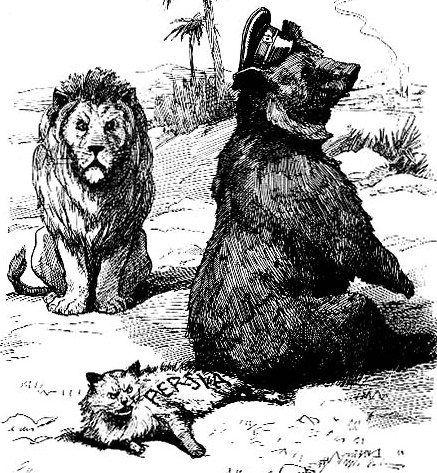
I have a new post on Bears and the Russian Body Politic at allegralaboratory.net. Go check it out.
Two interesting new publications – in light of recent events and in continuation of my previous post on Supreme Court Decisions:

Attacking Judges takes a close look at the effects of televised advertising, including harsh attacks, on state supreme court elections. Author Melinda Gann Hall investigates whether these divisive elections have damaging consequences for representative democracy. To do this, Hall focuses on two key aspects of those elections: the vote shares of justices seeking reelection and the propensity of state electorates to vote. In doing so, Attacking Judges explores vital dimensions of the conventional wisdom that campaign politics has deleterious consequences for judges, voters, and state judiciaries.

Now in reissue, this truly rugged and much-admired classic is sure to inform, and also delight readers with its retro 1950s ethos. Your Rugged Constitution proceeds through the text of theConstitution with descriptions that are put in clear, easy-to-understand language, accompanied by commentary and lively drawings so you can easily grasp all the ideas and concepts.
I have a workshop on “The concept of crisis and the permanent state of exception” at the GAA Biannual Conference 2015 30.9. – 3.10.2015 at Marburg University. Here is the full text
Crisis is a temporal concept, indicating a turning point (from the Greek krisis). Its use suggests that it alternates with stable states of being-in-the-world that are predictable and calm. Whereas the anthropological literature of the 1950s and 1960s analysed crisis and conflict in congruence with models of harmony, anthropological research in the last decades has emphasised war, violence and trauma as “existential experiences.” In this body of literature, attention has shifted away from understanding “mounting crisis” as a phase in a sequence of events aimed to restore social equilibrium (Turner 1972). Rather, recent approaches discuss the “ontological alienation” of persons whose bonds “to the everyday world have become stretched, distorted, and even torn; sometimes irreparably so” (Lester 2013). Zygmunt Bauman and Carlo Bodoni (2014) have recently classified “the present crisis” as a crisis of agency and of territorial sovereignty. So is crisis a con-cept of particular Western thinking and acting – an expression of modernity? Eric Wolf (1999) approached crisis differently, arguing that crises are part and parcel of social life everywhere and that the distinction between normality and crisis is to a large extent ficti-tious.
Drawing on classical and recent anthropological analyses of crisis for our own research, this workshop seeks to explore the equivalents of the concept from emic points of view. How do our informants conceptualise and word their often precarious ways of living? When do they experience moments of “judgment,” “separation” and “choice” (all syno-nyms of crisis) in their personal lives? And how do their personal or collective “crises” relate to a more permanent state of exception that increasingly presents itself as the dominant paradigm of government in contemporary politics (Agamben 2003)?
Abstracts should be submitted both as a long version (1,200 characters includ-ing spaces max.) and a short version (300 characters including spaces max.). Email me at my university address in Konstanz if you are interested in contributing. Deadline is February 15, 2015.
I am preparing for a two-day excursion with my Master students to the 20th Universal Periodic Review of the United Nations. The event will take place in the Palais des Nations in Geneva. In advance, we had to register via email, and in order to be allowed to participate, we will need to collect our “badges” on Monday morning at the gate of the palace.
We will be witnessing the Review of Iraq on Monday and the Review of Slovenia on Tuesday. We will hopefully also arrange for a tour around the building — in which the former Völkerbund was housed — and I am personally interested in observing the Distribution of the report on Kazakhstan.
My students’ task is to learn participant observation in an International Organization. That is, to employ anthropological research methods originally designed in and for colonized societies, in a setting that is not only “Western”, but also transnational, bureaucratic, complex, and …. boring? Maybe not. We shall see …
In order to prepare, we have read a couple of anthropological texts, most importantly those by Jane Cowan and Julie Billaud, who carried out long-term field research in the UPR two years ago. But also documentation itself such as
the English version of the National Report on Iraq
the Compilation of UN Information on Iraq
a Summary of Stakeholders’ Information on Iraq
and several sheets of advanced questions prepared by various member states of the UN. The UK, for example, would like to know the following:
“The situation for ethnic and religious groups including Muslims, Christians, Yezidis, Turkmen and others remains deeply concerning. What is being done to protect vulnerable groups from continued attacks and persecution; and also to enable them to return to their homes in areas where they have been displaced – particularly where their neighbours have allegedly been complicit in the persecution?”
I am very much looking forward to hearing how “Iraq” is going to answer that one …
Recently, a couple of blog posts have dealt with the most outrageous, important, and/or course-changing decisions of the US Supreme Court in the last months, including topics such as botched executions and the right of women to remain in control of their bodies. The following posts are worth reading:
1. Ilya Somin’s Religious Freedom in the Commercial Sphere (Burwell VS Hobby Lobby)
2. Austin Sarat’s Botching the 8th Amendment (Atkins VS Virginia)
3. Lyle Denniston’s Fifth Circuit Allows More Limits on Abortion in Texas
4. Amy Howe’s Court Strikes Down Abortion Clinic “Buffer Zone”( McCullen VS Coakley)
There is also a new monograph on the topic, published by University of Pennsylvania Press.
Garrett Epps’ American Justice 2014. Nine Clashing Visions on the Supreme Court
30.9. – 3.10.2015 an der Philipps-Universität Marburg
Krisen. Re-Formationen von Leben, Macht und Welt / Crises: Reconfigurations of Life, Power and Worlds
deadline: 15.09.2014!






 judith beyer