Tag Archives: fieldwork

New Article Out: Exiled Activists from Myanmar

Our collaborative article “Exiled Activists from Myanmar: Predicaments and Possibilities of Human Rights Activism from Abroad“, published in the Journal of Human Rights Practice (Oxford University Press), is finally out! 🎉

I am very proud of the work that my colleague Samia Akhter-Khan, my two Ph.D. students Sarah Riebel and Nickey Diamond, another author from Myanmar (who has to use a pseudonym for reasons of safety), as well as myself have managed to achieve under very difficult circumstances.

This article was born out of necessity to engage with the topic of exile. None of us had ever wanted to study yet alone experience this existential state of being. The empirical material we draw on in this article stems from autoethnographic accounts (Nickey Diamond and Demo Lulin), semi-structured interviews and conversations with around forty exiled activists currently residing in Thailand, the US, the UK, Austria, and Switzerland (Samia Akhter-Khan and myself) as well as extensive ethnographic work with exiled activists in Thailand (Sarah Riebel).

In this article, we put forward the concept of the ‘exiled activist’ to highlight the predicaments and the possibilities that practicing human rights activism from abroad bring with it. From our analysis, we have developed three so-called ‘practitioner points’ that might guide INGOs, NGOs, states and other bodies to properly relate to exiled activists from Myanmar. These are:

1. Develop trauma-informed support systems for exiled activists by integrating psychosocial care and peer-based mental health resources into human rights programming and diaspora organizing.

2. Adapt partnership models to accommodate the shifting positionality of exiled activists, recognizing their need for secure digital platforms, flexible funding, and shared decision-making across borders.

3. Acknowledge and navigate political divisions within diverse groups of exiled activists – such as differing views on the National League for Democracy, the military, or the Rohingya – by avoiding assumptions of unity and instead fostering inclusive collaboration that respects diverse activist trajectories and lived experiences.

We have made our article openaccess so that everyone is able to download it. Currently, we are working on a shorter version in Burmese/Myanma, to also allow those who do not speak English to read about this important topic.

Thank you to all exiled activists who have participated in this study, trusted us and shared their stories – and to the German Academic Exchange Service (DAAD) for the support of scholars at risk over the last years!
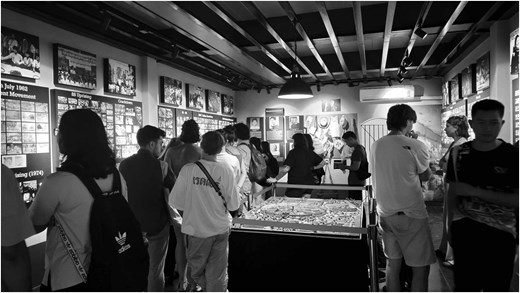
Assistance Association for Political Prisoners Burma Museum, Mae Sot, Thailand. Photograph: Sarah Riebel.

Pointing at the Past in Berlin

They must have boarded at Finsterwalde – the East German equivalent to the Black Forest – at least as far as the name is concerned. The shiny new Berlin airport was along the regional train’s route to Wismar on the Baltic Sea. The train was overcrowded and I had to leave my legs dangling outside of our joint compartment as the floor was blocked by their suitcases onto which each of them had rested one protective hand. A hand bag occupied its own seat, equally guarded by the elderly women’s hand; a small wedding band in silver caught my eye.

After we had exchanged a friendly ”Hello” and talked a bit about how packed the train was, but that for me it was just a short ride to the city center, the woman’s grey-haired, orderly combed husband, who was wearing a rain jacket, suddenly pointed at a dilapidated building that appeared on our left side. We turned our heads: “It’s the Gymnasium!”he exclaimed. Not his Gymnasium – “a” Gymnasium. He also recalled its name – the name of the street. The train continued its way through what used to be the countryside, but what is now – thanks to the airport – part of Berlin, home to 6.3 million people.

“We are getting a free city tour with our ride” she said amused and both looked outside their common window – she to the left, he to the right. I had planned to continue reading, but soon realised that listening closely to their conversation and especially following their pointing index fingers with my eyes would be more worthwhile.

It took me a while to understand what I found interesting: they were only looking at “old” things: the dilapidated Gymnasium, „JannowitzbrĂźcke“ – he named the bridge over the river Spree, when we entered Ostkreuz train station, they both said „Wasserturm!“, pointing their index fingers at the art nouveau landmark tower that is permanently closed. But for the elderly couple it seemed to have remained open. I tried to imagine seeing Berlin the way they were seeing it, actively unseeing everything “new”: the renovated train stations? No comment. Not there. The massive glas office buildings? No pointing. Not there. A building aptly called “Futurium”? No remark. Not there.

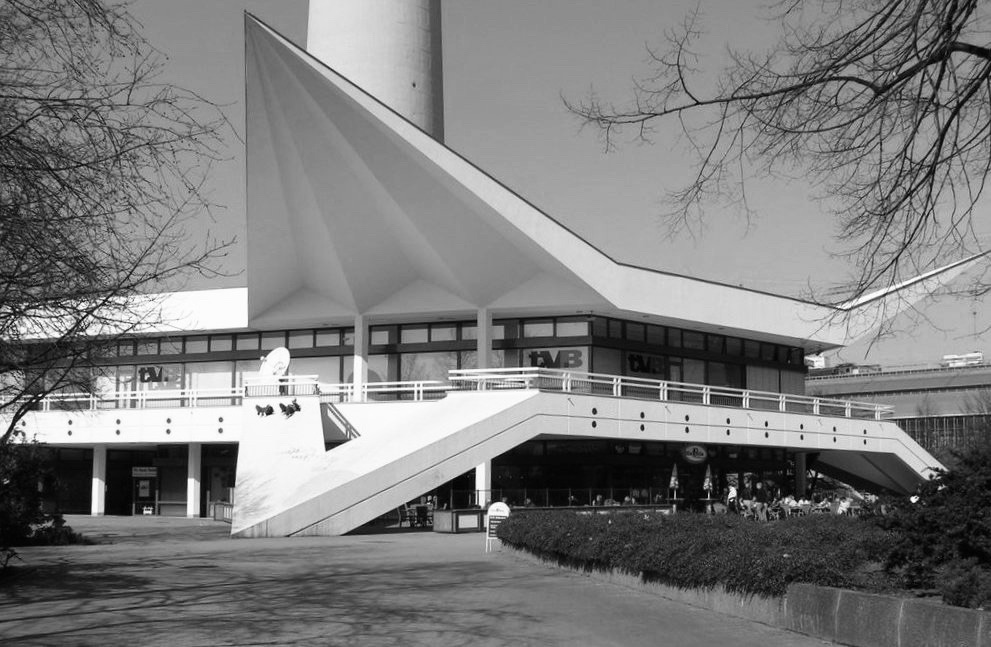
Pavilion in front of the Berlin Television Tower. (Creative Commons https://upload.wikimedia.org/wikipedia/commons/7/71/Berlin_fernsehturm_pavillon.jpg)

Suddenly both erupted in laughter when they saw the (formerly) white pavilion in front of the Alex: “Just like in the old days!” The train passed over the bridge that separates the “Museum Island” from the main land. “Repair work” she said. Oh! I noticed a break in the pattern. But then he told her: “It’s because they are repairing the war damage!“ “But the Bode Museum is still as it was?” she asks. “Yes, because they can only repair one building after the other.”

I was travelling with a couple who not only travelled through Berlin for the first time in decades, I was travelling with a couple who travelled through Eastern Berlin as if the war had just ended and through Western Berlin as if the wall had just come down.

But before I could tell them how much I liked them for this, another hand pointed its index finger onto the hand bag which had travelled comfortably on its own seat with us. A young Asian-looking man with grey glasses and headphones looked at me. I smiled and pointed towards the elderly lady. His index finger left the bag and now carefully tipped onto the woman’s shoulder. She had not noticed him, her body was turned towards the window where the past continued to pass by.

Both looked at the young man and the elderly man shouted a loud “No!” into his face that made me and him jump a little. I looked at the two without saying a word, the woman then took her bag and placed it onto the small table in front of her and the man assumed the handbag’s seat. “… oder ok” murmured the husband and both turned their heads again … I felt a stitch. Had this been a racist reaction? I looked at the young man, making sure he was ok. He wasn’t.

As soon as we had reached Hauptbahnhof where most people got out, the handbag reclaimed its seat as the young man quickly found himself another place to sit. Then a Black man arrived. He pointed at the handbag which was from a German brand and which depicted many people with different skin tones, wearing colourful clothes and sporting hairstyles! This time, the woman immediately reacted and nobody spoke a word. They were sitting quietly until I had to get out. I wished them safe travels and they wished me a “good night”, assuming that because I had been up since 5am, I was about to go to sleep. I did not correct them.

Walking through Berlin I contemplated: what if all the “different looking” and “different speaking” people were as “new” to this elderly couple as the shiny glass dome on top of the “Reichstag” was for them? What if they equally erased everyone as they had erased everything they did not remember from the past? What if “their past” was not gone?

We cannot assume that we are inhabiting the same world.

We also cannot assume that we are seeing the same things even when we are looking outside the same window.

We even cannot assume a “we” that is united by more than jointly passing by.