Tag Archives: ethnography

Pointing at the Past in Berlin

They must have boarded at Finsterwalde – the East German equivalent to the Black Forest – at least as far as the name is concerned. The shiny new Berlin airport was along the regional train’s route to Wismar on the Baltic Sea. The train was overcrowded and I had to leave my legs dangling outside of our joint compartment as the floor was blocked by their suitcases onto which each of them had rested one protective hand. A hand bag occupied its own seat, equally guarded by the elderly women’s hand; a small wedding band in silver caught my eye.

After we had exchanged a friendly ”Hello” and talked a bit about how packed the train was, but that for me it was just a short ride to the city center, the woman’s grey-haired, orderly combed husband, who was wearing a rain jacket, suddenly pointed at a dilapidated building that appeared on our left side. We turned our heads: “It’s the Gymnasium!”he exclaimed. Not his Gymnasium – “a” Gymnasium. He also recalled its name – the name of the street. The train continued its way through what used to be the countryside, but what is now – thanks to the airport – part of Berlin, home to 6.3 million people.

“We are getting a free city tour with our ride” she said amused and both looked outside their common window – she to the left, he to the right. I had planned to continue reading, but soon realised that listening closely to their conversation and especially following their pointing index fingers with my eyes would be more worthwhile.

It took me a while to understand what I found interesting: they were only looking at “old” things: the dilapidated Gymnasium, „Jannowitzbrücke“ – he named the bridge over the river Spree, when we entered Ostkreuz train station, they both said „Wasserturm!“, pointing their index fingers at the art nouveau landmark tower that is permanently closed. But for the elderly couple it seemed to have remained open. I tried to imagine seeing Berlin the way they were seeing it, actively unseeing everything “new”: the renovated train stations? No comment. Not there. The massive glas office buildings? No pointing. Not there. A building aptly called “Futurium”? No remark. Not there.
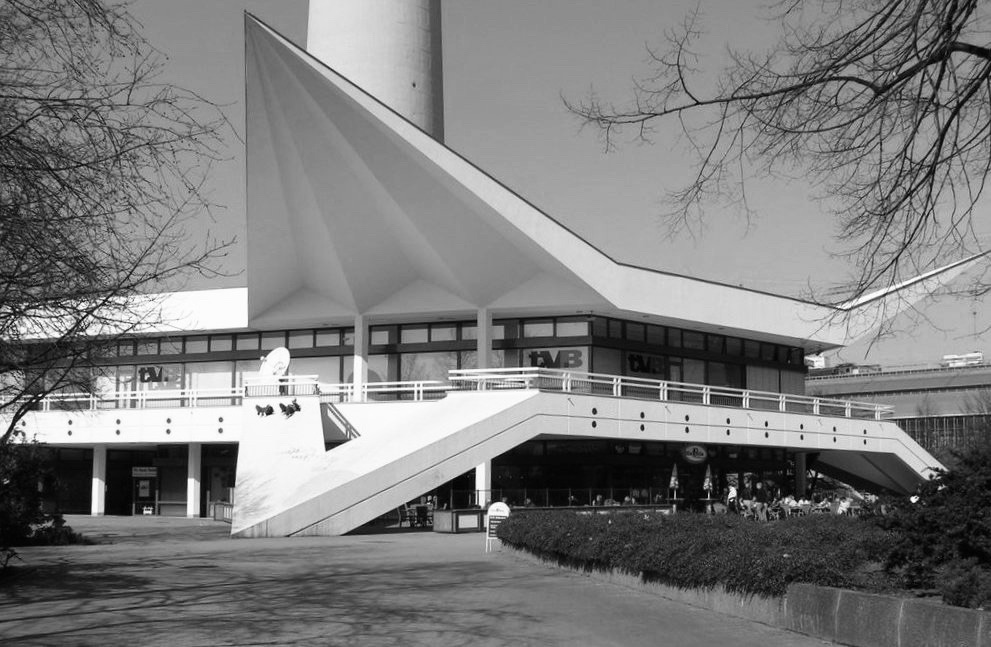
Pavilion in front of the Berlin Television Tower. (Creative Commons https://upload.wikimedia.org/wikipedia/commons/7/71/Berlin_fernsehturm_pavillon.jpg)

Suddenly both erupted in laughter when they saw the (formerly) white pavilion in front of the Alex: “Just like in the old days!” The train passed over the bridge that separates the “Museum Island” from the main land. “Repair work” she said. Oh! I noticed a break in the pattern. But then he told her: “It’s because they are repairing the war damage!“ “But the Bode Museum is still as it was?” she asks. “Yes, because they can only repair one building after the other.”

I was travelling with a couple who not only travelled through Berlin for the first time in decades, I was travelling with a couple who travelled through Eastern Berlin as if the war had just ended and through Western Berlin as if the wall had just come down.

But before I could tell them how much I liked them for this, another hand pointed its index finger onto the hand bag which had travelled comfortably on its own seat with us. A young Asian-looking man with grey glasses and headphones looked at me. I smiled and pointed towards the elderly lady. His index finger left the bag and now carefully tipped onto the woman’s shoulder. She had not noticed him, her body was turned towards the window where the past continued to pass by.

Both looked at the young man and the elderly man shouted a loud “No!” into his face that made me and him jump a little. I looked at the two without saying a word, the woman then took her bag and placed it onto the small table in front of her and the man assumed the handbag’s seat. “… oder ok” murmured the husband and both turned their heads again … I felt a stitch. Had this been a racist reaction? I looked at the young man, making sure he was ok. He wasn’t.

As soon as we had reached Hauptbahnhof where most people got out, the handbag reclaimed its seat as the young man quickly found himself another place to sit. Then a Black man arrived. He pointed at the handbag which was from a German brand and which depicted many people with different skin tones, wearing colourful clothes and sporting hairstyles! This time, the woman immediately reacted and nobody spoke a word. They were sitting quietly until I had to get out. I wished them safe travels and they wished me a “good night”, assuming that because I had been up since 5am, I was about to go to sleep. I did not correct them.

Walking through Berlin I contemplated: what if all the “different looking” and “different speaking” people were as “new” to this elderly couple as the shiny glass dome on top of the “Reichstag” was for them? What if they equally erased everyone as they had erased everything they did not remember from the past? What if “their past” was not gone?

We cannot assume that we are inhabiting the same world.

We also cannot assume that we are seeing the same things even when we are looking outside the same window.

We even cannot assume a “we” that is united by more than jointly passing by.
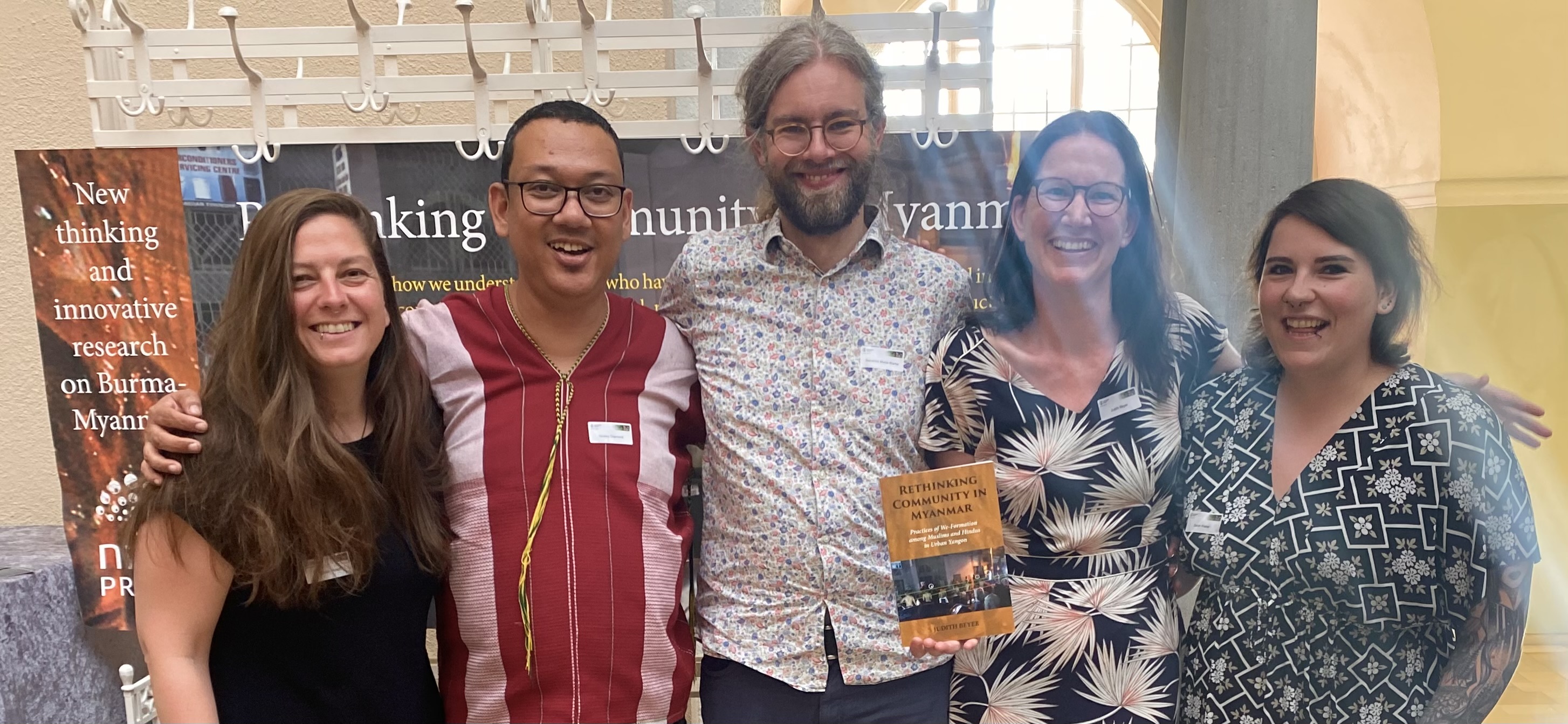
Book Launch: Rethinking Community in Myanmar. 15th Int. Burma Studies Conference

At the 15th International Burma Studies Conference, hosted at the University of Zurich, (9-11 June 2023), I launched my book Rethinking Community in Myanmar. Practices of We-Formation Among Muslims and Hindus in Urban Yangon.

Informal book launch in good company — while missing many from Myanmar

I wanted to celebrate the publication of my monograph: 10 years in the making if I count from the first days of fieldwork in 2012-2013. Good anthropological monographs take time and they are never the result of one indiviual only, even though writing can be a solitary process, particularly towards the end. I wanted to use the occasion of having over 200 Myanmar specialists gathering in one place, to say “Thank you” publicly to all the important people who could not be present in Zurich, but also to those who were able to share a glass of wine with me that day.

Great PhDs to be: Carolin Hirsch, Nickey Diamond, Benedict Mette-Starke, Sarah Riebel (plus book and me)

I set out by thanking my Muslim and Hindu interlocutors in Myanmar — there can neither be an anthropology nor an ethnography without the people ‘in’ (paraphrasing Tim Ingold). I owe them everything and I am glad that there will be an open access version of my book coming out towards the end of this year that will allow at least some of my interlocutors to download the book in Myanmar — I cannot bring it to them at the moment; not so much because it would be dangerous for me (it might be), but because I simply cannot take the risk of putting them into danger once I have left the country or their houses …

I then thanked my four research assistants — my KRA (Kachin Research Army) — and I explained to the audience of Burma/Myanmar experts that I profited enormously from them having conversations with my interlocutors about what it means to be a member of a minority in a majority Buddhist country. Listening in — as I am currently developing also in another context — is a methodologically fruitful approach to conduct fieldwork or carry out digital ethnography where fieldwork is not possible, because it decenters the anthropologist. What I am interested in mostly is “free-flowing talk” where my interlocutors do not try to guess what it is I want from them (in terms of what they might be expected to tell me), but where I can simply follow them having conversations with one another. Since all of my research assistants were Christian Kachin women, it was not religion they shared with my interlocutors (who were Muslims and Hindus), but the experience of being ‘slotted in’ as members of ‘communities’.

I also thanked my colleagues in Myanmar who had been professors of Anthropology at the University of Yangon prior to the attempted military coup in February 2021. Thanks to them, my PhD students received research visa, thanks to them, I had the opportunity of teaching and learning from young anthropology students, and thanks to them I learned a lot about the history of the discipline in Myanmar and about the history of the University of Yangon. I truly hope that one day they will be able to return to their professional jobs — which they cherished a lot, and to their students whom they loved.

None of these people could be with my family, my PhD students, and the other Myanmar scholars that day.

Thanking those who were there

I was happy to be surrounded by many friends, who had helped in different ways to bring this book to fruition: many of my colleagues had read draft chapters, some had written reviews or are going to write them. Alicia Turner gave some introductory words — she knows the book very well as she has written the most constructive and helpful review that made the final product so much better!

The managing editor of NIAS Press, Gerald Jackson, had come from Copenhagen to Zurich with his research assistant Julia Heinle and with a lot of amazing books on Southeast Asia and on Myanmar in tow. He took my book project on board and steered it smoothly through the production process in not even two years from the submission date!

Gerald Jackson and Julia Heinle (both NIAS Press) with the book and me.

My PhD students who are working on Myanmar, were all present, too. We discussed my material just as much as we discussed theirs. They all completed long-term ethnographic fieldwork in or on Myanmar and I can’t wait to see their own books!

And — last but not least — my family — who accompanied me from 2012 onwards and carried out their own research projects in Yangon: on the politics of cultural heritage in one case and on what it means to go to a local school in Chinatown in Yangon in the other case.

Thank you to everyone who was there that evening — be it in spirit or in the flesh — I am very grateful for the support I have received in the last decade. I hope the book will be useful to many.