
On July 28, 2024 at 4.30pm, my dear Akbar Hussain passed away.
We have known each other for over a decade and as is the case with many central interlocutors in anthropology, there is never a way to thank them enough for what they are enabling us to achieve. Akbar Hussain was born as Mohammad Akbar Hussain Khan. He descended from a well-known Turkic Qizilbash family of high-ranking warriors, originating from Lankaran in what is now Azerbaijan. His ancestors had fought in the British Army and their heroic services were rewarded with name titles – such as “Captain” – and with land titles – such as a grant given to Akbar Hussain’s great-grandfather in 1886 that allowed him to relocate from the Northern part of British India to Burma. While the family raised their children in Myanmar, they continued to go back and forth to countries in the East such as Pakistan (since 1947) and the West (Akbar Hussain himself lived in the USA for many years). Theirs was a polyglott Muslim family as most Muslim families are in Myanmar. In contrast to his ancestors, however, Akbar Hussain did not serve any army; he served his mosque in downtown Yangon. He knew its history better than most, and due to the location of his appartment, he also knew its present: who would go in and out, at what time and for what purpose. He was curious enough to engage with my curiosity, multi-lingual so that we could easily communicate about the most complicated matters, very knowledgable and yet modest and able to admit when he did not know something – suggesting that I probe literature instead of his brain.
 This is a very blurry picture of the two of us, but somehow, it says so much about our relation. Akbar Hussain was always there when I needed him and even, when I did not know that I needed him. He always kept to the background or to the sidelines, observing everything, commenting quietly afterwards or hinting at things, pointing at people, alerting me what to pay attention to, and whom to listen to more closely. Translating from Urdu to English for me at times, and always making sure that I get home safely at night after a procession or another long day spent at his house with him and his lovely wife.
He passed away and I could not say goodbye properly, neither in person, nor at the graveyard. He had asked me many times to come see him during the last few years. We communicated via a third person who would scan his handwritten letters to me in an internet café … as if it were the 1990s, as if there was a military dicatorship in place … wait … oh. And I would write self-censored emails back, because I knew that I was sending them to an address and a person whom I did not know and that I relied on that person to print them out and give them to him when he came to pick up his ‘mail’. So he knew all about my private life in safe Europe, but little of my fears and worries for him, his wife and everyone in Myanmar, really, as there was no way to ask how he was really doing in the current situation. He never spoke of politics, he sticked to writing about his health, his religion, the weather and of course reported meticuously about all upcoming festivities at the mosque.
We met at the mosque over 10 years ago and soon I realized that he frequently stayed at the managing trustee’s house at the time. He was his right hand, but also a careful observer as the person was very old and also not uncomplicated, feared by some even. Akbar Hussain knew how to handle complicated people, he even knew how to deal with a female German anthropologist who intruded into the daily life of the mosque, too, but – in contrast to tourists or journalists who dropped in and out, sometimes coming only for one day in the year – Ashura – to witness, record and distribute gruesome images of men flagellating themselves or walking over burning coal – to then disappear again, thinking they had understood something, he dealt with me as someone who would always come back and stay because I somehow never understood enough. And he kept explaining. Eventually, when he thought, I had acquired enough knowledge, he asked me: “Hey, when will you become Shia?” In my book, I recall this sentence and have interpreted it in the following way:
‘Hey, when will you become Shia?’ he often asked, which indicated to me that it would have been easier for him to conceive of me as a converted ‘member’ than as someone who was simply very interested (and increasingly knowledgeable) in what it means to be a Shia in Yangon. My interest and knowledge in the Shia religion were fine, but they were not what mattered in the end: membership in the community did (Beyer 2024 ,8)
 He is on the cover photograph of my Myanmar book, as usual at the sidelines, with his back even turned away from where supposedly the ‘action’ is, yet later able to deconstruct and interpret the event with me in all its details. Since we often sticked together, everyone initiatially wondered who I was. The following conversation is from a transcript I made between Akbar Hussain, me and another person from the mosque who explained to me how Akbar Hussain would answer this question in my absence.
Third person (to me): they all ask ‘where is she from, where is she from?’ Akbar Hussain then always says ‘my relation’ #00:08:44-6#
AH Because my relation are all foreigners #00:08:49-8#
J That is true #00:08:51-8#
AH So they thought that you are my relative #00:08:57-3#
J That’s good – we can keep it this way (laughs) #00:09:02-9#
AH They ask me ‘from America?’ ‘No, I say, from Germany.’ They are very inquisitive (laughs) #00:09:18-7#
J That’s fine, I am also inquisitive #00:09:23-9#
(all laughing) #00:09:26-6#
All his relatives are foreigners, he said, because Akbar Hussain had chosen to never give up his Pakistani citizenship. He loved Myanmar and Yangon, the downtown area, his street and the mosque, but his home was in Pakistan where he spent his youth and went to university. He was fiercely political, one of the harshest critics of the mullahs in Pakistan and in Afghanistan, of those who perverted his beloved religion and his culture. He was proud and knowledgable and sometimes so outspoken that when he picked up the microphone at the mosque to condemn the killing of innocents, the endemic corruption or anything else going on in Pakistan, Saudi Arabia, Iran or Northern Africa, one could mistake him for being radical himself. He was radical in the sense that he did not only believe, but stood up for what he believed. But this concerned politics and religion abroad. He was careful to not position himself publicly when it came to Myanmar – knowing that he was a foreigner by choice. Someone who had to frequent the downtown visa section of the Ministry of Foreign affairs every few months to renew his residence status. While he had tried to incorporate me into his ‘community’ and even his family, he himself had remained Other all the time … we both occupied the same positionality, I later understood.
I read about Akbar Hussain’s death on the Facebook page of a friend of mine from Yangon. She is the wife of the late managing trustee and knew Akbar Hussain very well. He saw her getting married at a young age, he saw her two children growing up, he went in and out of her house in downtown for many years and he supported her late husband in many ways. She is thankful for him, her story being one of the numerous stories that need to be told because they are paradigmatic for Myanmar’s Muslims: for the way religious divides are being bridged, for the way religious tolerance is being practiced at a low level, for the way in which the people of Myanmar are capable of transcending the categories that have been imposed upon them throughout colonial history. These are the stories we do not get to hear about too much, but they exist and they matter. Just like the people that tell them.
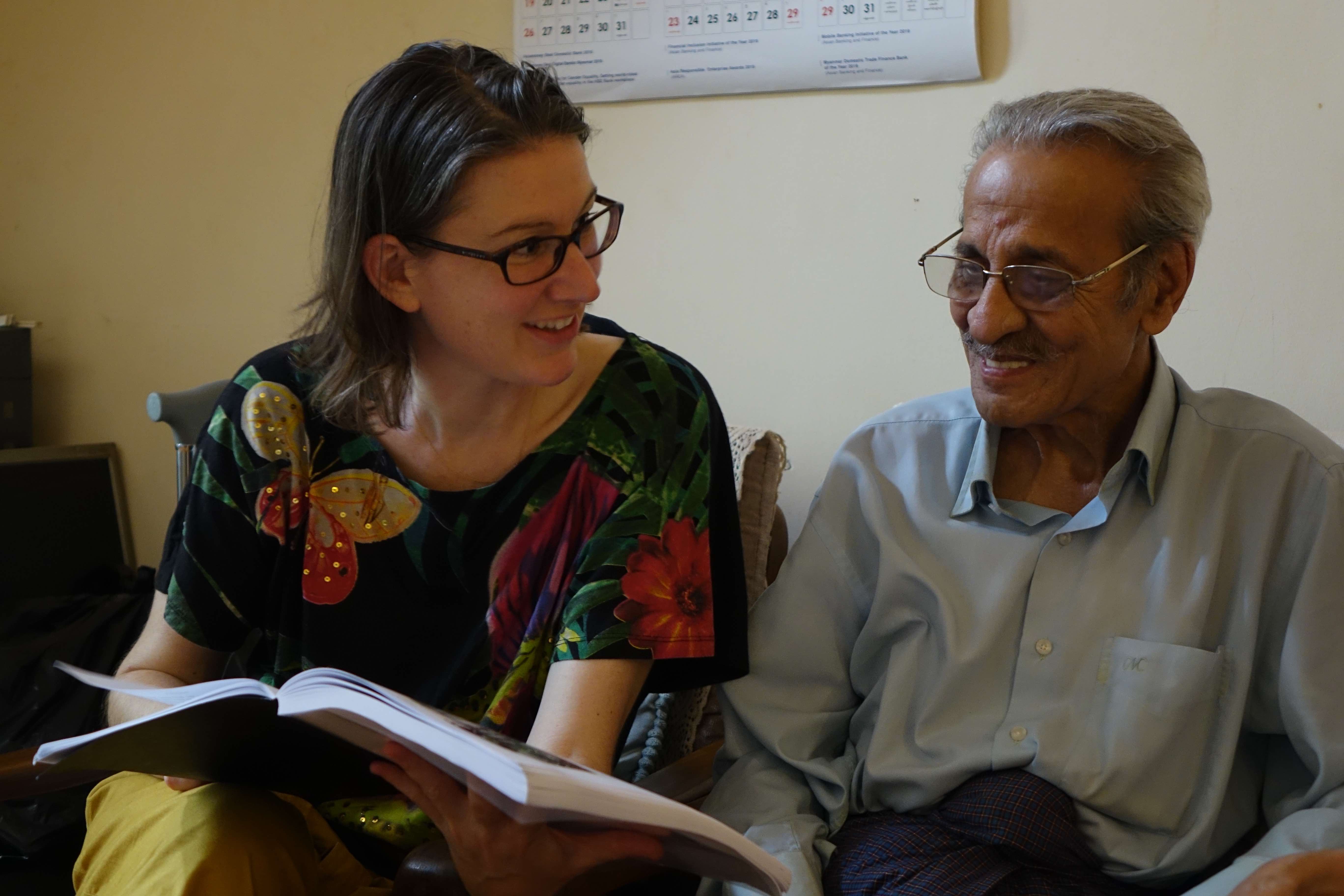
One last conversation in person. Spring 2020 (photo: Felix Girke)
Akbar Hussain, may you rest in peace and … thank you.
မိသားစုနဲ့ထပ်တူအလွန်တရာမှဝမ်းနည်းကြေကွဲမိပါတယ်စိတ်မကောင်းလိုက်တာသူသိတ်ချစ်မြတ်နိုးလှတဲ့လလေး Muharram လမှာဆုံးသွားရှာရတာစိတ်ထိခိုက်ဝမ်းနည်းမိပါတယ်
Inna lillahi wa inna ilayhi raji’un إِنَّا لِلَّٰهِ وَإِنَّا إِلَيْهِ رَاجِعُونَ.
 judith beyer