• Workshop 6–8 July 2017
    Institute for Advanced Study, Konstanz.

    Organized by Judith Beyer (University of Konstanz) and Birgit Bräuchler (Monash University)

    In this workshop, we intend to investigate divergent claims to resource access, thereby furthering our common interest in plural ecologies across Southeast Asia. Following Ribot and Peluso’s Theory of Access (2003), we define access to resources as the “ability to derive benefits from things – including material objects, persons, institutions, and symbols” (2003:153). Access to natural resources (such as land, water, mineral resources) is always legitimized, negotiated, defended, and denied through the recourse to cultural resources.

    Cultural resources include economic (markets, infrastructure, etc.), political (legitimation discourses about civil rights, ethnicity, indigeneity cultural heritage, etc.), and religious (traditional knowledge, cosmology, etc.) forms of power and influence. In social-political practice, natural and cultural resources never appear separately but are always intertwined, and, to a certain extent, interdependent. Competition for and claims to resources is decisive since privileged access and the inclusion of a particular group usually involves the exclusion or neglect of others (see Hall, Hirsch, & Li 2011: 8, 13; Adhuri 2009).

    We here consider the concepts of majority, minority, and indigeneity as political constructs functioning at the interface of local identity claims, traditional resource demands, the enforcement of national laws, and internationally promoted human rights. The “right to culture” is central in the recent development of collective human rights (see, for example, Francioni & Scheinin, 2008; Stamatopoulou, 2007) and the United Nations Declaration on the Rights of Indigenous Peoples (United Nations, 2007). Among others, it concerns the granting of long denied access to resources and promotes the advancement of group-specific rights on a national level, which is fostered by an increasing number of decentralization and demo- cratization processes in Southeast Asia and does not go undisputed as it leads to the exclusion of non-group members (compare e.g., F. v. Benda-Beckmann & K. von Benda-Beckmann, 2010; Kymlicka & Norman, 2000; Rosaldo, 2003; Taylor, 1994; Young, 1989). In debates on minority and indigeneity the question is whether it is justified to grant specific rights to individuals or groups within a state for historic reasons (see, in particular, Barnard, 2006; Bohnet & Höher, 2004; Guenther et al, 2003; Preece, 2005). Again, this implies a close interlinkage of political, cultural and natural resources.

    What is of special interest for this workshop is how such ambivalences and contestations between local, national and international rights and claims inform ecological policies and power struggles at the respective levels. Given the rising demand for cultural rights and the plurality of ecologies within and across countries in Southeast Asia, a regional comparison would shed
    new light on debates about diverging normative orders, the translation of individual and collective human rights, and the (sustainable) management of a broad range of resources.

    For a full programme of the workshop see here.


  • Sean Guillory of Sean’s Russia Blog spoke with me the other day about my book “The force of custom. Law and the ordering of everyday life in Kyrgyzstan.” You can listen to the podcast online here or download the podcast here.

    In our interview, Sean asked me what inspired me to do a study on “custom” (Kyrgyz salt) and how we can understand the concept anthropologically, how it is communicated, what metaphors are associated with it and in what contexts we can observe it in action.

    Sean was also interested in hearing my reasons for not anonymizing my main informants, how people in my fieldsite conceive of their history, what the historical trajectories of the local courts of elders (aksakal courts) are, how Soviet life has been unmade after Kyrgyzstan gained independence, how we should understand the role of the state in the countryside and what the roles of elders and their relationship with villagers, politicians and state administrators are.

    Finally, we discuss my decision to end the book with a criticism of the concept of postsocialism which, I argue, is not central for understanding everyday life in Kyrgyzstan.


  • This summer term, I am continuing my exploration of the concept of ‘community’ with an MA-course that is aimed at reading whole monographs instead of articles. We are reading Zygmunt Bauman’s “Community. Seeking safety in an insecure world” (2001), Miranda Joseph’s “Against the romance of community” (2002) and Michael Herzfeld’s “Siege of the spirits. Community and polity in Bangkok” (2016).

    What makes community? Solidarity, emotional attachment, common interests and practices? Dependence, debt, death? What is it that community asks from its participants, and what does it promise them? The academic discussion of what community really is has long been controversial. In the last few years, however, publications have critically questioned the concept and its often positive connotation without losing sight of its uninterrupted relevance both within and outside academia.

    The aim of the seminar is to examine the concept of community in its entire range: from our own everyday understanding to descriptions of a “paradise lost” to its philosophical “unthinkability.”

    Summer Term 2017. University of Konstanz. MA-Course as part of the MA in “Anthropology and Sociology”.


  • I wrote a book. No, it didn’t happen just like that. It was more of a ten-year thing. Starting in 2004 as part of a PhD thesis, the story unfolded over the course of 10 years, included language training, a lot of reading and thinking, but most importantly spending a long time in a rural part of Kyrgyzstan, getting to know people who grew up there, people who were different from me in so many ways, who knew so much more about life and what it means to grow up and grow older amongst the people you love, but in a society that was changing rapidly. How did ‘the big  change’ (the end of the Soviet Union) relate to the many small changes in a person’s course of life? How did people deal with the fact that the last century had come with a lot of unforseeable innovations impacting all spheres of life – from the economy to politics, religion and law? This book is a book about people not only coping with the fact that life is changing. It is about trying to understand the way in which they manage it – how do they order everyday life? And what role do ‘law’ and ‘custom’ play in this regard? My book is a legal anthropological exploration of people’s everyday lives. In it, I explore aspects of sociality which, at first sight, do not seem to involve law, but which are nevertheless shot through with it: funerals, village genealogies, veterans’ celebrations, mosque congregations…

    I am happy about this book. It tells real stories that were told to me by real people. It tries to do justice to their own ways of reasoning. It takes their struggles and concerns serious and it stays with their perspective on life when translating what I have come to understand into the language of social anthropology. I wrote this book for myself, for I wanted to understand. Now I hope it will get read by others, too.

    You can order my book here or here

    “Judith Beyer has done a magnificent job of unfolding current notions of legalism among the Kyrgyz of Talas province. Her prose is crystal clear, her ethnography is rich, and her theoretical engagement is stimulating and accessible. This book deserves a place on readers’ shelves alongside the best works on the anthropology of post-socialist Eurasia.”

    Paolo Sartori, Institute of Iranian Studies, Vienna

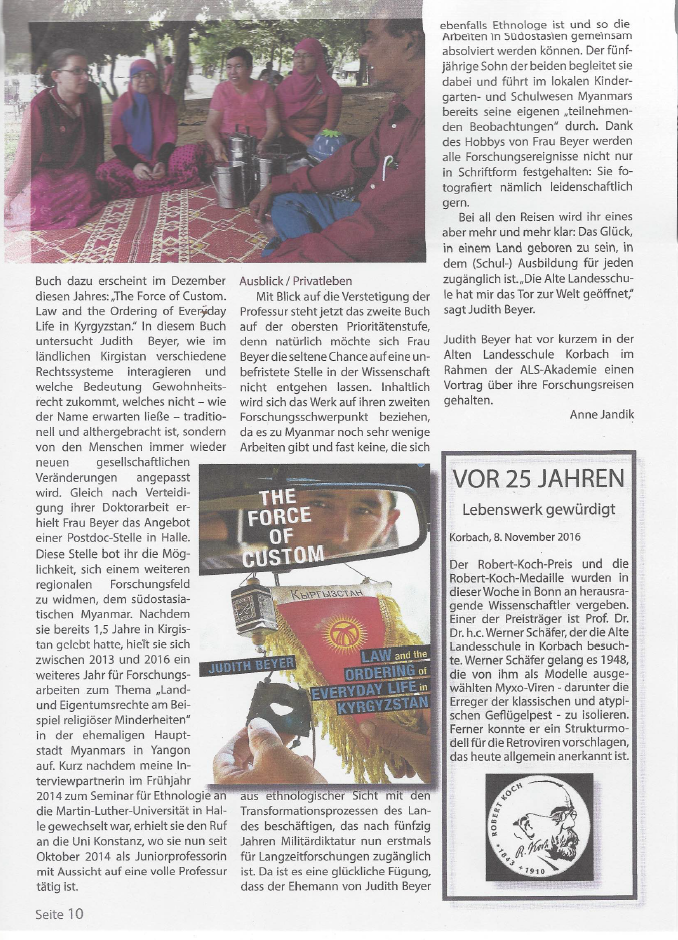
  • My old school (Alte Landesschule Korbach) published an interview with me this month in their alumni journal. Sweet!

    bildschirmfoto-2016-12-20-um-13-06-14

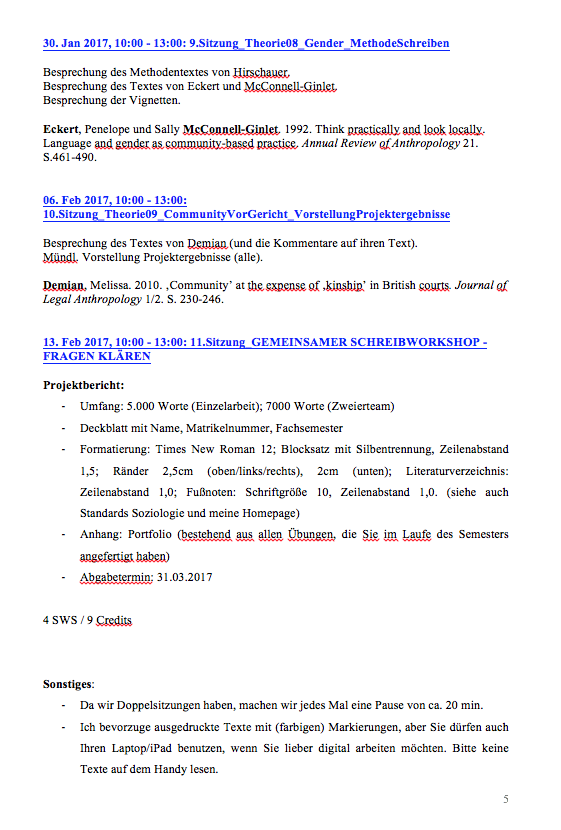
  • I am teaching a project seminar on the topic of “community” this semester (winter term 2016 / 2017) at the University of Konstanz. Here is the complete syllabus to the course.  bildschirmfoto-2016-10-24-um-12-23-21bildschirmfoto-2016-10-24-um-12-23-35bildschirmfoto-2016-10-24-um-12-23-42bildschirmfoto-2016-10-24-um-12-23-48bildschirmfoto-2016-10-24-um-12-23-55bildschirmfoto-2016-10-24-um-12-24-03


  • Celebrating-Arbaeen-Shia-in-Myanmar_origI posted a sound-bite from my recent fieldwork in Myanmar on Allegra this week.

    Here is the full text:

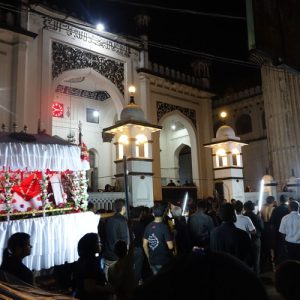
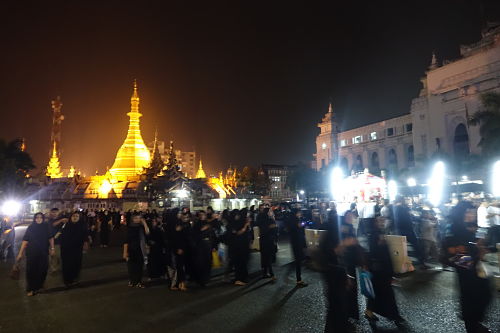
    On December 2nd 2015, the Shia community in Myanmar celebrated Arba’een – the fourtieth day after Ashura. I recorded this martyr song around midnight in Myanmar’s former capital Yangon where I have been carrying out 12 months of ethnographic fieldwork between 2013 and 2016. That night, men and women joined a downtown procession of a tomb replica of Imam Hussain, the grandson of Mohammad. The Arba’een celebration is one of the largest Muslim celebrations worldwide, attracting around 25 million people in Karbala (Iraq) in 2015 alone.

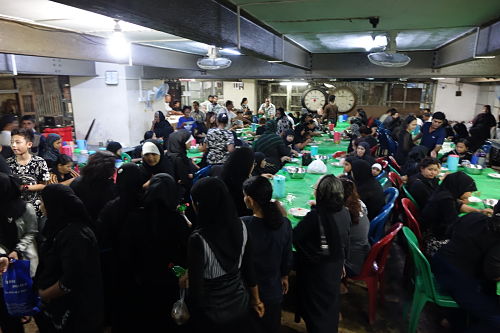
    In Yangon, however, the Shia community is very small. There are no official numbers; community leaders usually count the attendance at Ashura and Arba’een, the two most important memorial events of Shia. “We might be around 6000 in Myanmar,” one elder said, “but in Yangon, maybe around 3000 only.” During the yearly mourning period, which lasts for two months, the community gathers regularly in their two mosques in the downtown area. Women and men as well as various youth organizations have their own duties to perform and they organize seperate festive events. In 2015 and 2016, every week another donor came forward to pay for food to be prepared in the mosque on Fridays after juma, the weekly prayer meeting. The cooks, who are employed by the board of trustees of the mosque, prepared rice and chicken dishes for everyone and people took turns eating, making sure they finished their plate quickly to make space for new guests. Next to community members, also Buddhist monks, neighbours of various religious backgrounds, Sunni friends and the occasional tourists, who happened to pass by, were invited. Afterwards, milk tea was being served outside and people hung out to chat with each other.

    In the basement of the Shia mosque food is being served after prayer (Photo by Judith Beyer)
    In the basement of the Shia mosque food is being served after prayer (Photo by Judith Beyer)

    The Shia community in Myanmar traces its origin back to either Iran or to India. Community members are well aware of each others genealogical backgrounds and frequently point to differences in their physical appearance to indicate the geographial origin of their great-grandparents who all had been brought from India to Burma (as the country was called until 1989). From 1840 onwards, the British colonizers had shipped thousands of “Indians” across the Bay of Bengal to help them in the administration of their final addition to the British Empire. Muslims from India had been under colonial governance already, they often spoke English well and knew how to interact with the British authorities. Rangoon, as the small town by the Andaman sea was called back then, quickly turned into an “Indian city” and was composed of people referred to as kula lu-myo in the Burmese language, literally “people who have crossed over” (meaning journeyed from India to Burma across the Bay of Bengal).

    Members of the Shia community applied for a free land grant from the East India Company, an English, later British trade company that operated in India and Burma from the mid-18th century onwards. Their request was granted and two mosques were erected, both in the downtown area. Next to the two Shia mosques, Sunni mosques, Hindu temples and Christian churches were established in this period, turning Yangon into a multireligious place.

    Although Myanmar is a de facto Buddhist state in which the majority of its population practices Theravada Buddhism, Yangon has retained its plural religious landscape until today.

    Downtown-procession
    On Arba’een, the downtown procession passes the golden Sule pagoda (Photo by Judith Beyer)
  • This is a follow-up on my earlier post which I published with Allegra on Parasitic Professionalism.

    I received an email yesterday from one of the largest finance journals worldwide. Got asked whether I would like to write an article on Myanmar for them. They suggested I could “benefit from this opportunity” to publish with them. This was followed by a detailed description of how to write the article and a strict deadline.

    I answered and asked whether the article would be open access and what the journal usually pays its authors.

    The reply: “Regarding the fee, I regret to inform you that all the articles published in our journal are contributed from authors and we are unfortunately unable to provide remuneration due to our publisher’s policy. We hope that you will understand and still consider this a great opportunity to get your message across to some of the most powerful and informed business leaders and policy makers in the world.”

    They also offered a free subscription for one year and free advertisment of my book or the logo of my organisation in the printed version of their journal.

    The email ended with the phrase: “We hope this is acceptable to you and that you enjoy this publication experience.”

    I replied:
    “Dear xxxx, as an academic scholar, I am a strong advocate of open access policy. As a professional, I think that one should get paid for one’s expertise.
    While reaching a large audience with one’s writing is certainly important, exposure and prestige is no substitution for financial renumeration. I am sure that as an edior of “XXXX” you understand this – and I would seriously question your publisher’s policy on this issue. To emphasize: While I do have a steady income and thus would not “need” a honorarium, a lot of scholars whom you can count among “the world’s smartest people” (your webpage) much more than me, do not. It is for them, not for me, that I therefore have to decline your offer.
    If you are interested in knowing more about the state of academia worldwide, I suggest reading the following – open-access – articles” (all written by fellow anthropologist – and journalist – Sarah Kendzior):

    http://www.aljazeera.com/…/surviving-post-employment-econom…
    http://www.aljazeera.com/…/…/2013/09/201391764312806487.html
    http://www.aljazeera.com/…/…/2013/03/201331116423560886.html

    (Photo: A Sheep Parasite. Open Source Photography / Oregon State University)

  • I recently published a post entitled “On parasitic professionalism” over at allegralaboratory.net – here it is:

    Last month I received an email from an “associate” working at a research institution that caters to the biggest development agencies worldwide: DFID, UN, Worldbank, Australian Aid – you name it.

    This associate was doing part-time work at the institution’s “research helpdesk“ and their job was to put together research reports on certain topics of interest to the big development agencies. So far, so good. These reports, however, are to include “expert comments“ from academics. This is where I seemed to come in. The associate asked me to provide the development agency with expertise on a couple of questions related to conflict and security issues in one of my fieldsites: “We often find that even 4-5 lines of pointers and specific comments from experts can be really useful in informing [name of organization]’s thinking and policies.“

    In turn, my name could appear in the report “in a list amongst the contributing experts.“ I declined and replied that I only work pro bono for refugees and asylum seekers who cannot afford to pay for my expertise.

    There is something seriously wrong with these kinds of requests. The problem is not that this person was asking for my expertise. It is that they did it in the name of one of the biggest development agencies, who was not even their direct employer, but in all likelihood only paid the research institution at which helpdesk the person was working as an “associate,” thus probably also precariously employed.

    Who profits from this arrangement? Not I, not the associate – maybe their research institute. In the end, however, the procedure seems to be set up to benefit the big development agencies: They receive an expert report without having to invest a lot of time, expertise, and money themselves. Who knows what revenue they, in turn, can generate with it.

    But the kind of knowledge these reports contain is often diluted through a process of what I would call parasitic professionalism: It is knowledge that is being generated by one academic living off the expertise of another academic. The first academic is working for the gross benefit of a third, often corporate, actor who only has to initiate the knowledge extraction at the very beginning in order to then lean back and wait for the results to come in.

    These “far-fetched facts” as the German anthropologist Richard Rottenburg (2009) has aptly called the specific kind of genre through which the development industry legitimizes itself, are being produced through chains of translations that make the tracing of original sources impossible. The effort that is being demanded from each person in this kind of knowledge production assembly line seems minimal at first sight: an issue you could summarize in “4-5 lines of pointers” does not sound like a lot of work or even worth asking money for. But we all know that in order to write intelligently about topics such as conflict, rule of law, civil society, or any of the other big themes development agencies are usually interested in, you indeed do have to be an expert in your field. And writing concisely takes a lot more effort than writing longer pieces; anyone who has ever written a research application knows this.

    New research in ecology has shown that by laying eggs inside other animals such as aphid mummies, a certain type of wasp has not only found a reliable source of food for their hatching larvae, but in doing so has managed to convert their food into a much higher amount of their own biomass than previously thought it could. The scientists at the University of Exeter refer to this successful type of animal as a “hyperparasitoid” – or “real-life ‘alien’”: a parasitoid that feeds off another parasitoid. Likewise, large global policy institutions feed from their own experts’ capacity to syphon off the knowledge of external scholars, the hosts to which this entire industry attaches itself.

    The in-house experts of the hyperparasites reach out to other experts or mid-range research institutes because they themselves have become “too expensive to do fieldwork” as David Mosse described for the case of World Bank anthropologists (2006: 11). “Associates” working for these institutes are then, in turn, aiming at acquiring specialized knowledge from outside experts who might be tenured and well-situated or – nowadays more likely – who might be living in even more precarious conditions.

    These “hosts” often offer their free service, hoping that their name being mentioned in a prestigious report of a global development agency might help them on the job market.

    Parasitic professionalism is inherently linked to the prestige economy. The term dates back to anthropological writings of Herskovits (1940) and Bascom (1948) in the 1950s where it described “goods through which social approval and social status are gained” (Bascom 1948: 220-221). Sarah Kendzior has recently employed it in the context of university graduates indebting themselves by working in unpaid internships after finishing college, or as underpaid adjunct faculty, hoping that the institution’s prestige will rub off: “But these are hollow victories, designed to suck you dry ….”, writes Kendzior. “Research associates” aim for the same thing as they work for little or no money, hoping that the well-known name of the company or institute they are associated with will help them to move up the career ladder.

    In a post on academic precarity at Savage Minds from July 2012, Nathan Fisk (@nwfisk) cited his friend Lane saying “I prefer to think of myself as a virus, any prospective employer as a host.” Nathan then already suspected that “it should be expected that said hosts have something of an immune system.” The point I am trying to make is that academics in precarious living situations are more likely to be the hosts who are not immune at all, but have become easy prey: While it is commonsensical for lawyers and doctors, for example, to demand money for their expertise, no matter how small, in academia this is still considered unusual. But it should not be.

    We need to make sure that the knowledge we have painfully acquired over decades, knowledge which is often intrinsically related to our personal development as an academic, is well accounted for.

    We need to demand adequate compensation from those who themselves make a lot of money using our analyses. In the end, it boils down to one important rule: For the sake of everyone, do not work for free – especially if you can afford it.

    Works cited.

    Bascom, William. 1948. Ponapean Prestige Economy. Southwestern Journal of Anthropology  4(2): 211-221.

    Herskovits, Melville. 1940. The economic life of primitive peoples. New York: Knopf.

    Rottenburg, Richard. 2009. Far-fetched facts. A parable of development aid. Boston: MIT Press.

    xxxxxxx

    The post generated some discussion and I received emails from colleagues who shared their (similar) experience with me. Some of the comments can be read here below the original post.


  • Community. Anthropological and Sociological Perspectives on Vergemeinschaftung

    Project Seminar (4 SWS with Fieldwork Component, in German); University of Konstanz

    The English term ‘community’ has been established in the German language as jargon. It is usually used in combination with various adjectives and thus covers a wide range of meanings: communities can be imagined, virtual, indigenous, radical, religious, sustainable, or alternative, to name just a few examples.

    But what exactly do we mean when we use the term in the academic context? What are the important shifts in meaning that have occurred in the last two centuries, and why is the notion still relevant today? After reading classic and current literature on the topic, students will carry out fieldwork in the Konstanz area with a group that identifies itself as a community. Using ethnographic methods such as participant observation, the aim of this course is to collect, interpret and analyze data from one’s own fieldwork in order to gain a better understanding of how social organizations and social relations are being achieved, maintained, and challenged. The course is accompanied by a methods training, data sessions, and a final meeting in which students present and receive feedback on their field report.