Category Archives: law

The force of custom. Lecture at the Institute’s Colloquium in Hamburg

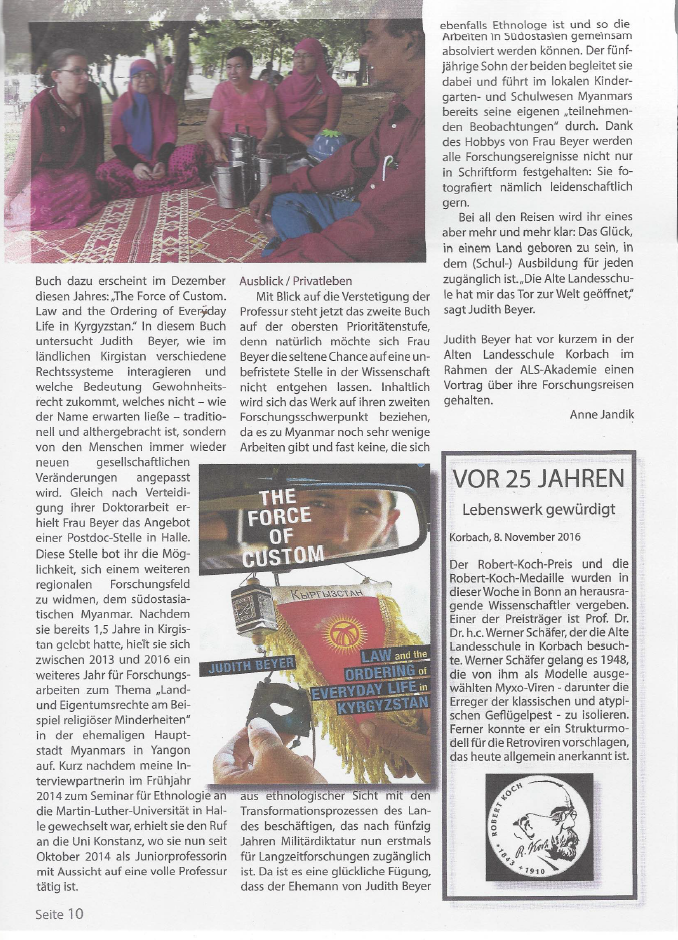
I’ll be travelling to Hamburg next week (13.11) to present the findings of my long-term ethnographic engagement in Kyrgyzstan. My book “The force of custom. Law and the ordering of everyday life in Kyrgyzstan” came out in December 2016, almost two years ago. I am still happy with how a decade of scholarship has turned out and am looking forward to hearing comments and feedback from my Hamburg colleagues. Here’s the link to the programme in case you are around. Join me!

And here’s what I will be talking about:

In this talk, I offer a unique critique of the concept of ‘postsocialism’, a new take on the concept of legal pluralism, and a plea to bring ethnomethodological approaches into correspondence with ethnographic data. Drawing on a decade of anthropological fieldwork and engagement with Central Asia, I will focus on describing how my informants in rural Kyrgyzstan order their everyday lives and rationalize their recent history by invoking the force of custom (Kyrgyz salt).

Although salt is often blamed for bringing about more disorder and hardship than order and harmony, as I will exemplify with the example of mortuary rituals, it allows my informants to disavow responsibility for their actions by pushing a model of ‘how things get done here’ to the front. Invoking salt enables actors even as they claim to be constrained by it, it opens up possibilities to conceptualize, classify, and contextualize large- and mid-scale developments in an intimate idiom. It also is a way to communicate to others that one is an expert in and of one’s own culture. An ethnomethodological perspective, as I pursue it, challenges a conception of social order as hidden within the visible actions and behaviours of members of society. Rather, it examines how members produce and sustain the observable orderliness of their own actions.


The lecture will be in English. Venue: Institut für Ethnologie (Raum 222 im Gebäude ESA W – Westflügel des Hauptgebäudes, 2. Stock). 13.11. 6.15pm.

The force of custom. Law and the ordering of everyday life in Kyrgyzstan

In this third lecture that I will be giving while residing in Paris as a DEA-fellow, I will  present the key findings of my recent book  “The force of custom. Law and the ordering of everyday life in Kyrgyzstan” (2016, Pittsburgh University Press).

In this monograph, which covers a decade of anthropological fieldwork and scholarly engagement with Central Asia, I take up a particular counterintuitive perspective by looking at how my informants in rural Kyrgyzstan order their everyday lives and rationalize their recent history. I reveal how rather than conforming to a predictable ‘post-socialist’ pattern, my informants instead show a great capacity to hierarchize and create order on their own terms.

My approach investigates the ways in which actors tactically and persuasively invoke different kinds of law to constantly create a hierarchical model of socio-legal order in which the umbrella concept of custom (salt) comes to dominate their everyday life.

Invoking salt enables actors even as they claim to be constrained by it, it opens up possibilities to conceptualize, classify, and contextualize large- and mid-scale developments in an intimate idiom. It also is a way to communicate to others that one is an expert in and of one’s own culture.

I thus offer a unique critique of the concept of ‘postsocialism’, a new take on the concept of legal pluralism, and a serious plea to bring ethnomethodological approaches into correspondence with ethnographic data.

Location: Monday March 12, 13-16h. EHESS on 54 Boulevard Raspai.

Shari’a, tradition and the state in Kyrgyzstan. Competing repertoires of order: the case of mortuary rituals

This will be my second lecture while I am in Paris, this time as part of the “Séminaire Transformations de la Normativité Islamique” organized by Professors Baudouin Dupret, Nathalie Bernard-Maugiron, Jean Philippe-Bras, and Marième N’Diaye

Jeudi 8 mars de 10h à 13h, en salle de réunion de l’IISMM (96 boulevard Raspail, 1er étage)

Abstract:

In Central Asian Kyrgyzstan, shari’a and tradition are best understood as two interrelated répertoires of order. Historically, they have developed alongside each other and the population has learned to reclassify social practices or local institutions that might be regarded as unlawful or illegal by Islamic clergy on the one hand or the state on the other by reinterpreting them ‘according to custom’. I refer to this process as ‘customization’.

In this lecture, I will use the example of elaborate gift-exchange practices during mortuary rituals in order to show how imams, state officials and the local population try to grapple with the disputed social practice of giving large carpets during funerals and mortuary rituals that is considered against shari’a and also contradicting new state regulations. Nevertheless, gift exchange continues and has even intensified in the last decade.

This lecture investigates emic local understandings of shari’a and tradition and positions these in the context of a changing social and economic environment where formerly Russian and Soviet state practices aimed at curbing ‘irrational’ local behaviour and where nowadays remittances from Central Asian labour migrants fuel the local ritual economy.

Podcast about my book

Sean Guillory of Sean’s Russia Blog spoke with me the other day about my book “The force of custom. Law and the ordering of everyday life in Kyrgyzstan.” You can listen to the podcast online here or download the podcast here.

In our interview, Sean asked me what inspired me to do a study on “custom” (Kyrgyz salt) and how we can understand the concept anthropologically, how it is communicated, what metaphors are associated with it and in what contexts we can observe it in action.

Sean was also interested in hearing my reasons for not anonymizing my main informants, how people in my fieldsite conceive of their history, what the historical trajectories of the local courts of elders (aksakal courts) are, how Soviet life has been unmade after Kyrgyzstan gained independence, how we should understand the role of the state in the countryside and what the roles of elders and their relationship with villagers, politicians and state administrators are.

Finally, we discuss my decision to end the book with a criticism of the concept of postsocialism which, I argue, is not central for understanding everyday life in Kyrgyzstan.


Teaching: Disputing. Legal anthropological and sociological perspectives on a human universal

 BA-Seminar in Sociology, University of Konstanz, Germany

Winter term 2015 / 2016 (starting mid-October 2015)

Dispute is a human universal and an integral part of social life. Why this is so, however, has been interpreted differently in the social sciences. How do disputes start at all? What happens when we argue? When does an argument become a legal dispute? When does a dispute divide us, and when does it bind us together even stronger? And when is a dispute actually ended?

Scholars of legal anthropology and legal sociology have studied different dispute settlement procedures since the 1960s. In the sociology of law this has occurred primarily in the context of Western state jurisdiction. In legal anthropology, it has occurred in the non-European context, focussing on non-state actors such as councils of elders or religious leaders. In the course of (post-)colonisation, Western-style state jurisdiction was exported to the global South, while dispute settlement procedures (ADR, Alternative Dispute Resolution) enjoyed increasing popularity in Western societies. Both developments are scientifically controversial as their practical success is questionable.

In the seminar we will read texts from legal anthropology and legal sociology. Furthermore, we will draw extracts from classical ethnographies, and try to grasp theoretically how disputes and their proceedings have been studied in non-Western societies, along with new approaches, and phenomena well-known to us such as disputes over the neighbourhood apple tree, the fascination with “court shows,” as well as the trans-local arbitration of disputes in international courts. Moreover, the seminar is also dedicated to qualitative methods, through which dispute settlement procedures can be investigated.

All students enrolled in a sociology BA or a related discipline at the University of Konstanz (Germany) can attend.

Statelessness – Summer Term 2015

Here is one of two seminars on “the state” I will be teaching in the coming Summer Term 2015 at the University of Konstanz.

All MA-students registered in Konstanz are welcome:


Statelessness: On the permanent state of exception

What does it mean to live without citizenship in the time of nation states? 10 million people globally find themselves in exactly this situation. As the UNHCR proclaims the end of statelessness in the context of its refugee work (the ‘iBelong-Campaign’) by 2020, more people are born into statelessness or lose their citizenship each day.

In this seminar we will work on ethnographic case studies focusing on the causes and consequences of statelessness. Legal sociological and legal anthropological texts as well as texts from legal philosophy will help us to reflect better on our own civic existence, as well as to critically question the concept of statehood as a ‘normality’ (e.g. with texts from Agamben, Arendt, Badiou). Literature on transnationalism and exceptional cases, in addition to current approaches that understand statelessness as a humane alternative to nation states, will broaden the scope of the seminar. An external speaker will report on stateless women in Central Asia, the so-called border brides.

Seminar requirements: regular participation; reading of texts; presentation of a case study.

Ethnography of the State – Summer Term 2015

Here is one of two seminars on “the state” I will be teaching in the coming Summer Term 2015 at the University of Konstanz.

All BA-students registered in Konstanz are welcome:

Ethnography of the state: Participant observation and photography

The methodology of participant observation is at the forefront of this seminar. Aided by photography, we will close in on self-selected themes within the subject of ‘state’. Once characterised as “fiction of philosophers” (Radcliffe-Brown 1940), the representation of states (i.e. what concretely the state is) has become the central focus today. Students’ field research can be concentrated on institutions, such as the courts, police, state/municipal administration, and other public institutions. It can, however, also focus on other material embodiments of the state, such as streets, architecture, monuments or borders.

The topic will first be explored with the camera, and connected to the seminar by way of a concrete research question. Over the course of the seminar we will examine specific subjects in addition to making observations, and if possible we will also use other qualitative methods such as open questions and semi-structured interviews. As an accompaniment, we will read texts on ethnographic methods together with texts on the ethnography of the state.

The seminar has two goals: firstly, to discuss the method of participant observation in order to understand its possibilities and limitations; and secondly to offer a practical introduction to the theme of the ‘state’ and reflect on how such manifestations influence our daily lives.

New equipment (small and large cameras) has been purchased for the seminar specifically for students to borrow. Students can, however, also use their own cameras.

Possible work formations: individual work or two-person teams.

Seminar requirements: regular participation in class; reading of literature; regular conducting of field exercises during the semester; presentation of preliminary results; seminar paper to be written during the semester break.

Watching Iraq talk about Human Rights. Excursion to the 20th Universal Periodic Review in Geneva

I am preparing for a two-day excursion with my Master students to the 20th Universal Periodic Review of the United Nations. The event will take place in the Palais des Nations in Geneva. In advance, we had to register via email, and in order to be allowed to participate, we will need to collect our “badges” on Monday morning at the gate of the palace.

We will be witnessing the Review of Iraq on Monday and the Review of Slovenia on Tuesday. We will hopefully also arrange for a tour around the building — in which the former Völkerbund was housed — and I am personally interested in observing the Distribution of the report on Kazakhstan.

My students’ task is to learn participant observation in an International Organization. That is, to employ anthropological research methods originally designed in and for colonized societies, in a setting that is not only “Western”, but also transnational, bureaucratic, complex, and …. boring? Maybe not. We shall see …

In order to prepare, we have read a couple of anthropological texts, most importantly those by Jane Cowan and Julie Billaud, who carried out long-term field research in the UPR two years ago. But also documentation itself such as

the English version of the National Report on Iraq

the Compilation of UN Information on Iraq

a Summary of Stakeholders’ Information on Iraq

and several sheets of advanced questions prepared by various member states of the UN. The UK, for example, would like to know the following:

“The situation for ethnic and religious groups including Muslims, Christians, Yezidis, Turkmen and others remains deeply concerning. What is being done to protect vulnerable groups from continued attacks and persecution; and also to enable them to return to their homes in areas where they have been displaced – particularly where their neighbours have allegedly been complicit in the persecution?”

I am very much looking forward to hearing how “Iraq” is going to answer that one …