
Judith Beyer is currently carrying out several research projects.
1. Towards an anthropology of statelessness
Anthropologists have historically dealt with stateless societies in the context of colonial politics of expansion and exploitation. Ethnographic monographs of the time centered on ‘acephalous’ ethnic groups or tried to grapple with understanding how groups organized themselves and interacted with one another without a clear leadership. After the demise of colonial empires, such ethnographic work has almost completely come to a halt. The state has come to tighten its grip on ethnic groups to such an extent that there is, by now, no place on earth that would not feel its often eerie presence. This includes hunter-gatherer societies and sedentary tribes in rural Africa and Central Asia as much as agrarian groups in Southeast Asia. However, statelessness as a condition of individuals and groups of people who are not recognized as belonging to any state, has remained a phenomenon worthy of anthropological attention and theoretization. Despite two UN Conventions against statelessness (1954, 1961) which many states have ratified, statelessness not only continues to exist across the world, including in Europe, the numbers of stateless individuals are even increasing. Statelessness remains one of the most overlooked human rights violations as it effectively deprives individuals of their ‘right to have rights’ as Hannah Arendt, drawing on Immanuel Kant, put it.
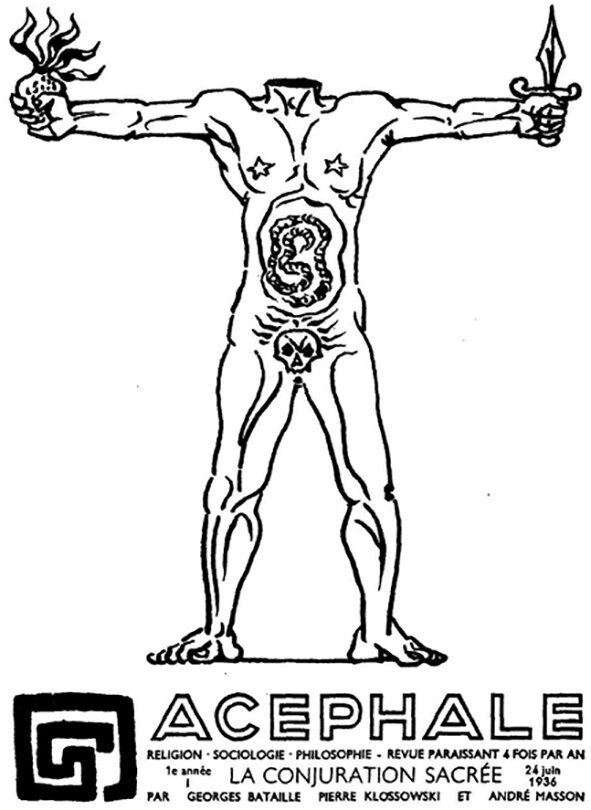
Cover of the surrealist journal Acephale. 1936.
In this project, Beyer works towards establishing an anthropology of statelessness that focuses on stateless subjects and scrutinizes the public portrayal of the stateless as an amorphous mass of ‘nowhere people’, ‘legal ghosts’ or ‘aliens.’ Her aim is to research statelessness not as a historical leftover of group encounters with (colonial) states, but as an existential human condition of currently at least 15 million people worldwide that also allows for a novel perspective on the very concept of ‘the state’. She argues that an anthropology of statelessness can fruitfully expand the well-established subfield on the anthropology of the state, but it requires its own theoretization. Statelessness can neither be found at the ‘heart of the state’ (Fassin) nor at its ‘margins’ (Das and Poole), where anthropology has so far located its objects of inquiry when studying the state tangentially (Harvey). Statelessness rather points to what Beyer – with Jacques Lacan – regards as a structural lack that is crucial for how we imagine and theorize the state (Abrams) and its state effects (Mitchell). While (I)NGOs, activists, legal practitioners and scholars mostly treat statelessness as an ‘anomaly’ for which a technical (juridical) fix could be found, Beyer argues that statelessness posits a structural lack that cannot be ‘filled’ or ‘fixed’ and that it is ‘the state’ itself that contributes to the phenomenon.
Her project draws on ongoing ethnographic fieldwork with stateless individuals, NGOs and lower-level bureaucrats in Germany and Europe, on case material she obtains in her role as a country-of-origin expert concerning asylum cases of stateless individuals in the UK, on the critical reading of science fiction literature and on Lacanian psychoanalysis.
Publications:
2025. Asylum interviews in the UK. The problem of evidence and the possibility of applied anthropology. Social Anthropology/Anthropologie Sociale 33(3): 51-65.
2024. Unsicheres Wissen. Die asymmetrische Ko-Konstruktion von Plausibilität in britischen Asylverfahren. In: Vorläufige Gewissheiten. Plausibilität als soziokulturelle Praxis, Thomas G. Kirsch and Christina Wald (eds.). Edition Kulturwissenschaft. Bielefeld: Transcript. pp 129-149.
2022. Statelessness, expert activists and the ‘practitioner-scholar dilemma’. Critical Statelessness Studies Blog. November.
2022. The common sense of expert activists: practitioners, scholars, and the problem of statelessness in Europe. Dialectical Anthropology 46: 457–473.
2019. Accountability in statelessness. Allegra Lab. June.
2. Expert activists
In this ongoing multi-sited ethnographic research project, Beyer follows a group of high-skilled people she refers to as “expert activists” in their work of human rights advocacy in Europe. She argues against a theoretical reductionism that regards expertise and activism as two essentially different and mostly individual properties, drawing instead on classical socio-political theories that relate the individual to class and the state (e.g. Hannah Arendt and Antonio Gramsci) and on recent literature from the anthropology of activism and the anthropology of expertise.
Her data from this ongoing research project consists of written observations, photographs, the recording and subsequent transcription of free flowing talk, listening to podcasts and webinars as well as to oral presentations and speeches obtained from participating in workshops, conferences and policy briefings in various European settings, such as universities, museums, event spaces or EU offices.
Publications:
2025. Asylum interviews in the UK. The problem of evidence and the possibility of applied anthropology. Social Anthropology/Anthropologie Sociale 33(3): 51-65.
2024. ‘Illegal’ migration and the Othering of activist lawyers in the UK. Activist Lawyer. January.
2024. Unsicheres Wissen. Die asymmetrische Ko-Konstruktion von Plausibilität in britischen Asylverfahren. In: Vorläufige Gewissheiten. Plausibilität als soziokulturelle Praxis, Thomas G. Kirsch and Christina Wald (eds.). Edition Kulturwissenschaft. Bielefeld: Transcript. pp. 129-149.
2022. Statelessness, expert activists and the ‘practitioner-scholar dilemma’. Critical Statelessness Studies Blog. November.
2022. The common sense of expert activists: practitioners, scholars, and the problem of statelessness in Europe. Dialectical Anthropology 46: 457–473.
2019. Accountability in statelessness. Allegra Lab. June.
3. Listening
Together with two PhD students, Judith Beyer currently explores ways to strengthen listening as part of anthropological method/ology and as a way of a more ethical encounter in research situations. The team will scrutinize not only how anthropologists interact with their interlocutors during field research, but also how they conceptualize the other and themselves when doing so.
Within the frame of this project, listening is understood to be more than a practice (as in hearing the other with the intention to understand or even to just ‘collect data’). Listening requires a theoretical conceptualization of what the anthropological subject is and how it is constituted via the other — the speaking and listening other, that is.
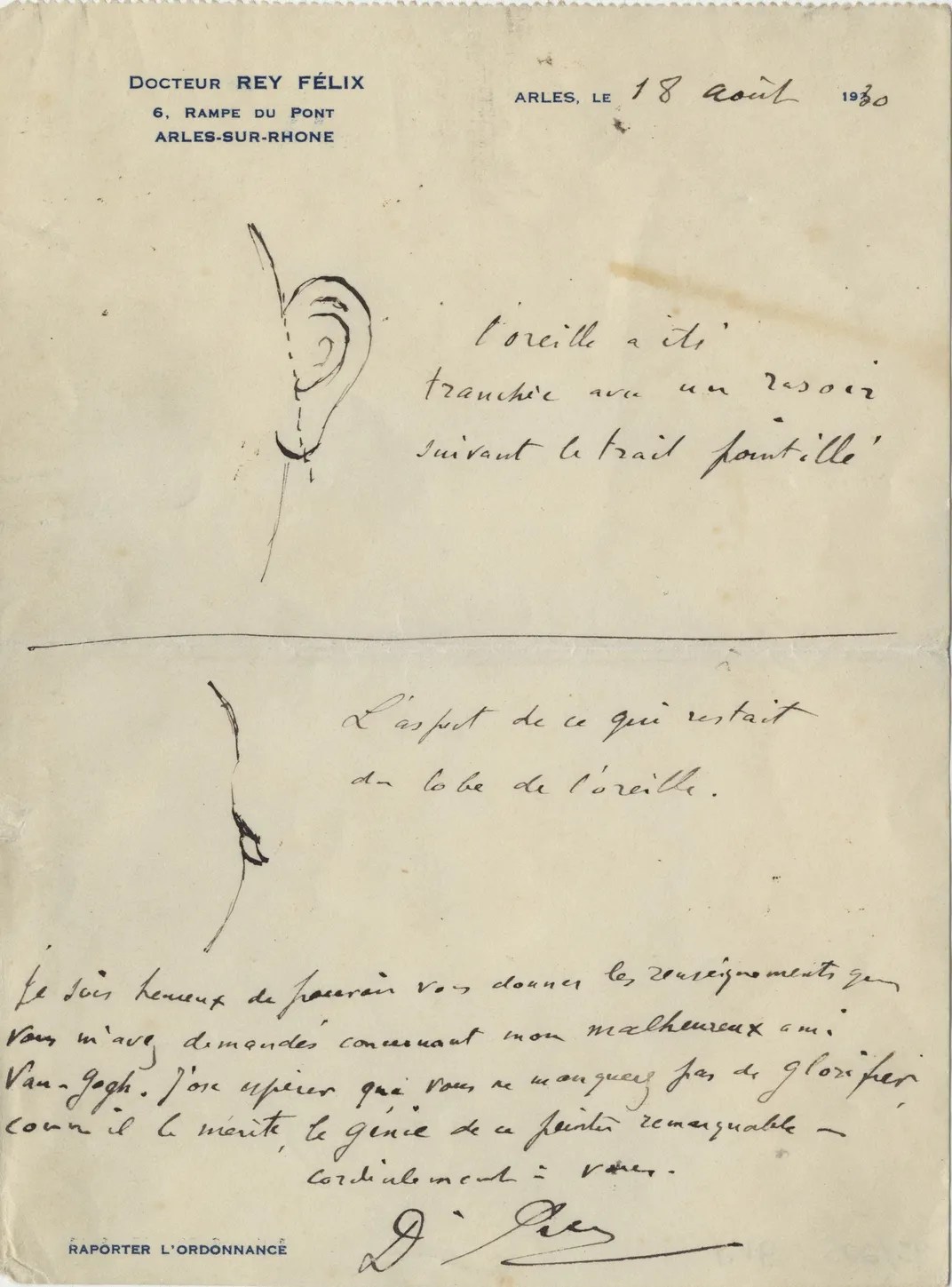
Diagram by Van Gogh’s physician Dr. Felix Rey, showing how and where van Gogh cut off his ear. The Bancroft Library, University of California, Berkeley
Themes the group will explore in this context in both empirical and theoretical dimensions are: silence/ing, non-human listening, indifference as subject position, and atmospheric sound/ings.
Members of the project read literature from anthropology, political theory, psychoanalysis and ethnomethodology and employ multimodal anthropology during their ongoing field research in different locations in Europe.
A workshop on the theme with scholars from diverse backgrounds is envisioned for the end of 2026.
 judith beyer