2024 has been the deadliest year for migrants trying to cross the Channel in small boats to reach the UK, with 69 deaths reported (Refugee Council 2025). British politicians have been referring to the circumstances under which people migrate to the UK as “the small boat crisis“ and subsequently made a “small boat deal“ with countries such as Ruanda, to which they wanted to ship people to.
I recently bought a small booklet filled with Walter Benjamin’s short stories. Tales out of loneliness is its subtitle. In it, there is a 1-page story entitled How the Boat was Invented and Why It Is Called ‘Boat‘. It follows a similar pattern as Benjamin’s short story on Why the elephant is called ‘elephant‘ that immediately precedes the story about the boat.
The storyteller. Tales out of loneliness. Walter Benjamin. Verso Books 2023.
Here’s how Boat’s story goes:
Before all the other people, there lived one person and he was called Boat. He was the first person, as before him there was only an angel who transformed himself into a person, but that is another story.
So the man called Boat wanted to go on the water — you should know that back then there was a lot more water than today. He tied himself to some planks with ropes, a long plank along the belly, that was the keel. And he took a pointed cap of planks, which was, when he lay in the water, at the front — that was the prow. And he stretched out a leg behind him and navigated with it.
In this manner he lay on the water and navigated and rowed with his arms and moved very easily through the water with his plank cap, because it was pointed. Yes, that is how it was: the man Boat, the first man, made himself into a boat, with which one could travel on water.
And therefore — of course that is quite obvious — because he himself was called Boat, he named what he had made ‘boat‘. And that is why the boat is called ‘boat‘.
(Walter Benjamin, 26 September 1933; published posthumously)
The “small boats crisis” is Boat’s crisis, the crisis of man. This is the elephant in the room that nobody wants to talk about. Because they do not know why the elephant is called ‘elephant‘ either.
Philosophy saves lives.
Paper boat made out of a book page (photo by: Maddy Freddie, pexels.com).
Eid Mubarak, Айт маарек болсун, Ramadan kareem, Ein gesegnetes Ramadanfest … to all my friends, colleagues, interlocutors across the world who are celebrating today!
This year, my thoughts are with all Muslims in Myanmar, particularly those most heavily affected by the earthquake. After a month of fasting, which is physically and psychologically challenging, instead of celebrating with their family and friends, they are searching for or burying their loved ones. For many children there might be no new clothes and toys today and no sweets. There will also be no places to pray as many mosques have collapsed.
Dozens of religious buildings in Mandalay are gone. This is partly due to the fact that – particularly for Islamic congregations – it has been near impossible to get official permits from the authorities to renovate the often dilapidated structures. Many stem from colonial times. I have seen in Yangon, how both Sunni and Shia congregations had to patch up holes in ceilings, stop water leaks and support crumbling walls without being able to properly renovate.
The landscape of Mandalay in particular will be changed and almost certainly, mosques will not be allowed to be rebuild. While human lifes are of course more important than buildings, these buildings have provided shelter and food for the less fortunate. Within their walls there was possibility for safe conversations, education was given for free in subjects not taught at public schools and in universities (not only about Islam, but also literature or English language), and they offered a space both for individual contemplation as well as for gathering and celebrating together.
Today, on Eid, it would be more than a nice gesture to donate to the victims in Myanmar – independently of their and our religious belief! I am copying the three links from my previous post below. In any case, make sure that your money does not go to the military by donating to small-scale initiatives instead.
The people of Myanmar are the most resilient people I have ever met. But now, after this devastating earthquake, and with ongoing relentless attacks from the military since the attempted coup of 1 February 2021, they are exhausted and really need our support.
This is easier said than done. When a military dictator, notorious for shooting civilians in broad daylight, for bombing innocent children in their schools out of airplanes, for planting mines across the entire country which will cause suffering for decades to come, suddenly begs the “international community” for any humanitarian aid possible, we need to be very careful.
While international aid and financial support is of utmost importance at this moment, it can not go to the “state” of Myanmar, a structural position currently occupied by the military. As there is no legitimate government inside the country, there will be no way to ensure that the money reaches those who need it.
Instead, we can be sure that humanitarian aid will be diverted by the generals. So, how can you support those suffering?
Here are three initiatives, the first two are known for having done great work since at least the attempted coup, the third one is a personal recommendation:
To see a World in a Grain of Sand And a Heaven in a Wild Flower Hold Infinity in the Palm of Your Hand And Eternity in an Hour.
(William Blake. Auguries of Innocence, 1803/1863)
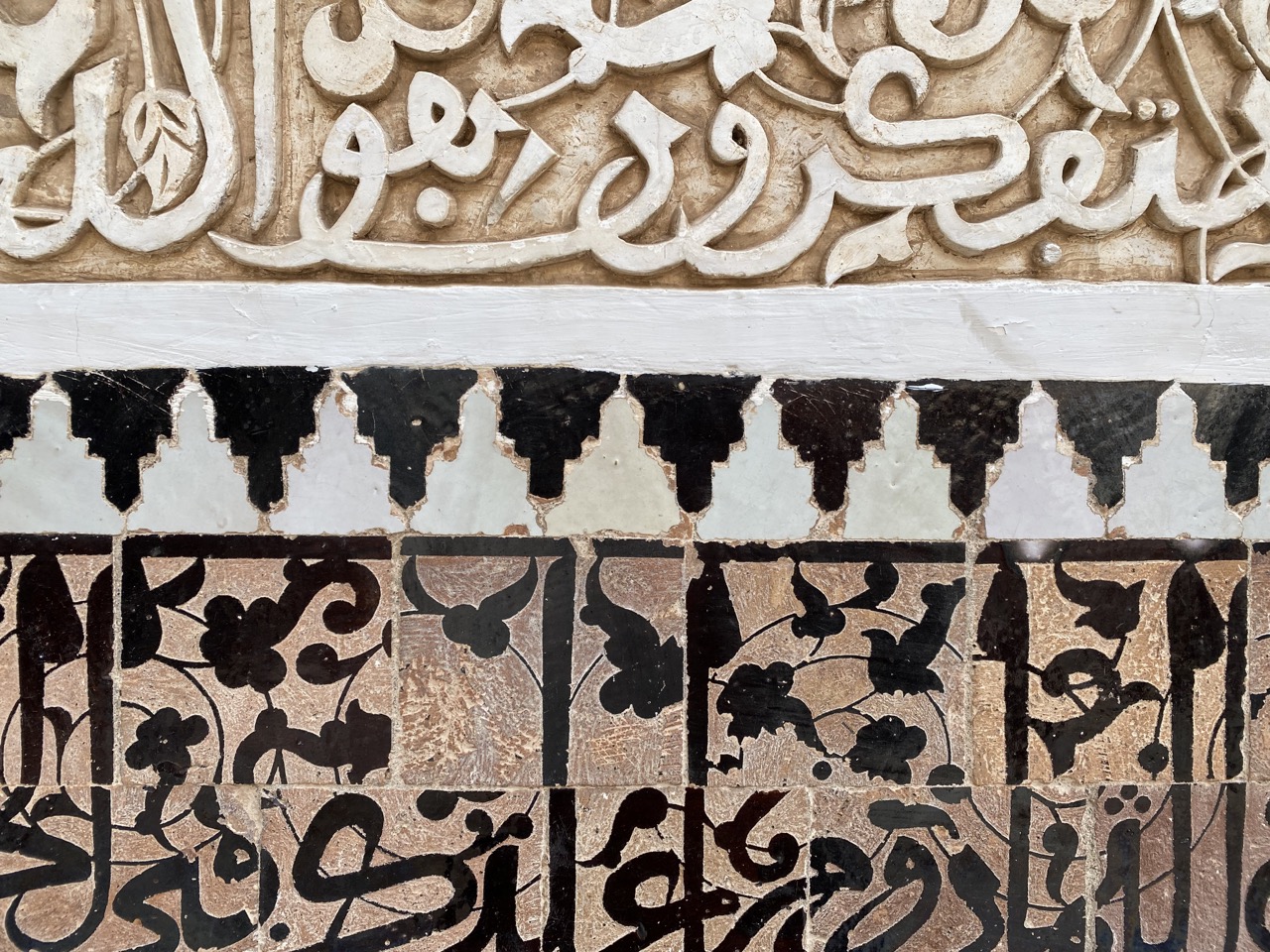
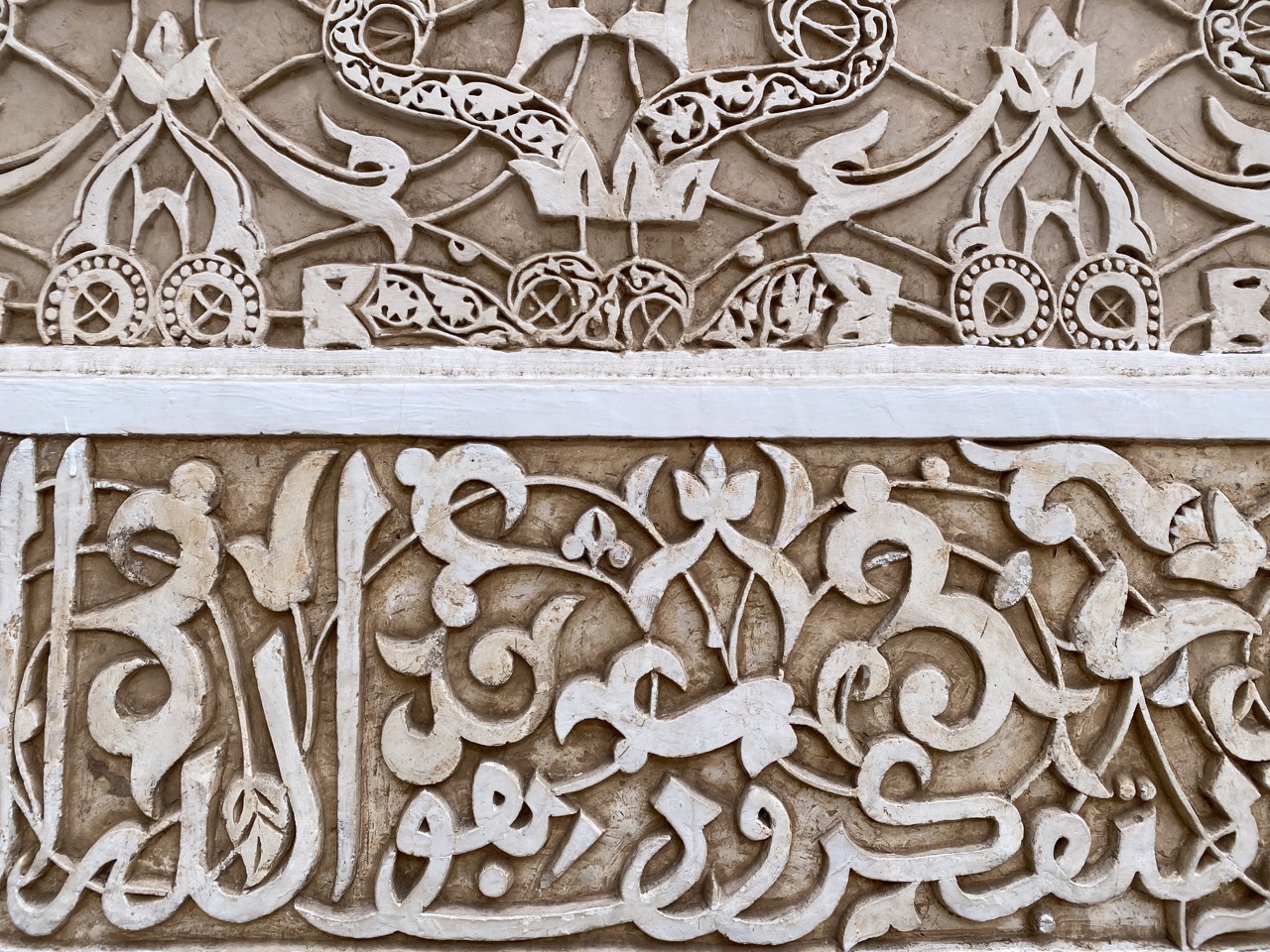
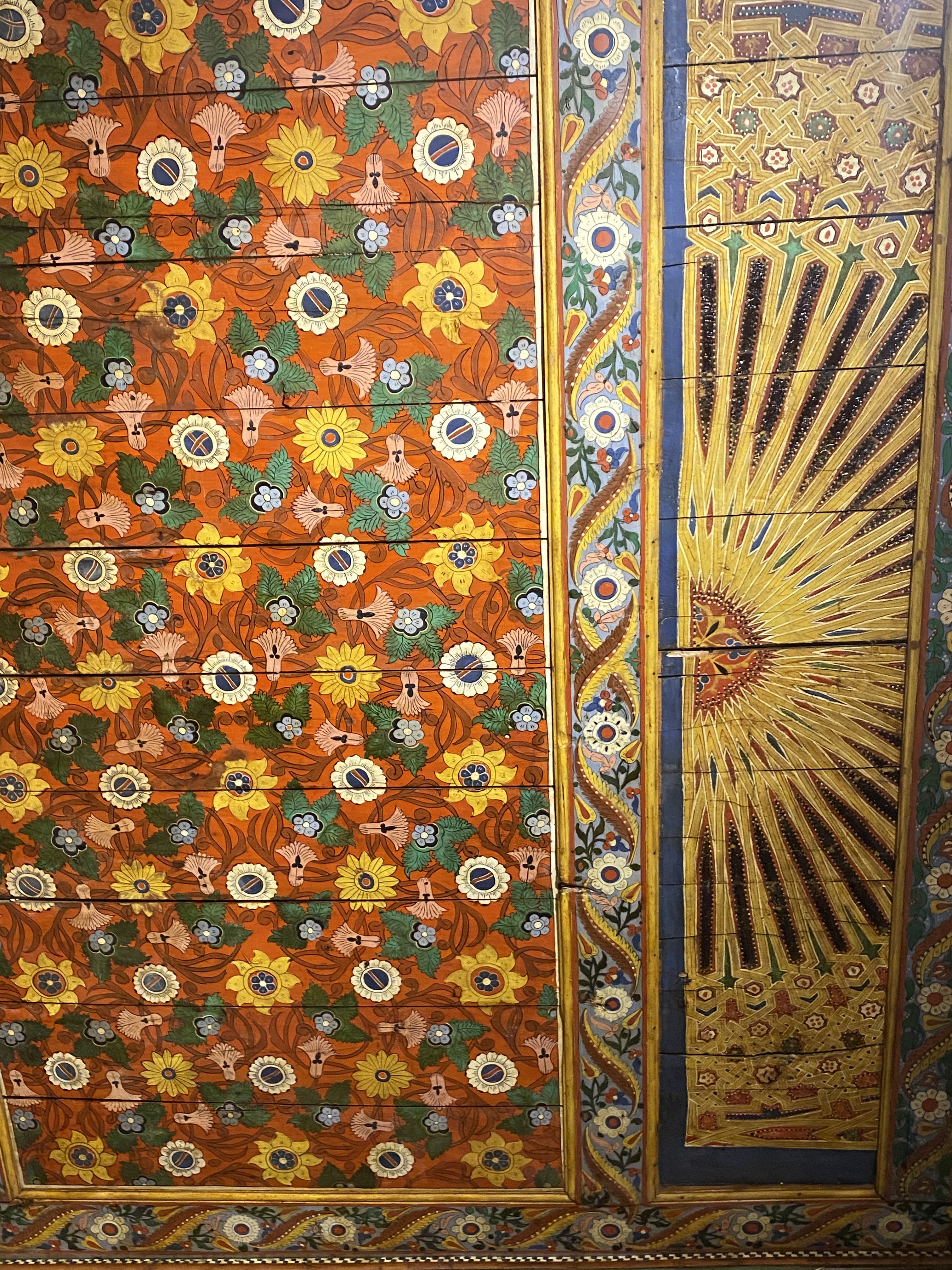
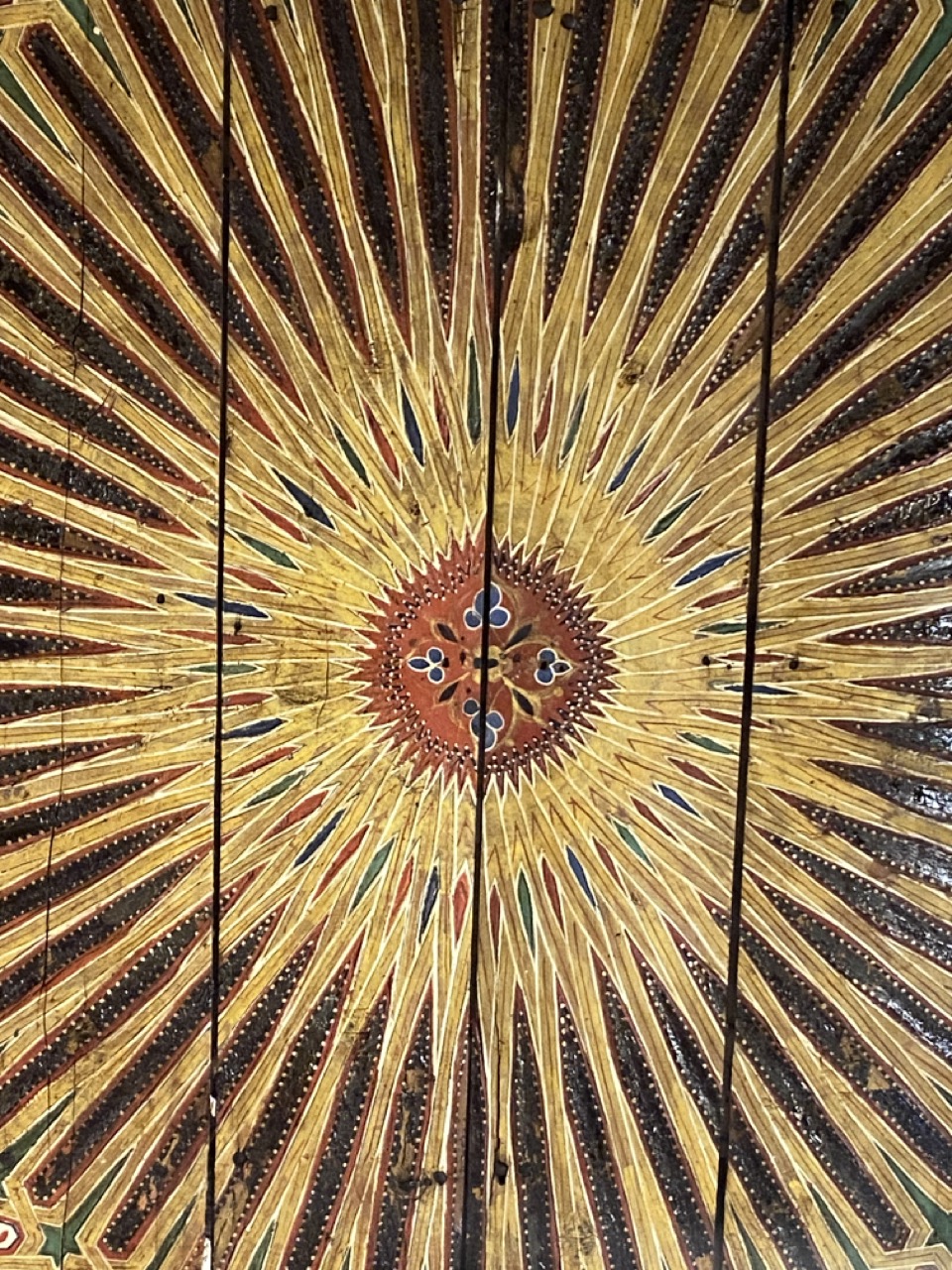
details on the walls of the Ben Youssef Madrasa, Marrakesh, Moroccodetails on the walls of the Ben Youssef Madrasa, Marrakesh, Moroccodetails on the ceiling of a Saadian douiria house from the 16th century, Marrakesh, Moroccodetails on the ceiling of a Saadian douiria house from the 16th century, Marrakesh, Morocco
Decaying lemon and living fungi and a print of a Burmese fruit basket made of raffia, the lemon‘s home.A quark ball covered in powdered sugar and a lemon covered in mold.Holding on for dear life.Never gonna let you go …
We are way into the winter term in all public universities in France. I am currently on a research sabbatical at the University Paris-Nanterre where I also teach a course on the Introduction to Legal Anthropology.
Half an hour before my lecture is about to start, one student already sits prepared with their laptop in the hallway. I open the door to the lecture room to allow them to sit more comfortably. But it is as freezing in the room as it is in the hallway. There is no heating in the building. I wonder how many of my students might come today given the heavy rainfall …
Ten minutes before my lecture, I check my emails. I see that several students have written to me already. Only one calls in sick, all others are stuck in the outbound RER A train from central Paris to Nanterre. There has been an incident, the students explained: “We are all stuck”. Another one shares a screenshot of the offical traffic announcement and an additional photograph: an official attestation that there has been a disruption. The document carries the title “Attestation de pertubation”
The date and time is neatly printed and I contemplate how fast and effective not being fast and effective can be. I suggest to the student later to use this textual artefact as an entry point to an essay my students are supposed to write at the end of the term on the everyday life of the law.
It is 10.30h and I decide to see who might have shown up despite the rain falling and the train being late. The room is half full already and within the next 20 minutes the rest trickle in. We are almost at full capacity and I am seriously impressed.
It is on the same day that I learn that in France there is no longer an obligation to attend classes in presence if your personal circumstances do not allow you to do so. Students may study long distance at all universities in France for health-related reasons or because they have to work. At the end of my course I will have to grade essays of students whom I will have never seen in person and who will not have attended a single lecture of mine on campus.
I wonder: what kind of anthropologists are we releasing into the world if the only encounter many students have with the discipline is via self-study ? No dialogue with teachers, no spending time with classmates, no campus experience. Not only that the state keeps on moving the universities beyond the bande péripherique into suburbia, by allowing students to study long-distance, it reduces the campus to mere sites of administration. In the name of “flexibility”, students work towards their grades, but are being deprived of what Bell Hooks has called “the most radical space of possibility in the academy”: the classroom.
Universities are easier to manage if fewer people are around. One might be tempted to reframe long-distance studies as “needs-centred”. Paris already suffered from high living costs before the Covid-19 lockdowns struck. After 2021, many never moved back to the city, but remained in their home towns far away. At times, the campus feels deserted – a striking difference to 2018 and 2019 when I last spent some time in Paris on fellowships.
The students who do attend my seminar, always listen attentively and eagerly write down what I am presenting on my slides. I have split the seminar into two parts: the first is a lecture, the second was intended as an interactive space for discussing the weekly reading and give them the possibility to ask questions – in French or English. However, only very few attend the second part of the seminar. I now understand that this is the case because very few have read the text. I was warned by other lecturers that this is indeed the case: “Students do not read texts.” When I inquired why, the answer was always because they are overworked – from having to take too many courses and from having to work in order to finance their studies …
But anthropology is not a subject that can be taught only. It needs to be ingested until it has become part of oneself. Students need to anthropologize themselves throughout their studies in order to be able to later claim “I am an anthropologist” and mean themselves instead of a mere profession. Anthropology needs to become an integral part of one’s own humaneness, ideally, before one can collaborate with others and analyse what one has learned from them in an ethical manner. But the discipline is increasingly expected to be taught in ways that ensure it remains outside of our students’ individual experience.
Our most important task is therefore to get students back into the classroom while at the same time opening that very classroom up to the world. Rather than transmitting a particular kind of ‘knowledge’, we should be transmitting that anthropology provides a multitude of ways of seeing and conceptualizing humanity as such. While taking our students and their current experiences seriously, our task is also to de-self-center their existing worldview and help them get unstuck. We do not need more ‘attestations des pertubations‘, we need ‘pertubations des attestions‘!”
Flâneuse [flanne-euhze], nom, du français. Forme féminine de flâneur [flanne-euhr], un oisif, un observateur flânant, que l’on trouve généralement dans les villes.
An incremental part of anthropology has always been photography for me. It can be used as an aide mémoire to simply remember where one has been or whom one has encountered on a particular day, thus substituting for fieldnotes. It can also be used as a methodological tool in order to detect the ‘minor modes’ in everyday life or in co-existence. A photograph can be scrutinized for its details, revealing more and more of them, every time one looks closer. But photography can also help express oneself when words fail. Rather than serving the eye, it serves the mouth that does not find the right words or ceases to speak alltogether. When used in this way, photography is neither only a method nor a product. It becomes a mode of existence in itself.
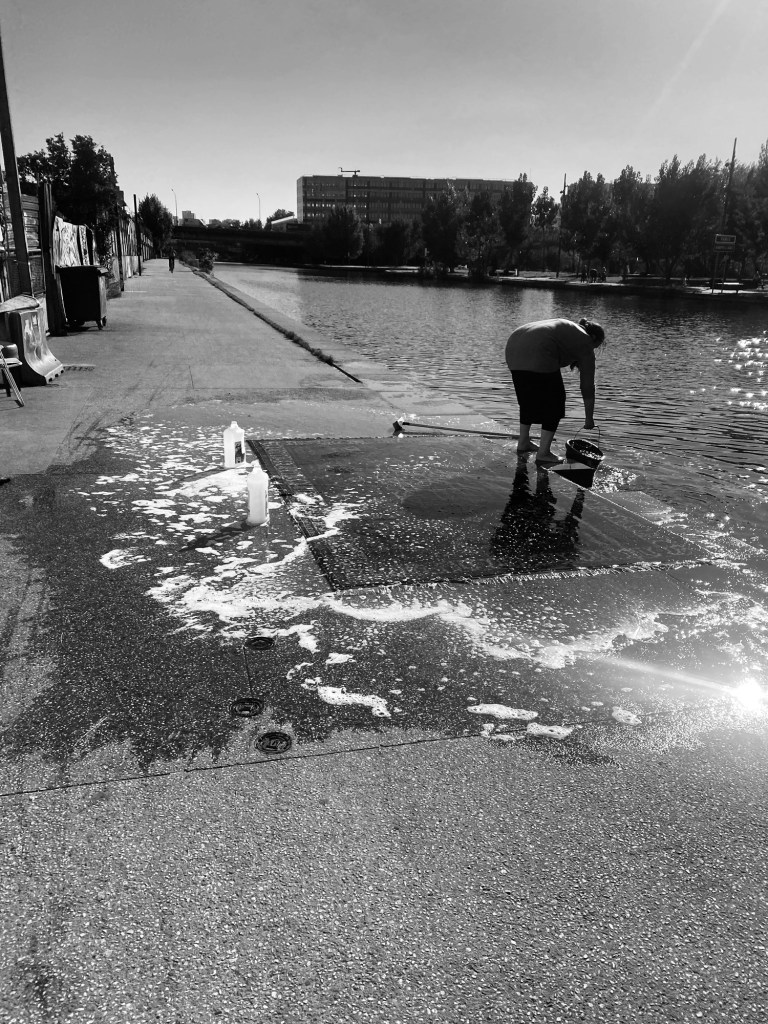
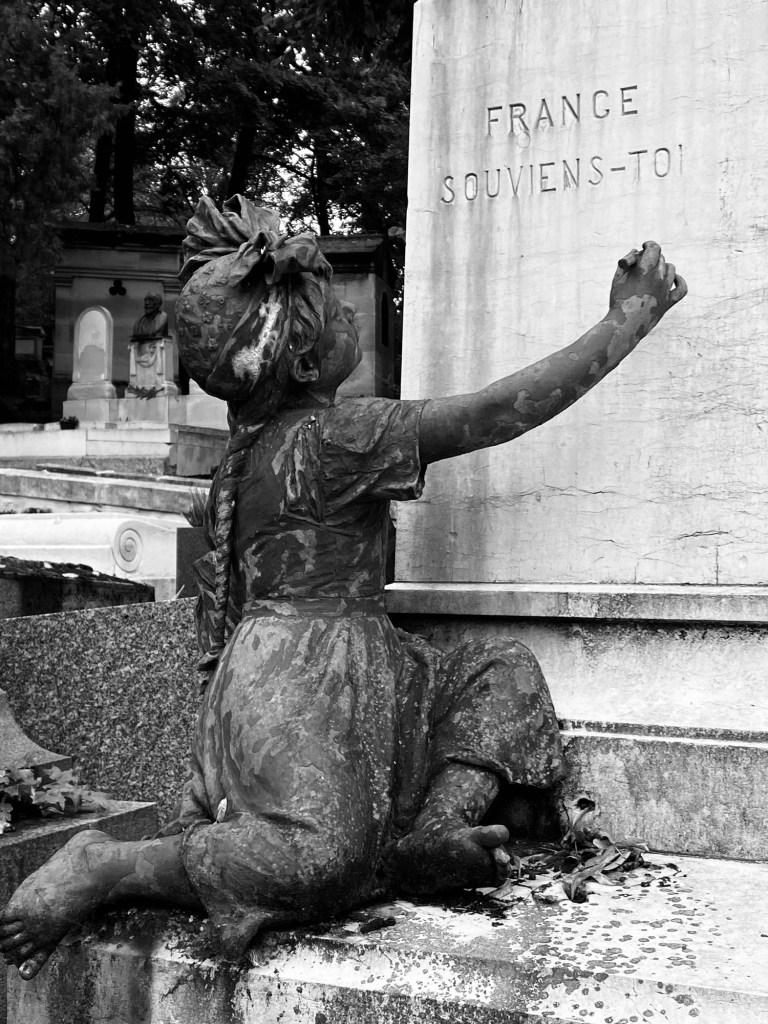
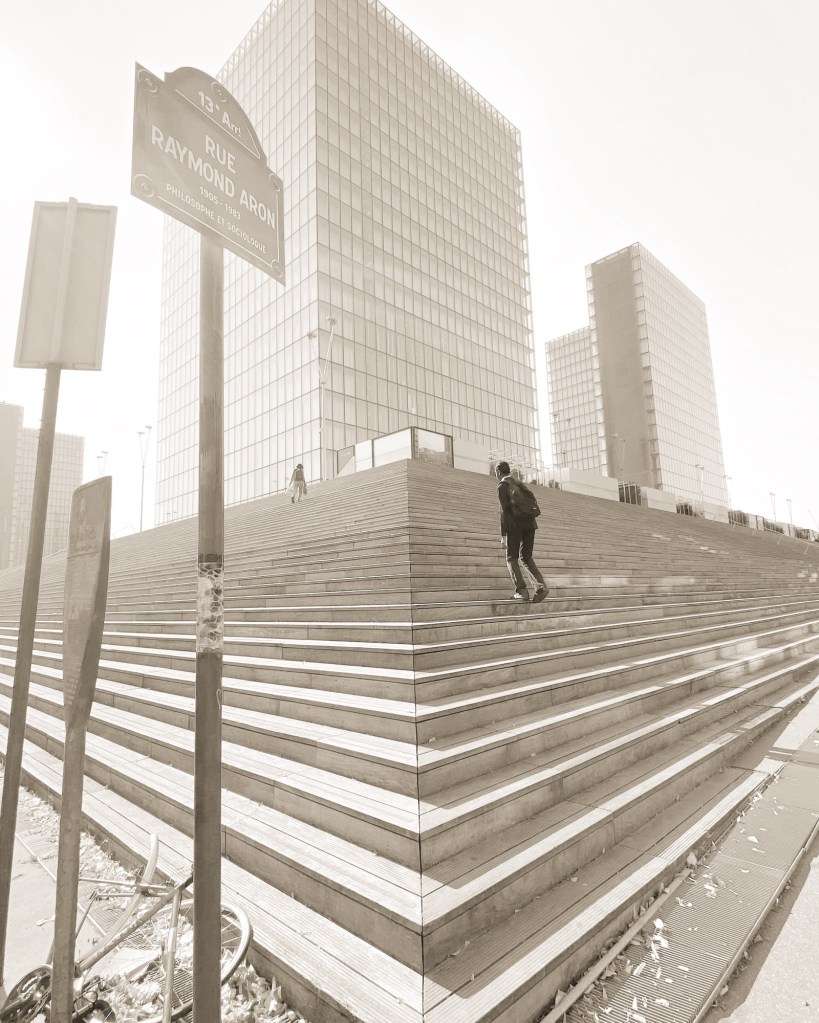
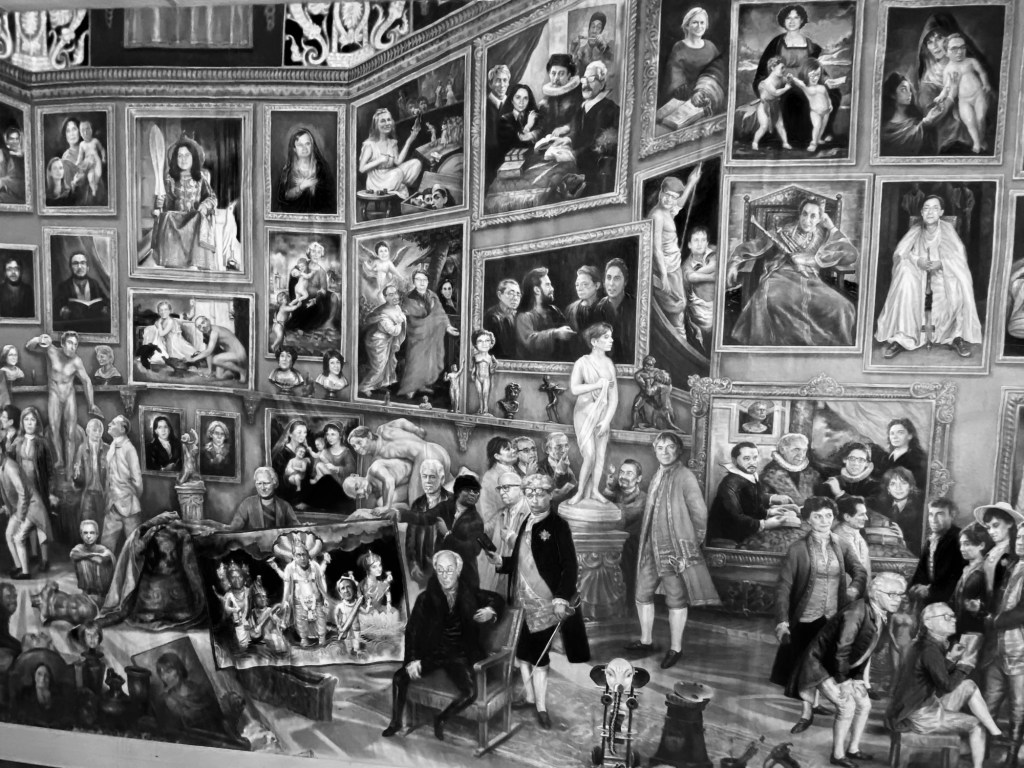
Woman emptying out the Canal. / Femme vidant le canalLittle girl with no memory of the war urges the French to remember it / Une petite fille qui n’a aucun souvenir de la guerre exhorte les Français à s’en souvenir14 million books locked in four towers while researchers work underground / 14 millions de livres enfermés dans quatre tours pendant que les chercheurs travaillent sous terrePart of a wall painting of the anthropology faculty at University Paris-Nanterre, painted by a determined artist / Partie d’une peinture murale de la faculté d’anthropologie de l’Université Paris-Nanterre, réalisée par un artiste déterminé.The Genius of Liberty on top of a tree — optical illusions at the Place de la Bastille / Le Génie de la Liberté au sommet d’un arbre — illusions d’optique à la Place de la Bastille
This winter term, I will be spending some time with my anthropology colleagues at Paris-Nanterre as part of the Laboratoire d’Ethnologie et de Sociologie comparative (LESC), part of the Centre National de la Recherche Scientifique (CNRS).
One part of my research stay is devoted to working on my current project: “Towards an anthropology of statelessness”. I will be speaking at the Department’s Colloquium in December (see plan below). I will also be teaching a course in legal anthropology … more about this one later.
The colloquium is free and open to the public, everyone is welcome.
On July 28, 2024 at 4.30pm, my dear Akbar Hussain passed away.
We have known each other for over a decade and as is the case with many central interlocutors in anthropology, there is never a way to thank them enough for what they are enabling us to achieve. Akbar Hussain was born as Mohammad Akbar Hussain Khan. He descended from a well-known Turkic Qizilbash family of high-ranking warriors, originating from Lankaran in what is now Azerbaijan. His ancestors had fought in the British Army and their heroic services were rewarded with name titles – such as “Captain” – and with land titles – such as a grant given to Akbar Hussain’s great-grandfather in 1886 that allowed him to relocate from the Northern part of British India to Burma. While the family raised their children in Myanmar, they continued to go back and forth to countries in the East such as Pakistan (since 1947) and the West (Akbar Hussain himself lived in the USA for many years). Theirs was a polyglott Muslim family as most Muslim families are in Myanmar. In contrast to his ancestors, however, Akbar Hussain did not serve any army; he served his mosque in downtown Yangon. He knew its history better than most, and due to the location of his appartment, he also knew its present: who would go in and out, at what time and for what purpose. He was curious enough to engage with my curiosity, multi-lingual so that we could easily communicate about the most complicated matters, very knowledgable and yet modest and able to admit when he did not know something – suggesting that I probe literature instead of his brain.
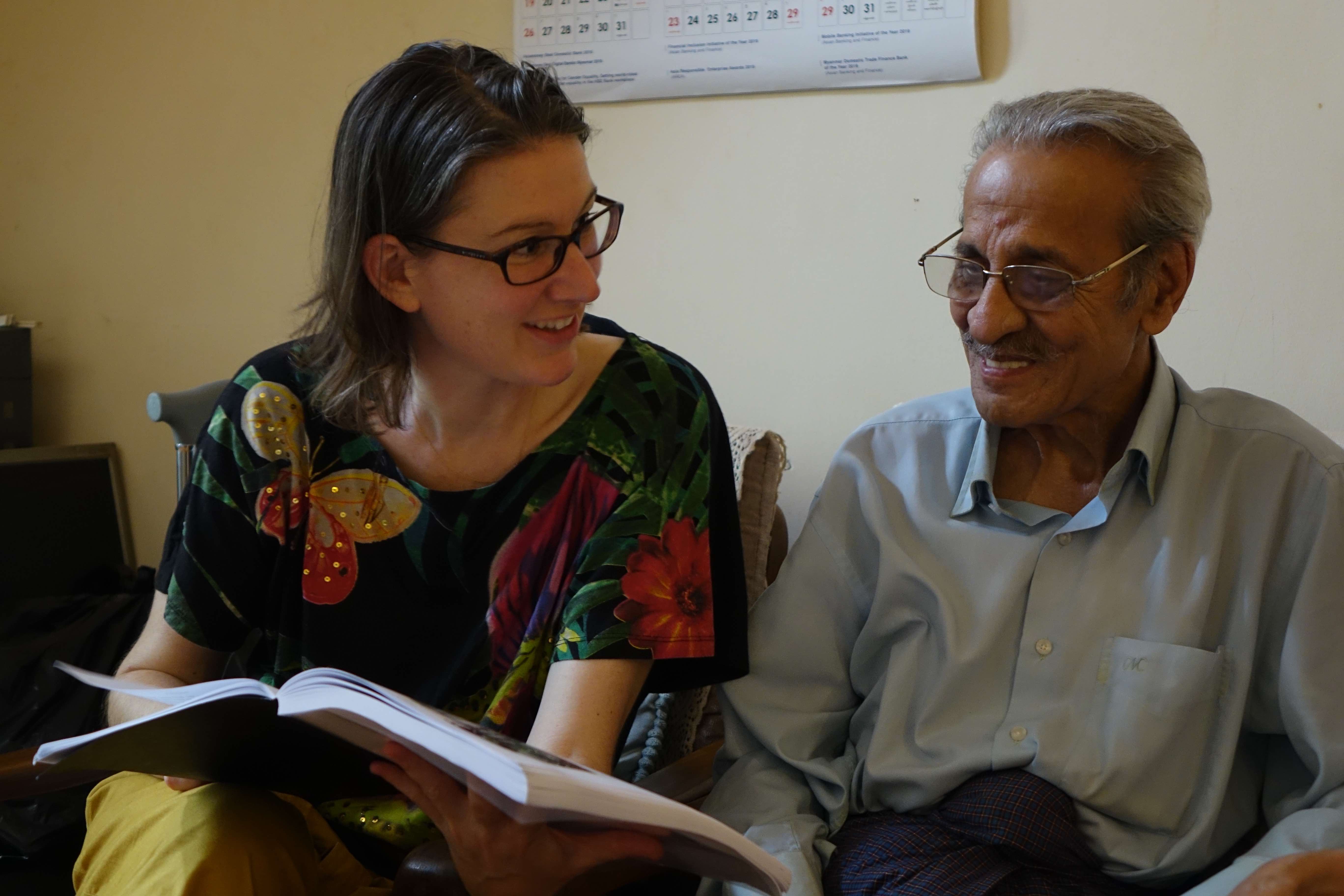
This is a very blurry picture of the two of us, but somehow, it says so much about our relation. Akbar Hussain was always there when I needed him and even, when I did not know that I needed him. He always kept to the background or to the sidelines, observing everything, commenting quietly afterwards or hinting at things, pointing at people, alerting me what to pay attention to, and whom to listen to more closely. Translating from Urdu to English for me at times, and always making sure that I get home safely at night after a procession or another long day spent at his house with him and his lovely wife.
He passed away and I could not say goodbye properly, neither in person, nor at the graveyard. He had asked me many times to come see him during the last few years. We communicated via a third person who would scan his handwritten letters to me in an internet café … as if it were the 1990s, as if there was a military dicatorship in place … wait … oh. And I would write self-censored emails back, because I knew that I was sending them to an address and a person whom I did not know and that I relied on that person to print them out and give them to him when he came to pick up his ‘mail’. So he knew all about my private life in safe Europe, but little of my fears and worries for him, his wife and everyone in Myanmar, really, as there was no way to ask how he was really doing in the current situation. He never spoke of politics, he sticked to writing about his health, his religion, the weather and of course reported meticuously about all upcoming festivities at the mosque.
We met at the mosque over 10 years ago and soon I realized that he frequently stayed at the managing trustee’s house at the time. He was his right hand, but also a careful observer as the person was very old and also not uncomplicated, feared by some even. Akbar Hussain knew how to handle complicated people, he even knew how to deal with a female German anthropologist who intruded into the daily life of the mosque, too, but – in contrast to tourists or journalists who dropped in and out, sometimes coming only for one day in the year – Ashura – to witness, record and distribute gruesome images of men flagellating themselves or walking over burning coal – to then disappear again, thinking they had understood something, he dealt with me as someone who would always come back and stay because I somehow never understood enough. And he kept explaining. Eventually, when he thought, I had acquired enough knowledge, he asked me: “Hey, when will you become Shia?” In my book, I recall this sentence and have interpreted it in the following way:
‘Hey, when will you become Shia?’ he often asked, which indicated to me that it would have been easier for him to conceive of me as a converted ‘member’ than as someone who was simply very interested (and increasingly knowledgeable) in what it means to be a Shia in Yangon. My interest and knowledge in the Shia religion were fine, but they were not what mattered in the end: membership in the community did (Beyer 2024 ,8)
He is on the cover photograph of my Myanmar book, as usual at the sidelines, with his back even turned away from where supposedly the ‘action’ is, yet later able to deconstruct and interpret the event with me in all its details. Since we often sticked together, everyone initiatially wondered who I was. The following conversation is from a transcript I made between Akbar Hussain, me and another person from the mosque who explained to me how Akbar Hussain would answer this question in my absence.
Third person (to me): they all ask ‘where is she from, where is she from?’ Akbar Hussain then always says ‘my relation’ #00:08:44-6#
AH Because my relation are all foreigners #00:08:49-8#
J That is true #00:08:51-8#
AH So they thought that you are my relative #00:08:57-3#
J That’s good – we can keep it this way (laughs) #00:09:02-9#
AH They ask me ‘from America?’ ‘No, I say, from Germany.’ They are very inquisitive (laughs) #00:09:18-7#
J That’s fine, I am also inquisitive #00:09:23-9#
(all laughing) #00:09:26-6#
All his relatives are foreigners, he said, because Akbar Hussain had chosen to never give up his Pakistani citizenship. He loved Myanmar and Yangon, the downtown area, his street and the mosque, but his home was in Pakistan where he spent his youth and went to university. He was fiercely political, one of the harshest critics of the mullahs in Pakistan and in Afghanistan, of those who perverted his beloved religion and his culture. He was proud and knowledgable and sometimes so outspoken that when he picked up the microphone at the mosque to condemn the killing of innocents, the endemic corruption or anything else going on in Pakistan, Saudi Arabia, Iran or Northern Africa, one could mistake him for being radical himself. He was radical in the sense that he did not only believe, but stood up for what he believed. But this concerned politics and religion abroad. He was careful to not position himself publicly when it came to Myanmar – knowing that he was a foreigner by choice. Someone who had to frequent the downtown visa section of the Ministry of Foreign affairs every few months to renew his residence status. While he had tried to incorporate me into his ‘community’ and even his family, he himself had remained Other all the time … we both occupied the same positionality, I later understood.
I read about Akbar Hussain’s death on the Facebook page of a friend of mine from Yangon. She is the wife of the late managing trustee and knew Akbar Hussain very well. He saw her getting married at a young age, he saw her two children growing up, he went in and out of her house in downtown for many years and he supported her late husband in many ways. She is thankful for him, her story being one of the numerous stories that need to be told because they are paradigmatic for Myanmar’s Muslims: for the way religious divides are being bridged, for the way religious tolerance is being practiced at a low level, for the way in which the people of Myanmar are capable of transcending the categories that have been imposed upon them throughout colonial history. These are the stories we do not get to hear about too much, but they exist and they matter. Just like the people that tell them.
One last conversation in person. Spring 2020 (photo: Felix Girke)
Akbar Hussain, may you rest in peace and … thank you.
During the winter term 2024, I will be continuing my research project on statelessness in Europe at the Department d’Anthropologie. Laboratoire d’Ethnologie et de Sociologie Comparative(LESC) at the University of Paris Nanterre.
I will be teaching a course on the anthropology of law for first and second-year MA students and give lectures on the Anthropology of Statelessness.